Next Step: Write your New Story, making sure that it fulfills the criteria for good storytelling.
Crafting a new story is liberating. Also challenging, scary, and painful. It should be painful. After all, it will be more clear eyed than your Old Story was in defining what you really want from life; it hacks away at the excuses and rationalizations that appeared in your Old Story; and it demands real change, something your Old Story was probably not that interested in. In short, it is more purposeful, truer and more action – oriented than your Old Story.
In other words, it’s got all the ingredients of a really good story. That doesn’t mean that all new stories have the same feel to them. Just because it’s called your New Story doesn’t mean it is all sweetness and light. To accept seriously the challenge of writing your new story, you must write it while fully conscious. No sleepwalking through the process; no mailing it in. To craft your new story, you’ll need to confront the truth of your old story. You’ll need to hold tight to your ultimate quest. You’ll need to suggest an urgency for finding a better way. You’ll need to dig deep.
So you need to actually write your story. It is here in this written story that you will discover (or more likely rediscover) your voice, the true and private voice, the intuitive voice. You will not only know it, but you’ll find a way to turn up the volume and become a master storyteller.
Your new story is your blueprint for the future. It exists for you to chart new pathways for energy to flow in all those areas of your life you want to change. Your new story is a map of how you will change the dynamics of the energy you give to things. In this way, your new story helps to chart your destiny.
I always have people begin their new story with these three words:
The truth is …………….
Indeed the majority of sentences in the new story begin with that phrase. This forces the writer always to confront Storytelling Rule 2: it must be truthful. Beginning your new story with these words commits you to strip away denial, rationalization or mythical thinking and to confront the truth about where your Old Story has led you and continues to mislead you.
In your New Story, describe how you’d likely feel if, say, you died young or, because of your disengagement, were divorced and lost your family. Confront whether the price you might pay is acceptable. Expose details left out in your Old Story, or things you made up to support the faulty subplots you wrote there. Magnify the conflicts your Old Story well might have created until you clearly see them and feel them. In your New Story bring all the facts and evidence you can to support the conclusion that your Old Story does not represent the truth, that it is faulty, that it will not work. That it simply cannot take you where you ultimately want to go.
But that’s not all that goes into your New Story. It’s not just about exposing and breaking down what does not work. It is very much about articulating what will work. Your New Story must suggest a general plan of action. Your New Story must therefor articulate a belief about where you want to go; that is, it must be consumed by purpose.
After your New Story is written, ask yourself the following questions:
- Does it take me where I want to go?
- Is it grounded in reality?
- Does it lead to action that stimulates genuine hope?
If the answer to all three questions is yes, then you’re ready to move on to the second part of this guide, which discusses the most vital life force of all, the one without which our stories and very lives do not happen, a force which we spectacularly ignore, misdirect and downright abuse.
“Did he train you? Did he rehearse you? Did he tell you what to do and what to say?”
This cry from a wounded heart comes at the end of Alfred Hitchcock’s “Vertigo,” and by the time it comes we are completely in sympathy. A man has fallen in love with a woman who does not exist, and now he cries out harshly against the real woman who impersonated her. But there is so much more to it than that. The real woman has fallen in love with him. In tricking him, she tricked herself. And the man, by preferring his dream to the woman standing before him, has lost both.
Then there is another level, beneath all of the others. Alfred Hitchcock was known as the most controlling of directors, particularly when it came to women. The female characters in his films reflected the same qualities over and over again: They were blond. They were icy and remote. They were imprisoned in costumes that subtly combined fashion with fetishism. They mesmerized the men, who often had physical or psychological handicaps. Sooner or later, every Hitchcock woman was humiliated.
“Vertigo” (1958), which is one of the two or three best films Hitchcock ever made, is the most confessional, dealing directly with the themes that controlled his art. It is *about* how Hitchcock used, feared and tried to control women. He is represented by Scottie (James Stewart), a man with physical and mental weaknesses (back problems, fear of heights), who falls obsessively in love with the image of a woman–and not any woman, but the quintessential Hitchcock woman. When he cannot have her, he finds another woman and tries to mold her, dress her, train her, change her makeup and her hair, until she looks like the woman he desires. He cares nothing about the clay he is shaping; he will gladly sacrifice her on the altar of his dreams.
But of course the woman he is shaping and the woman he desires are the same person. Her name is Judy (Kim Novak), and she was hired to play the dream woman, “Madeleine,” as part of a murder plot that Scottie does not even begin to suspect. When he finds out he was tricked, his rage is uncontrollable. He screams out the words: “Did he train you? . . .” Each syllable is a knife in his heart, as he spells out that another man shaped the woman that Scottie thought to shape for himself. The other man has taken not merely Scottie’s woman, but Scottie’s dream.
That creates a moral paradox at the center of “Vertigo.” The other man (Gavin, played by Tom Helmore) has after all only done to this woman what Scottie also wanted to do. And while the process was happening, the real woman, Judy, transferred her allegiance from Gavin to Scottie, and by the end was not playing her role for money, but as a sacrifice for love.
All of these emotional threads come together in the greatest single shot in all of Hitchcock. Scottie, a former San Francisco police detective hired by Gavin to follow “Madeleine,” has become obsessed with her. Then it appears Madeleine has died. By chance, Scottie encounters Judy, who looks uncannily like Madeleine, but appears to be a more carnal, less polished version. Of course he does not realize she is exactly the same woman. He asks her out and Judy unwisely accepts. During their strange, stilted courtship, she begins to pity and care for him, so that when he asks her to remake herself into Madeleine, she agrees, playing the same role the second time.
The great scene takes place in a hotel room, lit by a neon sign. Judy has arrived, not looking enough like Madeleine to satisfy Scottie, who wants her in the *same* dress, with the *same* hair. His eyes burn with zealous fixation. Judy realizes that Scottie is indifferent to her as a person and sees her as an object. Because she loves him, she accepts this. She locks herself into the bathroom, does the makeover, opens the door and walks toward Scottie out of a haunting green fog that is apparently explained by the neon sign, but is in fact a dreamlike effect.
As Hitchcock cuts back and forth between Novak’s face (showing such pain, such sorrow, such a will to please) and Stewart’s (in a rapture of lust and gratified control), we feel hearts being torn apart: They are both slaves of an image fabricated by a man who is not even in the room–Gavin, who created “Madeleine” as a device to allow himself to get away with the murder of his wife.
As Scottie embraces “Madeleine,” even the background changes to reflect his subjective memories instead of the real room he’s in. Bernard Herrmann’s score creates a haunting, unsettled yearning. And the camera circles them hopelessly, like the pinwheel images in Scottie’s nightmares, until the shot is about the dizzying futility of our human desires, the impossibility of forcing life to make us happy. This shot, in its psychological, artistic and technical complexity, may be the one time in his entire career that Alfred Hitchcock completely revealed himself, in all of his passion and sadness. (Is it a coincidence that the woman is named Madeleine–the word for the French biscuit, which, in Proust, brings childhood memories of loss and longing flooding back?)
Alfred Hitchcock took universal emotions, like fear, guilt and lust, placed them in ordinary characters, and developed them in images more than in words. His most frequent character, an innocent man wrongly accused, inspired much deeper identification than the superficial supermen in today’s action movies.
He was a great visual stylist in two ways: He used obvious images and surrounded them with a subtle context. Consider the obvious ways he suggests James Stewart’s vertigo. An opening shot shows him teetering on a ladder, looking down at a street below. Flashbacks show why he left the police force. A bell tower at a mission terrifies him, and Hitchcock creates a famous shot to show his point of view: Using a model of the inside of the tower, and zooming the lens in while at the same time physically pulling the camera back, Hitchcock shows the walls approaching and receding at the same time; the space has the logic of a nightmare. But then notice less obvious ways that the movie sneaks in the concept of falling, as when Scottie drives down San Francisco’s hills, but never up. And note how truly he “falls” in love.
There is another element, rarely commented on, that makes “Vertigo” a great film. From the moment we are let in on the secret, the movie is equally about Judy: her pain, her loss, the trap she’s in. Hitchcock so cleverly manipulates the story that when the two characters climb up that mission tower, we identify with both of them, and fear for both of them, and in a way Judy is less guilty than Scottie.
The danger is to see Judy, played by Novak, as an object in the same way that Scottie sees her. She is in fact one of the most sympathetic female characters in all of Hitchcock.
Over and over in his films, Hitchcock took delight in literally and figuratively dragging his women through the mud–humiliating them, spoiling their hair and clothes as if lashing at his own fetishes. Judy, in “Vertigo,” is the closest he came to sympathizing with the female victims of his plots. And Novak, criticized at the time for playing the character too stiffly, has made the correct acting choices: Ask yourself how you would move and speak if you were in unbearable pain, and then look again at Judy.
The Power of Your Story Seminar
Amsterdam 17 April
You will examine with Peter de Kuster, founder of The Power of Your Story the way we tell stories about ourselves to ourselves — and, most important, the way we can change those stories to transform our business and personal lives.
“Your story is your life,” says Peter. As human beings, we continually tell ourselves stories — of success or failure; of power or victimhood; stories that endure for an hour, or a day, or an entire lifetime. We have stories about ourselves, our creative business, our customers ; about what we want and what we’re capable of achieving. Yet, while our stories profoundly affect how others see us and we see ourselves, too few of us even recognize that we’re telling stories, or what they are, or that we can change them — and, in turn, transform our very destinies.
Telling ourselves stories provides structure and direction as we navigate life’s challenges and opportunities, and helps us interpret our goals and skills. Stories make sense of chaos; they organize our many divergent experiences into a coherent thread; they shape our entire reality. And far too many of our stories, says Peter, are dysfunctional, in need of serious editing. First, he asks you to answer the question, “In which areas of my life is it clear that I cannot achieve my goals with the story I’ve got?” He then shows you how to create new, reality-based stories that inspire you to action, and take you where you want to go both in your work and personal life.
Our capacity to tell stories is one of our profoundest gifts. Peter’s approach to creating deeply engaging stories will give you the tools to wield the power of storytelling and forever change your business and personal life.
About Peter de Kuster
Peter de Kuster is the founder of The Heroine’s Journey & Hero’s Journey project, a storytelling firm which helps creative professionals to create careers and lives based on whatever story is most integral to their lifes and careers (values, traits, skills and experiences). Peter’s approach combines in-depth storytelling and marketing expertise, and for over 20 years clients have found it effective with a wide range of creative business issues.
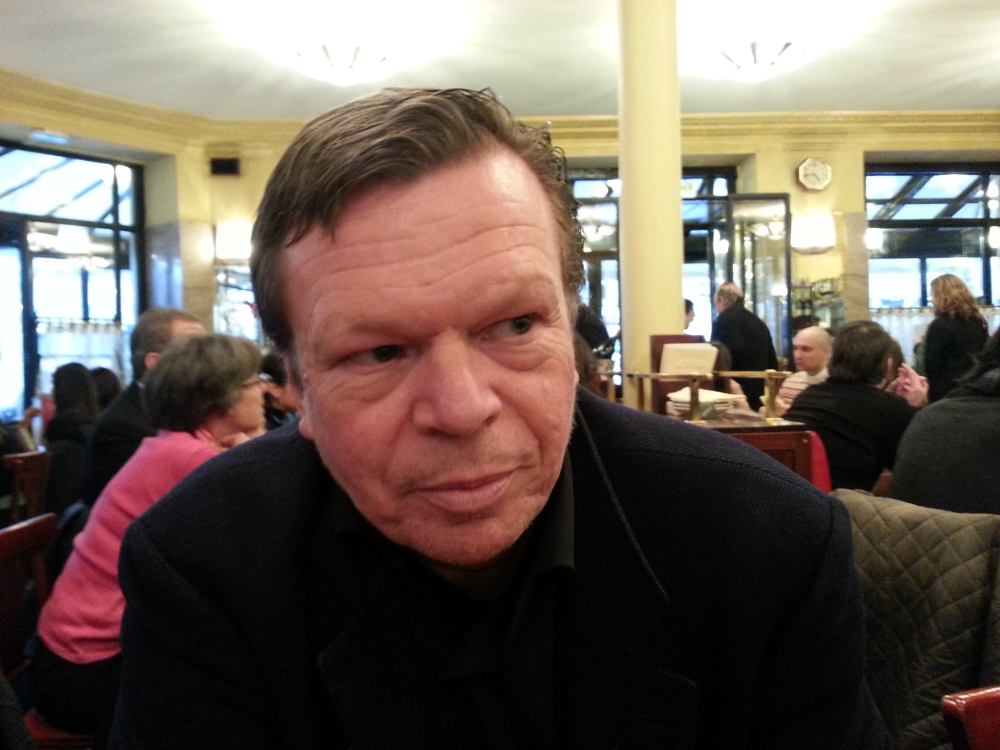
Peter is writer of the series The Heroine’s Journey and Hero’s Journey books, he has an MBA in Marketing, MBA in Financial Economics and graduated at university in Sociology and Communication Sciences.
Become a Great Storyteller in One Day
That’s why I set up The Power of your Story journey in the great cities of the world. A new way to use the power of your story. To guide you to life-changing, eye-opening movies, art, literature that truly have the power to enchant, enrich and inspire.
In this journey with Peter de Kuster you’ll explore your relationship with stories so far and your unique story identity will be sketched. You will be guided to movies, art, literature, myths that can put their finger on what you want to rewrite in your story, the feelings that you may often have had but perhaps never understood so clearly before; movies that open new perspectives and re-enchant the world for you.
You will be asked to complete a questionnaire in advance of your session and you’ll be given an instant story advice and movies to see to take away. Your full story advice and movies to see list will follow within a couple of days.
Practical Info
The price of this one day storytelling seminar is Euro 995 excluding VAT per person. There are special prices when you want to attend with three or more people.
You can reach Peter for questions about dates and the program by mailing him at peterdekuster@hotmail.nl
TIMETABLE
09.40 Tea & Coffee on arrival
10.00 Morning Session
13.00 Lunch Break
14.00 Afternoon Session
18.00 Drinks
Read on for a detailed breakdown of the Power of your Story itinerary.
What Can I Expect?
Here’s an outline of the THE POWER OF YOUR STORY journey.
Journey Outline
OLD STORIES
- What is your Story?
- Are you even trying to tell a Story?
- Old Stories (stories about you, your art, your clients, your money, your self promotion, your happiness, your health)
- Tell your current Story
- Is this Really Your Story?
YOUR NEW STORY
- The Premise of your Story. The Purpose of your Life and Art
- The words on your tombstone
- You ultimate mission, out loud
- The Seven Great Plots
- The Twelve Archetypal Heroines
- The One Great Story
- Purpose is Never Forgettable
- Questioning the Premise
- Lining up
- Flawed Alignment, Tragic Ending
- The Three Rules in Storytelling
- Write Your New Story
TURNING STORY INTO ACTION
- Turning your story into action
- The Story Effect
- Story Ritualizing
- The Storyteller and the art of story
- The Power of Your Story
- Storyboarding your creative process
- They Created and Lived Happily Ever After
 The Power of Your Story