Quest, truth, action.
When writers really want to emphasize something, they put in a one sentence paragraph. If they suspect even that isn’t emphasis enough, then they go to Plan B: break things into still more melodramatic, one-word paragraphs.
Quest.
Truth.
Action.
All good storytelling coheres around those three ideas. They are the three criteria, taken together, by which we judge the workability and ultimate success of our story. With these three principles in your pocket, you can summon your deepest intelligence and wisdom to protect yourself from all forms of sinister indoctrination and faulty storytelling, bad influences from without and within; armed with those three principles, you are virtually guaranteed to keep your story vital, moving, productive, fulfilling.
Dialogue drives Quentin Tarantino’s “Pulp Fiction,” dialogue of such high quality it deserves comparison with other masters of spare, hard-boiled prose, from Raymond Chandler to Elmore Leonard. Like them, QT finds a way to make the words humorous without ever seeming to ask for a laugh. Like them, he combines utilitarian prose with flights of rough poetry and wicked fancy.
Consider a little scene not often mentioned in discussions of the film. The prizefighter Butch (Bruce Willis) has just killed a man in the ring. He returns to the motel room occupied by his girlfriend Fabienne (Maria de Medeiros). She says she’s been looking in the mirror and she wants a pot belly. “You have one,” he says, snuggling closer. “If I had one,” she says, “I would wear a T-shirt two sizes too small, to accentuate it.” A little later she observes, “It’s unfortunate what we find pleasing to the touch and pleasing to the eye are seldom the same.”
This is wonderful dialogue (I have only sampled it). It is about something. The dialogue comes at a moment of desperation for Butch. He agreed to throw the fight, then secretly bet heavily on himself, and won. He will make a lot of money, but only if he escapes the vengeance of Marsellus Wallace (Ving Rhames) and his hit-men Jules and Vincent (Samuel L. Jackson and John Travolta). In a lesser movie, the dialogue in this scene would have been entirely plot-driven; Butch would have explained to Fabienne what he, she and we already knew. Instead, Tarantino uses an apparently irrelevant conversation to quickly establish her personality and their relationship. His dialogue is always load-bearing.
It is Tarantino’s strategy in all of his films to have the characters speak at right angles to the action, or depart on flights of fancy. Remember the famous opening conversation between Jules and Vincent, who are on their way to a violent reprisal against some college kids who have offended Wallace and appropriated his famous briefcase. They talk about the drug laws in Amsterdam, what Quarter Pounders are called in Paris, and the degree of sexual intimacy implied by a foot massage. Finally Jules says “let’s get in character,” and they enter an apartment.
Tarantino’s dialogue is not simply whimsical. There is a method behind it. The discussion of why Quarter Pounders are called “Royales” in Paris is reprised, a few minutes later, in a tense exchange between Jules and one of the kids (Frank Whaley). And the story of how Marsellus had a man thrown out of a fourth-floor window for giving his wife a foot massage turns out to be a set-up: Tarantino is preparing the dramatic ground for a scene in which Vincent takes Mia Wallace (Uma Thurman) out on a date, on his bosses’ orders. When Mia accidentally overdoses, Vincent races her to his drug dealer Lance (Eric Stoltz), who brings her back to life with a shot of adrenaline into the heart.
And that scene also begins with dialogue that seems like fun, while it’s also laying more groundwork. We meet Lance’s girlfriend Jody (Rosanna Arquette), who is pierced in every possible place and talks about her piercing fetish. Tarantino is setting up his payoff. When the needle goes into the heart, you’d expect that to be one of the most gruesome moments in the movie, but audiences, curiously, always laugh. In a shot-by-shot analysis at the University of Virginia, we found out why. QT never actually shows the needle entering the chest. He cuts away to a reaction shot in which everyone hovering over the victim springs back simultaneously as Mia leaps back to life. And then Jody says it was “trippy” and we understand that, as a piercer, she has seen the ultimate piercing. The body language and the punchline take a grotesque scene and turn it into dark but genuine comedy. It’s all in the dialogue and the editing. Also, of course, in the underlying desperation, set up by thoughts of what Marsellus might do to Vincent, since killing Mrs. Wallace is much worse than massaging her foot.
The movie’s circular, self-referential structure is famous; the restaurant hold-up with Pumpkin and Honey Bunny (Tim Roth and Amanda Plummer) begins and ends the film, and other story lines weave in and out of strict chronology. But there is a chronology in the dialogue, in the sense that what is said before invariably sets up or enriches what comes after. The dialogue is proof that Tarantino had the time-juggling in mind from the very beginning, because there’s never a glitch; the scenes do not follow in chronological order, but the dialogue always knows exactly where it falls in the movie.
I mentioned the way the needle-to-the-heart scene is redeemed by laughter. That’s also the case with the scene where the hit-men inadvertently kill a passenger in their car. The car’s interior is covered with blood, and The Wolf (Harvey Keitel) is called to handle the situation; we remember much more blood than we actually see, which is why the scene doesn’t stop the movie dead in its tracks. Scenes of gore are deflected into scenes of the Wolf’s professionalism, which is funny because it is so matter-of-fact. The movies does contain scenes of sudden, brutal violence, as when Jules and Vincent open fire in the apartment, or when Butch goes “medieval” (Marsellus’ unforgettable word choise) on the leather guys. But Tarantino uses long shots, surprise, cutaways and the context of the dialogue to make the movie seem less violent than it has any right to.
Howard Hawks once gave his definition of a good movie: “Three good scenes. No bad scenes.” Few movies in recent years have had more good scenes than “Pulp Fiction.” Some are almost musical comedy, as when Vincent and Mia dance at Jackrabbit Slim’s. Some are stunning in their suddenness, as when Butch returns to his apartment and surprises Vincent. Some are all verbal style, as in Marsellus Wallace’s dialogue with Butch, or when Capt. Koons (Christopher Walken) delivers a monologue to the “little man” about his father’s watch.
And some seem deliberately planned to provoke discussion: What is in the briefcase? Why are there glowing flashes of light during the early shooting in the apartment? Is Jackson quoting the Bible correctly? Some scenes depend entirely on behavior (The Wolf’s no-nonsense cleanup detail). Many of the scenes have an additional level of interest because the characters fear reprisals (Bruce fears Wallace, Vincent fears Wallace, Jimmie the drug dealer wants the dead body removed before his wife comes home).
It isn’t the structure that makes “Pulp Fiction” a great film. Its greatness comes from its marriage of vividly original characters with a series of vivid and half-fanciful events and from the dialogue. The dialogue is the foundation of everything else. The characters in “Pulp Fiction” are always talking, and always interesting, funny, scary or audacious.
The Power of Your Story Seminar
Amsterdam 17 April
You will examine with Peter de Kuster, founder of The Power of Your Story the way we tell stories about ourselves to ourselves — and, most important, the way we can change those stories to transform our business and personal lives.
“Your story is your life,” says Peter. As human beings, we continually tell ourselves stories — of success or failure; of power or victimhood; stories that endure for an hour, or a day, or an entire lifetime. We have stories about ourselves, our creative business, our customers ; about what we want and what we’re capable of achieving. Yet, while our stories profoundly affect how others see us and we see ourselves, too few of us even recognize that we’re telling stories, or what they are, or that we can change them — and, in turn, transform our very destinies.
Telling ourselves stories provides structure and direction as we navigate life’s challenges and opportunities, and helps us interpret our goals and skills. Stories make sense of chaos; they organize our many divergent experiences into a coherent thread; they shape our entire reality. And far too many of our stories, says Peter, are dysfunctional, in need of serious editing. First, he asks you to answer the question, “In which areas of my life is it clear that I cannot achieve my goals with the story I’ve got?” He then shows you how to create new, reality-based stories that inspire you to action, and take you where you want to go both in your work and personal life.
Our capacity to tell stories is one of our profoundest gifts. Peter’s approach to creating deeply engaging stories will give you the tools to wield the power of storytelling and forever change your business and personal life.
About Peter de Kuster
Peter de Kuster is the founder of The Heroine’s Journey & Hero’s Journey project, a storytelling firm which helps creative professionals to create careers and lives based on whatever story is most integral to their lifes and careers (values, traits, skills and experiences). Peter’s approach combines in-depth storytelling and marketing expertise, and for over 20 years clients have found it effective with a wide range of creative business issues.
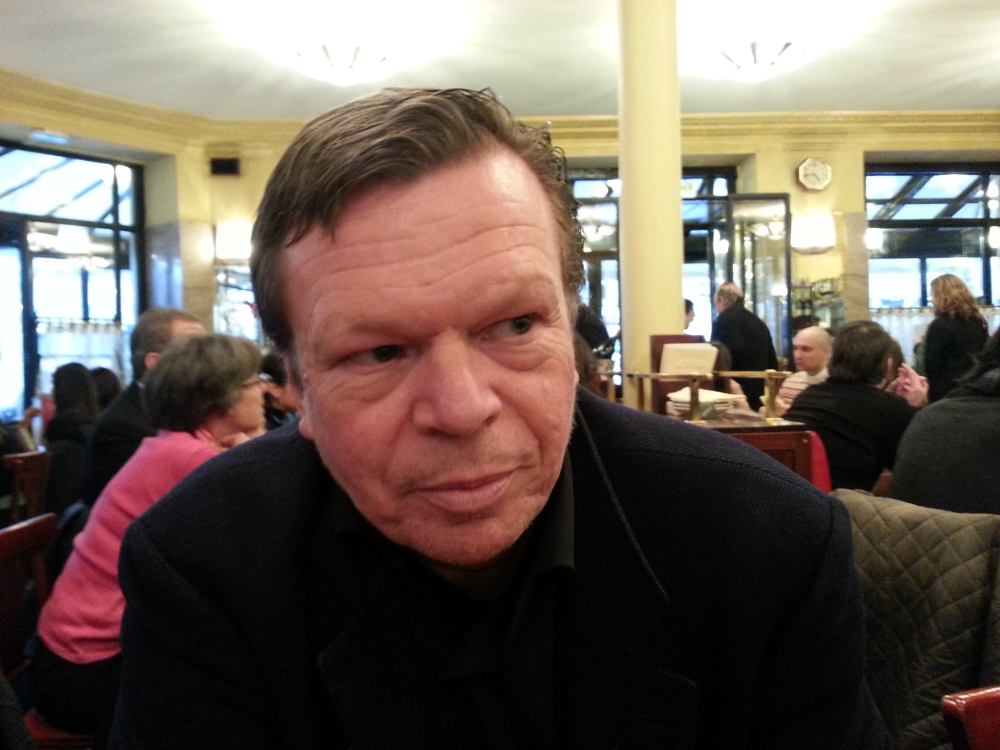
Peter is writer of the series The Heroine’s Journey and Hero’s Journey books, he has an MBA in Marketing, MBA in Financial Economics and graduated at university in Sociology and Communication Sciences.
Become a Great Storyteller in One Day
That’s why I set up The Power of your Story journey in the great cities of the world. A new way to use the power of your story. To guide you to life-changing, eye-opening movies, art, literature that truly have the power to enchant, enrich and inspire.
In this journey with Peter de Kuster you’ll explore your relationship with stories so far and your unique story identity will be sketched. You will be guided to movies, art, literature, myths that can put their finger on what you want to rewrite in your story, the feelings that you may often have had but perhaps never understood so clearly before; movies that open new perspectives and re-enchant the world for you.
You will be asked to complete a questionnaire in advance of your session and you’ll be given an instant story advice and movies to see to take away. Your full story advice and movies to see list will follow within a couple of days.
Practical Info
The price of this one day storytelling seminar is Euro 995 excluding VAT per person. There are special prices when you want to attend with three or more people.
You can reach Peter for questions about dates and the program by mailing him at peterdekuster@hotmail.nl
TIMETABLE
09.40 Tea & Coffee on arrival
10.00 Morning Session
13.00 Lunch Break
14.00 Afternoon Session
18.00 Drinks
Read on for a detailed breakdown of the Power of your Story itinerary.
What Can I Expect?
Here’s an outline of the THE POWER OF YOUR STORY journey.
Journey Outline
OLD STORIES
- What is your Story?
- Are you even trying to tell a Story?
- Old Stories (stories about you, your art, your clients, your money, your self promotion, your happiness, your health)
- Tell your current Story
- Is this Really Your Story?
YOUR NEW STORY
- The Premise of your Story. The Purpose of your Life and Art
- The words on your tombstone
- You ultimate mission, out loud
- The Seven Great Plots
- The Twelve Archetypal Heroines
- The One Great Story
- Purpose is Never Forgettable
- Questioning the Premise
- Lining up
- Flawed Alignment, Tragic Ending
- The Three Rules in Storytelling
- Write Your New Story
TURNING STORY INTO ACTION
- Turning your story into action
- The Story Effect
- Story Ritualizing
- The Storyteller and the art of story
- The Power of Your Story
- Storyboarding your creative process
- They Created and Lived Happily Ever After
 The Power of Your Story