A story can only work if its Ultimate Quest is positive, it won’t work if its main goal is merely the avoidance of risk and pain. Even if we’re wired to be pessimists, there is something about the glass half filled camp that appeals irresistibly. As I said earlier, more important than the ‘facts’ of any life story is the meaning we attribute to the facts. It is crucial therefore to be aware not only of external influences of our perception – the inherent biases in information sources such as one’s family and friends, news channels but also our internal tendencies. Our basic stories have an enormous effect on how we see things. If you are inclined toward pessimism, perhaps no otherwise rational analysis of your situation or story will make things seem attainable or fixable. Once people develop pessimism they have made it much harder for themselves to contront the truth of their story and thus to move to greater fulfillment. Such people must find a way to move from what renowned Martin Seligman termed ‘learned helplessness’ toward ‘learned optimism’.
“My Fair Lady”‘s story involves a meeting of two egos, one belonging to the linguist Henry Higgins, the other, no less titanic, to the flower girl Eliza Doolittle. It is often mistakenly said that they collaborate because Higgins (Rex Harrison) decides to improve Eliza’s Cockney accent. In fact it is Eliza (Audrey Hepburn) who takes the initiative, presenting herself at Henry’s bachelor quarters to sign up for lessons: “I know what lessons cost as well as you do, and I’m ready to pay.”
Even in this early scene, it is Eliza’s will that drives the plot; Higgins might have tinkered forever with his phonetic alphabet and his recording devices if Eliza hadn’t insisted on action. She took seriously his boast the night before, in Covent Garden: “You see this creature with her curbstone English? The English that will keep her in the gutter till the end of her days? Well, sir, in six months, I could pass her off as a duchess at an Embassy Ball. I could even get her a job as a lady’s maid or a shop assistant, which requires better English.” The final twist, typical Shavian paradox, is what Eliza hears, and it supplies her inspiration: “I want to be a lady in a flower shop instead of sellin’ at the corner of Tottenham Court Road. But they won’t take me unless I can talk more genteel.”
It is her ambition, not Henry’s, that sets the plot in motion, including the professor’s bet with his fellow linguist Pickering, who says he’ll pay for the lessons if Higgins can transform her speech. Higgins’ response will thrum below the action for most of the play: “You know, it’s almost irresistible. She’s so deliciously low. So horribly dirty.” If Henry will teach Eliza to improve her speech, she will try to teach him decency and awaken his better nature.
It is difficult to discuss George Cukor’s 1964 film as it actually exists because, even now, an impenetrable thicket of legend and gossip obscures its greatness. Many viewers would rather discuss the film that wasn’t made, the one that would have starred Julie Andrews, who made the role of Eliza her own on the stage. Casting Audrey Hepburn was seen as a snub of Andrews, and so it was; producer and studio head Jack L. Warner chose Hepburn for her greater box-office appeal, and was prepared to offer the role to Elizabeth Taylor if Hepburn turned it down.
“My Fair Lady,” with its dialogue drawn from Shaw, was trickier and more challenging than most other stage musicals; the dialogue not only incorporated Shavian theory, wit and ideology, but required Eliza to master a transition from Cockney to the Queen’s English. All of this Hepburn does flawlessly and with heedless confidence, in a performance that contains great passion. Consider the scenes where she finally explodes at Higgins’ misogynist disregard, returns to the streets of Covent Garden, and finds she fits in nowhere. “I sold flowers,” she tells Henry late in their crisis. “I didn’t sell myself. Now you’ve made a lady of me, I’m not fit to sell anything else.”
It is typical of Shaw, admirable of Lerner and Loewe, and remarkable of Hollywood, that the film stays true to the original material, and Higgins doesn’t cave in during a soppy rewritten “happy ending.” Astonished that the ungrateful Eliza has stalked out of his home, Higgins asks in a song, “Why can’t a woman be more like a man?” He tracks her to her mother’s house, where the aristocratic Mrs. Higgins (Gladys Cooper) orders him to behave himself. “What?” he asks his mother. “Do you mean to say that I’m to put on my Sunday manners for this thing that I created out of the squashed cabbage leaves of Covent Garden?” Yes, she does. Higgins realizes he loves Eliza, but even in the play’s famous last line he perseveres as a defiant bachelor: “Eliza? Where the devil are my slippers?” It remains an open question for me, at the final curtain, whether Eliza stays to listen to what he says next.
Apart from the wonders of its words and music, “My Fair Lady” is a visual triumph. Cukor made use above all of Cecil Beaton, a photographer and costume designer, who had been production designer on only one previous film (“Gigi,” 1958). He and cinematographer Harry Stradling, who both won Oscars, bring the film a combination of sumptuousness and detail, from the stylization of the famous Ascot scene to the countless intriguing devices in Higgins’ book-lined study.
The supporting performances include Wilfred Hyde-White as the decent Pickering, speaking up for Eliza; and Stanley Holloway as her father, Alfred P. Doolittle, according to Higgins “the most original moral philosopher in England.” Doolittle was originally to have been played in the movie by Jimmy Cagney; he might have been good, but might have been a distraction, and Holloway with his ravaged demeanor is perfect.
What distinguishes “My Fair Lady” above all is that it actually says something. It says it in a film of pointed words, unforgettable music and glorious images, but it says it. Bernard Shaw’s “Pygmalion” was a socialist attack on the British class system, and on the truth (as true when the film was made as when Shaw wrote his play) that an Englishman’s destiny was largely determined by his accent. It allowed others to place him, and to keep him in his place.
Eliza’s escape from the “lower classes,” engineered by Higgins, is a revolutionary act, dramatizing how “superiority” was inherited, not earned. It is a lesson that resonates for all societies, and the genius of “My Fair Lady” is that it is both a great entertainment and a great polemic. It is still not sufficiently appreciated what influence it had on the creation of feminism and class-consciousness in the years bridging 1914 when “Pygmalion” premiered, 1956 when the musical premiered, and 1964 when the film premiered. It was actually about something. As Eliza assures the serenely superior Henry Higgins, who stood for a class, a time and an attitude:
They can still rule with land without you.
Windsor Castle will stand without you.
And without much ado we can all muddle through without you.
The Power of Your Story Seminar
Amsterdam 17 April
You will examine with Peter de Kuster, founder of The Power of Your Story the way we tell stories about ourselves to ourselves — and, most important, the way we can change those stories to transform our business and personal lives.
“Your story is your life,” says Peter. As human beings, we continually tell ourselves stories — of success or failure; of power or victimhood; stories that endure for an hour, or a day, or an entire lifetime. We have stories about ourselves, our creative business, our customers ; about what we want and what we’re capable of achieving. Yet, while our stories profoundly affect how others see us and we see ourselves, too few of us even recognize that we’re telling stories, or what they are, or that we can change them — and, in turn, transform our very destinies.
Telling ourselves stories provides structure and direction as we navigate life’s challenges and opportunities, and helps us interpret our goals and skills. Stories make sense of chaos; they organize our many divergent experiences into a coherent thread; they shape our entire reality. And far too many of our stories, says Peter, are dysfunctional, in need of serious editing. First, he asks you to answer the question, “In which areas of my life is it clear that I cannot achieve my goals with the story I’ve got?” He then shows you how to create new, reality-based stories that inspire you to action, and take you where you want to go both in your work and personal life.
Our capacity to tell stories is one of our profoundest gifts. Peter’s approach to creating deeply engaging stories will give you the tools to wield the power of storytelling and forever change your business and personal life.
About Peter de Kuster
Peter de Kuster is the founder of The Heroine’s Journey & Hero’s Journey project, a storytelling firm which helps creative professionals to create careers and lives based on whatever story is most integral to their lifes and careers (values, traits, skills and experiences). Peter’s approach combines in-depth storytelling and marketing expertise, and for over 20 years clients have found it effective with a wide range of creative business issues.
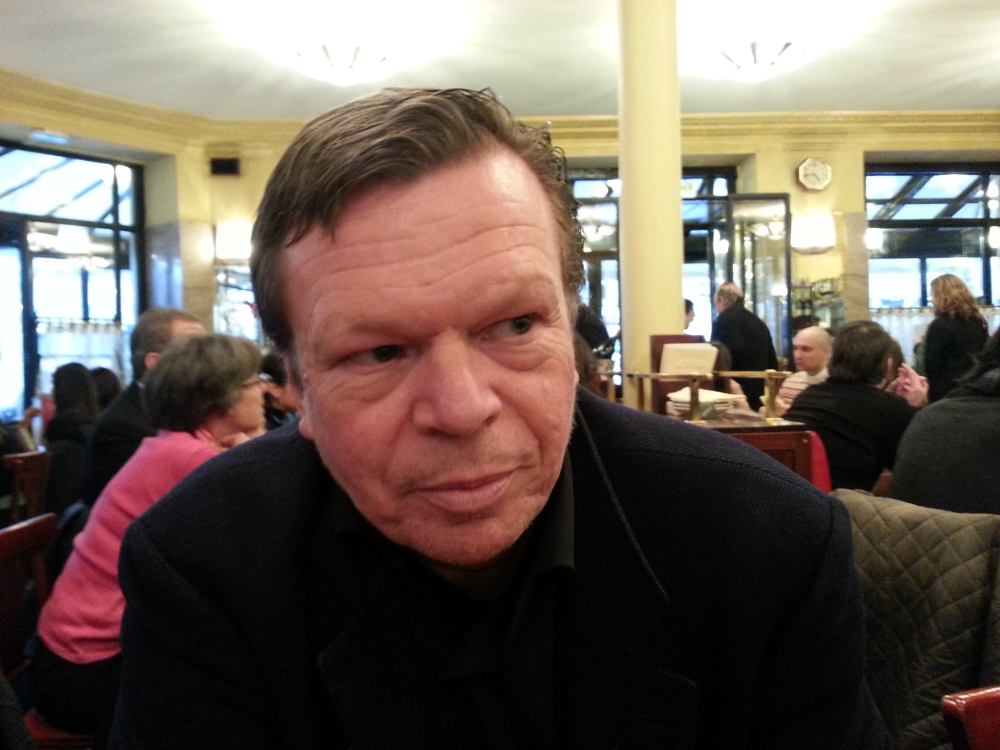
Peter is writer of the series The Heroine’s Journey and Hero’s Journey books, he has an MBA in Marketing, MBA in Financial Economics and graduated at university in Sociology and Communication Sciences.
Become a Great Storyteller in One Day
That’s why I set up The Power of your Story journey in the great cities of the world. A new way to use the power of your story. To guide you to life-changing, eye-opening movies, art, literature that truly have the power to enchant, enrich and inspire.
In this journey with Peter de Kuster you’ll explore your relationship with stories so far and your unique story identity will be sketched. You will be guided to movies, art, literature, myths that can put their finger on what you want to rewrite in your story, the feelings that you may often have had but perhaps never understood so clearly before; movies that open new perspectives and re-enchant the world for you.
You will be asked to complete a questionnaire in advance of your session and you’ll be given an instant story advice and movies to see to take away. Your full story advice and movies to see list will follow within a couple of days.
Practical Info
The price of this one day storytelling seminar is Euro 995 excluding VAT per person. There are special prices when you want to attend with three or more people.
You can reach Peter for questions about dates and the program by mailing him at peterdekuster@hotmail.nl
TIMETABLE
09.40 Tea & Coffee on arrival
10.00 Morning Session
13.00 Lunch Break
14.00 Afternoon Session
18.00 Drinks
Read on for a detailed breakdown of the Power of your Story itinerary.
What Can I Expect?
Here’s an outline of the THE POWER OF YOUR STORY journey.
Journey Outline
OLD STORIES
- What is your Story?
- Are you even trying to tell a Story?
- Old Stories (stories about you, your art, your clients, your money, your self promotion, your happiness, your health)
- Tell your current Story
- Is this Really Your Story?
YOUR NEW STORY
- The Premise of your Story. The Purpose of your Life and Art
- The words on your tombstone
- You ultimate mission, out loud
- The Seven Great Plots
- The Twelve Archetypal Heroines
- The One Great Story
- Purpose is Never Forgettable
- Questioning the Premise
- Lining up
- Flawed Alignment, Tragic Ending
- The Three Rules in Storytelling
- Write Your New Story
TURNING STORY INTO ACTION
- Turning your story into action
- The Story Effect
- Story Ritualizing
- The Storyteller and the art of story
- The Power of Your Story
- Storyboarding your creative process
- They Created and Lived Happily Ever After
 The Power of Your Story