Forms or images of a collective nature which occur practially all over the earth as constituents of myths and at the same time as individual products of unconscious origin. – C.G. Jung, Psychology and Religion
The concept of archetypes was borrowed by Jung from classic sources, including Cicero, Pliny and Augustine. Adolf Bastian called them ‘Elementary Ideas’. In Sanskrit, they were called ‘subjectively known forms’ and in Australia, they were known as the ‘Eternal Ones of the Dream’ – Joseph Campbell, The Hero with a Thousand Faces
Jung to some extent took the opposite approach to that of the behaviorists, that is, he did not observe people from the outside, did not ask how they behave, hoe we greet one another, how we mate, how we take care of our young. Instead, he studied what we feel and what we fantasize while we were doing those things. For Jung, archetypes are not only elementary ideas, but just as much elementary feelings, elementary fantasies, elementary visions. – Marie – Louise Von Franz, Psyche and Matter
“Raging Bull” is not a film about boxing but about a man with paralyzing jealousy and sexual insecurity, for whom being punished in the ring serves as confession, penance and absolution. It is no accident that the screenplay never concerns itself with fight strategy. For Jake LaMotta, what happens during a fight is controlled not by tactics but by his fears and drives.
Consumed by rage after his wife, Vickie, unwisely describes one of his opponents as “good-looking,” he pounds the man’s face into a pulp, and in the audience a Mafia boss leans over to his lieutenant and observes, “He ain’t pretty no more.” After the punishment has been delivered, Jake (Robert De Niro) looks not at his opponent, but into the eyes of his wife (Cathy Moriarty), who gets the message.
Martin Scorsese’s 1980 film was voted in three polls as the greatest film of the decade, but when he was making it, he seriously wondered if it would ever be released: “We felt like we were making it for ourselves.” Scorsese and De Niro had been reading the autobiography of Jake LaMotta, the middleweight champion whose duels with Sugar Ray Robinson were a legend in the 1940s and ’50s. They asked Paul Schrader, who wrote “Taxi Driver,” to do a screenplay. The project languished while Scorsese and De Niro made the ambitious but unfocused musical “New York, New York,” and then languished some more as Scorsese’s drug use led to a crisis. De Niro visited his friend in the hospital, threw the book on his bed, and said, “I think we should make this.” And the making of “Raging Bull,” with a screenplay further sculpted by Mardik Martin (“Mean Streets”), became therapy and rebirth for the filmmaker.
The movie won Oscars for De Niro and editor Thelma Schoonmaker, and also was nominated for best picture, director, sound, and supporting actor (Joe Pesci) and actress (Moriarty). It lost for best picture to “Ordinary People,” but time has rendered a different verdict.
For Scorsese, the life of LaMotta was like an illustration of a theme always present in his work, the inability of his characters to trust and relate with women. The engine that drives the LaMotta character in the film is not boxing, but a jealous obsession with his wife, Vickie, and a fear of sexuality. From the time he first sees her, as a girl of 15, LaMotta is mesmerized by the cool, distant blond goddess, who seems so much older than her age, and in many shots seems taller and even stronger than the boxer.
Although there is no direct evidence in the film that she has ever cheated on him, she is a woman who at 15 was already on friendly terms with mobsters, who knew the score, whose level gaze, directed at LaMotta during their first date, shows a woman completely confident as she waits for Jake to awkwardly make his moves. It is remarkable that Moriarty, herself 19, had the presence to so convincingly portray the later stages of a woman in a bad marriage.
Jake has an ambivalence toward women that Freud famously named the “Madonna-whore complex.” For LaMotta, women are unapproachable, virginal ideals–until they are sullied by physical contact (with him), after which they become suspect. During the film he tortures himself with fantasies that Vickie is cheating on him. Every word, every glance, is twisted by his scrutiny. He never catches her, but he beats her as if he had; his suspicion is proof of her guilt.
The closest relationship in the film is between Jake and his brother Joey (Joe Pesci). Pesci’s casting was a stroke of luck; he had decided to give up acting, when he was asked to audition after De Niro saw him in a B movie. Pesci’s performance is the counterpoint to De Niro’s, and its equal; their verbal sparring has a kind of crazy music to it, as in the scene where Jake loses the drift of Joey’s argument as he explains, “You lose, you win. You win, you win. Either way, you win.” And the scene where Jake adjusts the TV and accuses Joey of cheating with Vickie: “Maybe you don’t know what you mean.” The dialogue reflects the Little Italy of Scorsese’s childhood, as when Jake tells his first wife that overcooking the steak “defeats its own purpose.”
The fight scenes took Scorsese 10 weeks to shoot instead of the planned two. They use, in their way, as many special effects as a science fiction film. The soundtrack subtly combines crowd noise with animal cries, bird shrieks and the grating explosions of flashbulbs (actually panes of glass being smashed). We aren’t consciously aware of all we’re listening to, but we feel it.
The fights are broken down into dozens of shots, edited by Schoonmaker into duels consisting not of strategy, but simply of punishing blows. The camera is sometimes only inches from the fists; Scorsese broke the rules of boxing pictures by staying inside the ring, and by freely changing its shape and size to suit his needs–sometimes it’s claustrophobic, sometimes unnaturally elongated.
The brutality of the fights is also new; LaMotta makes Rocky look tame. Blows are underlined by thudding impacts on the soundtrack, and Scorsese uses sponges concealed in the gloves and tiny tubes in the boxers’ hair to deliver spurts and sprays of sweat and blood; this is the wettest of boxing pictures, drenched in the fluids of battle. One reason for filming in black and white was Scorsese’s reluctance to show all that blood in a color picture.
The most effective visual strategy in the film is the use of slow motion to suggest a heightened awareness. Just as “Taxi Driver’s” Travis Bickle saw the sidewalks of New York in slow motion, so LaMotta sees Vickie so intently that time seems to expand around her. Normal movement is shot at 24 frames a second; slow motion uses more frames per second, so that it takes longer for them to be projected; Scorsese uses subtle speeds such as 30 or 36 frames per second, and we internalize the device so that we feel the tension of narrowed eyes and mounting anger when Jake is triggered by paranoia over Vickie’s behavior.
The film is bookmarked by scenes in which the older Jake LaMotta, balding and overweight, makes a living giving “readings,” running a nightclub, even emceeing at a Manhattan strip club. It was De Niro’s idea to interrupt the filming while he put on weight for these scenes, in which his belly hangs over his belt. The closing passages include Jake’s crisis of pure despair, in which he punches the walls of his Miami jail cell, crying out, “Why! Why! Why!”
Not long after, he pursues his brother down a New York street, to embrace him tenderly in a parking garage, in what passes for the character’s redemption–that, and the extraordinary moment where he looks at himself in a dressing room mirror and recites from “On the Waterfront” (“I coulda been a contender”). It’s not De Niro doing Brando, as is often mistakenly said, but De Niro doing LaMotta doing Brando doing Terry Malloy. De Niro could do a “better” Brando imitation, but what would be the point?
“Raging Bull” is the most painful and heartrending portrait of jealousy in the cinema–an “Othello” for our times. It’s the best film I’ve seen about the low self-esteem, sexual inadequacy and fear that lead some men to abuse women. Boxing is the arena, not the subject. LaMotta was famous for refusing to be knocked down in the ring. There are scenes where he stands passively, his hands at his side, allowing himself to be hammered. We sense why he didn’t go down. He hurt too much to allow the pain to stop.
The Power of Your Story Seminar
You will examine with Peter de Kuster, founder of The Power of Your Story the way we tell stories about ourselves to ourselves — and, most important, the way we can change those stories to transform our business and personal lives.
“Your story is your life,” says Peter. As human beings, we continually tell ourselves stories — of success or failure; of power or victimhood; stories that endure for an hour, or a day, or an entire lifetime. We have stories about ourselves, our creative business, our customers ; about what we want and what we’re capable of achieving. Yet, while our stories profoundly affect how others see us and we see ourselves, too few of us even recognize that we’re telling stories, or what they are, or that we can change them — and, in turn, transform our very destinies.
Telling ourselves stories provides structure and direction as we navigate life’s challenges and opportunities, and helps us interpret our goals and skills. Stories make sense of chaos; they organize our many divergent experiences into a coherent thread; they shape our entire reality. And far too many of our stories, says Peter, are dysfunctional, in need of serious editing. First, he asks you to answer the question, “In which areas of my life is it clear that I cannot achieve my goals with the story I’ve got?” He then shows you how to create new, reality-based stories that inspire you to action, and take you where you want to go both in your work and personal life.
Our capacity to tell stories is one of our profoundest gifts. Peter’s approach to creating deeply engaging stories will give you the tools to wield the power of storytelling and forever change your business and personal life.
About Peter de Kuster
Peter de Kuster is the founder of The Heroine’s Journey & Hero’s Journey project, a storytelling firm which helps creative professionals to create careers and lives based on whatever story is most integral to their lifes and careers (values, traits, skills and experiences). Peter’s approach combines in-depth storytelling and marketing expertise, and for over 20 years clients have found it effective with a wide range of creative business issues.
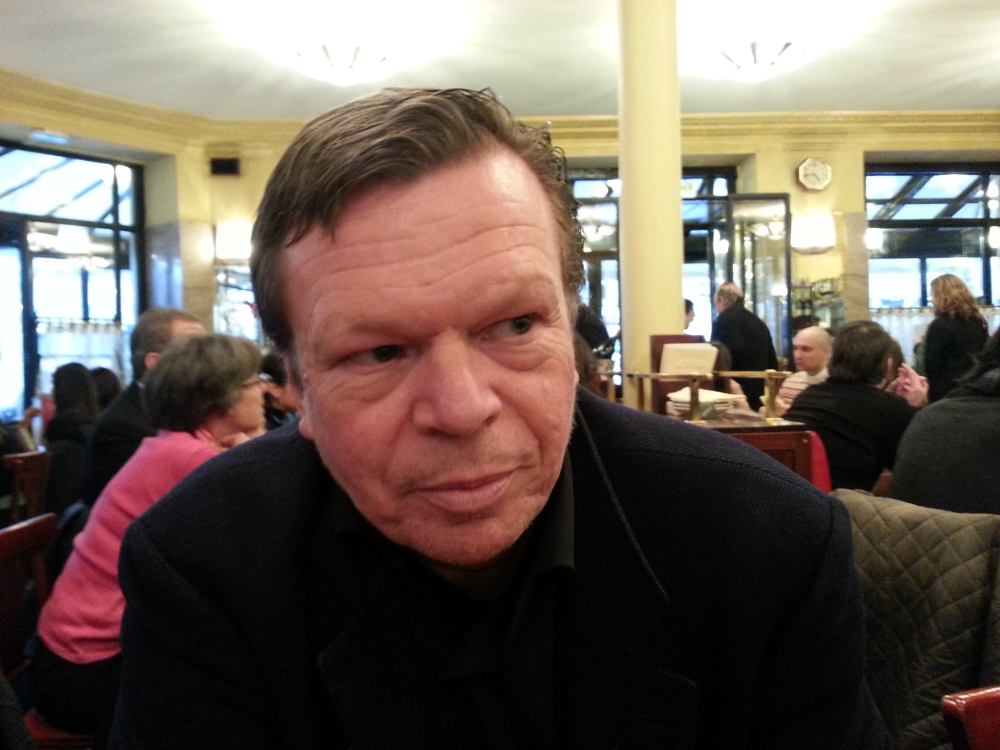
Peter is writer of the series The Heroine’s Journey and Hero’s Journey books, he has an MBA in Marketing, MBA in Financial Economics and graduated at university in Sociology and Communication Sciences.
Become a Great Storyteller
That’s why I set up The Power of your Story journey in the great cities of the world. A new way to use the power of your story. To guide you to life-changing, eye-opening movies, art, literature that truly have the power to enchant, enrich and inspire.
In this journey with Peter de Kuster you’ll explore your relationship with stories so far and your unique story identity will be sketched. You will be guided to movies, art, literature, myths that can put their finger on what you want to rewrite in your story, the feelings that you may often have had but perhaps never understood so clearly before; movies that open new perspectives and re-enchant the world for you.
You will be asked to complete a questionnaire in advance of your session and you’ll be given an instant story advice and movies to see to take away. Your full story advice and movies to see list will follow within a couple of days.
Practical Info
The price of this three day storytelling seminar is Euro 2850 excluding VAT per person. There are special prices when you want to attend with three or more people.
You can reach Peter for questions about dates and the program by mailing him at peterdekuster@hotmail.nl
TIMETABLE
09.40 Tea & Coffee on arrival
10.00 Morning Session
13.00 Lunch Break
14.00 Afternoon Session
18.00 Drinks
Read on for a detailed breakdown of the Power of your Story itinerary.
What Can I Expect?
Here’s an outline of the THE POWER OF YOUR STORY journey.
Journey Outline
OLD STORIES
- What is your Story?
- Are you even trying to tell a Story?
- Old Stories (stories about you, your art, your clients, your money, your self promotion, your happiness, your health)
- Tell your current Story
- Is this Really Your Story?
YOUR NEW STORY
- The Premise of your Story. The Purpose of your Life and Art
- The words on your tombstone
- You ultimate mission, out loud
- The Seven Great Plots
- The Twelve Archetypal Heroines
- The One Great Story
- Purpose is Never Forgettable
- Questioning the Premise
- Lining up
- Flawed Alignment, Tragic Ending
- The Three Rules in Storytelling
- Write Your New Story
TURNING STORY INTO ACTION
- Turning your story into action
- The Story Effect
- Story Ritualizing
- The Storyteller and the art of story
- The Power of Your Story
- Storyboarding your creative process
- They Created and Lived Happily Ever After
 The Power of Your Story