If you want to be engaged—to be sucked into a story completely, enveloped by another time and place—then the BBC’s epic World War II series might be just the ticket.
Peter Bowker’s “World On Fire” does one thing that seems especially appropriate right now: It focuses on the lives of people far from the podiums and big historical moments. Nor is its storytelling limited to one country or perspective. These seven episodes sprawl out from two characters, but they’re not the leads of a massive cast of supporting players. This is a true ensemble. So yes, we begin with Harry and Lois, two young lovers boldly shouting down some British fascists, but within moments we’re introduced to Lois’s father Douglas and Harry’s mother Robina; a jump forward in time introduces us to the family that Harry, a translator, is staying with in Poland, including the soft-spoken but brave Kasia and her brothers. Harry’s neighbor is Nancy, an American radio journalist typically stationed in Berlin, who has a nephew working as a doctor in Paris; the list goes on (and on, and on).
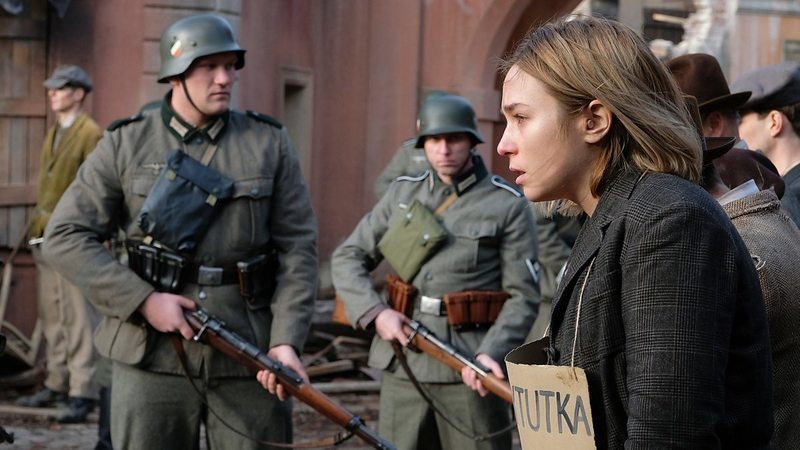
If that seems like a lot, it is. And there’s quite a bit more, including Polish resistance fighters, a German couple trying to hide their daughter’s epilepsy from the doctors who would euthanize her, Nancy’s Nazi handler, some jazz musicians, many soldiers and sailors, and so on. While this makes some of the characters harder to latch onto than others—every storyline is intense, so when someone disappears for a spell, the mind does tend to wander—it’s to Bowker’s credit that all the characters are reasonably well-developed, and a fairly high number are consistently engaging and complex. The Nazis are an exception to this rule, but a welcome one—this isn’t a both-sides-now kind of story, and the only Nazis that aren’t unabashedly racist monsters are by and large devices of the plot, intended to remind us that wars are often fought by terrified teenagers.
War isn’t just the setting here, either. Bowker’s characters often reckon with the costs of war, but they also tend to struggle with their own ideas about it. This is especially true of Bean and Manville’s characters (both excellent, which will surprise precisely no one who’s even seen either of them act in anything). Douglas, a pacifist still struggling with shellshock years after his experiences in the Battle of the Somme, struggles to with the parameters of beliefs that had seemed absolute, particularly when his troubled son joins up. His intellectual and emotional struggles are further spurred by Robina, who seems to relish an uncomfortable conversation and has her own complicated relationship with the cost of war, albeit one she keeps sealed behind the traditional stiff upper lip. There’s also an awkwardly charming pilot who says he fights so that other people have the freedom to go on living however they choose, his blunt acknowledgment that his job is to kill people plays as a person trying desperately to acclimate themselves to a horrifying reality, and call it by its name.

That name is war, and it’s present even when it’s not. The directors all manage to convey the abruptness of danger; you’re safe until you’re not, you round a corner and death waits. Nor, with the exception of Dunkirk (not Christopher Nolan-level stuff, but still pretty affecting), does the series interest itself in the big historical events. This is a story of life during the war: The young officer learning how to lead as he and his men do nothing but retreat toward the sea in a series of increasingly distressing but tactically insignificant skirmishes; the singer who can spot the shellshocked men in her audience in seconds; the young waitress who, just when she thinks she’s reached her breaking point, finds even more places to shatter. People drink coffee and check the mail and run errands, but always, disaster looms.
Not every scene is a winner. Bowker exercises admirable restraint through much of the series, allowing the horror and tragedy to speak for itself, but when he does lean on the gas, it can break the spell a bit (a mid-season singalong is particularly irksome). But even when the storylines don’t weave together perfectly or the story gets a bit precious, “World on Fire” remains engaging, because the cast understands exactly what’s being asked of them and by and large refuse to oversell. In addition to Bean, Manville, and the late-arriving Darvill, Hunt is predictably excellent; sometimes her broadcasts feel a bit too much like convenient history lessons, but her performance is never less than wholly compelling. Brown and Wichłacz are similarly successful, and Brown and Manville are largely responsible for the show’s brief moments of levity, with Manville in particular expertly balancing the need for a solid punchline with the character’s use of acerbic humor as a defense mechanism. (“Scotland? As if going through Dunkirk wasn’t suffering enough.”)
It’s not light viewing. It also betrays no interest in the torn-flag-waving-boldly-in-the-rubble kind of patriotism often typical of war epics. “World on Fire” and Bowker wisely stay away from such things, and by eschewing the Churchills of the world in favor of the people just trying to get by, they create an ensemble war drama that never loses focus. No, it’s not going to take your mind off the world’s troubles. But it’s honest about the troubles of that era, and about how hard it can be to simply keep going when everything’s turned upside down.
IS THE POWER OF YOUR STORY FOR YOU?
 You are a professional who is interested in developing yourself .
- You are aware that there are no quick fixes. Learning is a journey that works when you are fully committed to it. A guide like Peter de Kuster can bring awareness and help you navigate, but in the end it’s you who is in charge of your growth.
- You want to learn more about how to tell yourself a more powerful story, learn about blind spots, and get feedback.
- You are curious and want to engage in an interactive learning journey with Peter de Kuster.
- You are motivated to work in-between journeys on yourself (e.g. working on questions that will help you develop new storytelling, mindsets, skills, and behaviors).
WHAT’S YOUR QUEST-ION?
The Power of your Story is all about your development. To make the most out of your coaching with Peter, we ask you to prepare topics to work on with him. These topics can serve as a starting point for further in-depth exploration.
PRICING
Two Sessions Coaching for EUR 1,200 (excl. VAT)
Three Sessions Coaching for EUR 2,150 (excl. VAT)
Three Sessions Coaching for EUR 2,950 (excl. VAT)
BOOK THE POWER OF YOUR STORY
FAQ
Who can sign up for The Hero’s Journey?
Creative professionals who wish to improve their storytelling, mindset(s) and develop their leadership skills.
What language do we speak in the journey?
English
Can I bring my own topics?
Yes, you get to choose your own topic.
Are journeys confidential?
Yes. Peter will not share anything that is discussed in the journey.
Where will the journeys take place?
Sessions will take place travelling with Peter a world city like Paris, Rome, Florence, Barcelona, Amsterdam, London, Antwerp, Berlin, Madrid, New York, Venice.
How do I sign up?
Send Peter an email to theherojourneyquestionnaires@gmail.com
How do I pay?
After you booked The Hero’s Journey by sending an email to Peter you will receive an email with info how to pay.
How do I book and reschedule a journey?
Once we’ve received your payment, our Program Coordinator will book your journey. She will also support you with rescheduling journeys if needed.
What is your cancellation policy?
Individual journeys can be postponed up to one week before the journey.
 The Power of Your Story