Step into the stories that have shaped generations, inspired millions, and changed the way we see ourselves and the world. Join Peter de Kuster-renowned storyteller, and guide-on a cinematic adventure through the 1001 greatest movies ever made. This is not just a film list; it’s an invitation to explore the stories you tell yourself, discover your unique narrative identity, and transform your life and business through the timeless wisdom of cinema.
The Journey: Discover Your Story in the Movies We Love
Imagine your life as a film-full of drama, comedy, adventure, and transformation. On this journey, Peter de Kuster will guide you through cinematic masterpieces from every era and continent, from The Godfather and Seven Samurai to Pulp Fiction, Spirited Away, and The Shawshank Redemption. Each film is a mirror, reflecting archetypal patterns and universal themes that play out in your own story.
Together, we’ll explore the power of the stories you live by, using the world’s greatest movies as our guide. Through the lens of archetypes like the Seeker, Warrior, Creator, Sage, Jester, Magician, and Lover, you’ll uncover the deep, often unconscious patterns shaping your choices, relationships, and ambitions.
What to Expect
- A Cinematic Exploration:
Dive into the essential scenes, characters, and themes of the 1001 greatest films ever made-from classics like Casablanca, Citizen Kane, and Lawrence of Arabia to modern masterpieces like The Dark Knight, Eternal Sunshine of the Spotless Mind, and Parasite. - Personal Story Mapping:
Reflect on your own life as a movie. Which archetypes are you living? Where are you stuck in an old script? Where is your next plot twist waiting? - Practical Story Tools:
Use Peter’s “What Story Are You Living?” instrument to identify your strengths, challenges, and growth opportunities. Learn how to reframe setbacks as plot twists and discover new strategies for self-improvement and creative leadership. - Inspiration for Change:
Let the wisdom of cinema open new perspectives, rekindle your sense of wonder, and inspire you to rewrite your story with courage and creativity.
Who Is This For?
- Creative professionals, entrepreneurs, and leaders seeking clarity, confidence, and meaning in their story.
- Anyone who loves movies and wants to use their power to spark personal or professional transformation.
- Those ready to explore their blind spots, develop new mindsets, and gain feedback in a supportive, inspiring environment.
Practical Information
Start Date: Any Date You Want
Duration: 5 weeks
Time: 4 hours/ week
Language: English
Price: Euro 699 excluding VAT
Book your place by mailing us at peter@wearesomeone.nl
About Peter de Kuster
Peter de Kuster is the founder of The Power of your Story, a storyteller who helps creative professionals to create careers and lives based on whatever story is most integral to their lives and careers (values, traits, skills and experiences). Peter’s approach combines in-depth storytelling and marketing expertise, and for over 20 years clients have found it effective with a wide range of creative business issues.

Peter is writer of the series The Heroine’s Journey and Hero’s Journey books, he has an MBA in Marketing, MBA in Financial Economics and graduated at university in Sociology and Communication Sciences.
Benefits of the Journey
- Gain deep insight into your personal and professional narrative.
- Discover your unique strengths, challenges, and growth opportunities.
- Learn to reframe setbacks as opportunities for growth and creativity.
- Leave with a personalized list of films to watch and reflect on, tailored to your story journey.
- Experience the magic of cinema as a tool for self-discovery and leadership.

Ready to Become the Director of Your Own Life?
Your story is your life’s greatest masterpiece. Too often, we live by scripts we didn’t write. This journey is your chance to become the storyteller of your own legend, using the timeless wisdom of the movies we love as your guide.
Contact Peter de Kuster at peter@wearesomeone.nl to reserve your place on this cinematic journey of self-discovery and transformation.
Peter de Kuster is the founder of The Heroine’s Journey & Hero’s Journey project, helping creative professionals and leaders worldwide shape meaningful lives and careers through the power of story.
Join the founder of The Hero’s Journey, storytelling, mythologist, and tour leader Peter de Kuster on an exquisite exploration of Rome, one of the most sensual cultures in the world. To discover the story you tell yourself about yourself – your life and business – and how to transform this story.
Peter will lead you on an adventure through one of the most artistic cultures in the world, where we will visit great art masterpieces, brilliant public architecture, artisan studios and workshops.
Explore with Peter de Kuster the power of the stories you tell yourself. With the concept of archetypal stories Peter explores with you the deep, unconscious patterns in the ways we perceive, organize, and interpret the events of our lives. A wide variety of these shared human themes are reflected in both our cultural traditions and stories and in our personal experiences the stories we live.
Discover the archetypal patterns and themes that influence your daily life with this new journey with Peter de Kuster . We will explore through a journey across some famous artists and their works the relative influence of such archetypes as Seeker, Warrior, Creator, Sage, Jester, Magician, Lover, and more in your own life. Using Peter’s stories and his ‘What Story are You Living’ instrument together, you will learn your strengths, challenges, growth opportunities, and strategies for self-improvement.
Awaken your unrealized potential and hidden strengths to improve personal and business relationships, find new direction in career planning, or replace unproductive life patterns. Understanding your life story and the decisions you make along the way will help you on the path to a fuller, more satisfying journey. Since the What Story are You Living journey is intended to help guide and improve your journey through life.
HOW AND WHY WE LIVE STORIES
We are storytelling creatures. Listen to people talking in a restaurant, at the water cooler or at a party and you will quickly find that the majority of what they say is in the form of stories. We connect by telling each other stories. We can better understand ourselves by recognizing and exploring our life narratives. Your life story is the tale that your repeatedly tell yourself about who you are, what you want, what you can and cannot do. Before the second year of life, we are sensitive to the tone of stories lived around us, and we have already begun collecting thousands of images that resonate emotionally with us in some important way. At first the plots are inconsistent and illogical – much as our dreams continue to be. By elementary school , we follow particular rules about the beginning, middle and ending of stories, so they begin to make sense. By adolescence, we tell ourselves consistent stories about our lives that define who we are, how we came to be that way, and where we are headed. We see events that we can recount as vignettes of our central life narrative.
Although there are as many variations of life stories as there are individuals, people tend to crete narratives according to a finite number of templates. There are a very small number of general narrative forms in the world’s literature, movies, art. The same is true of characters and the roles they play. How can this be?
In the first part of the twentieth century, the psychiatrist Carl Jung recognized the universality of characters and situations. Just as there are certain musical tones that sound resonant across cultures, there are similarly a universal set of roles, situations and themes that are recognizable by everyone. These universal templates are called archetypes, which is derived from the Greek archetypos, meaning ‘molded first as a model’ (Merriam Webster 2002). Jung, and many other after him, saw that these stories which recur in literature and art are the same narratives we as humans live. For example we all recognize the love story whether we encounter it in a movie, an opera , or a novel. And when we fall in love, we experience for ourselves what that story is about. When we are in a loving relationship, we not only learn major life lessons (in this case about intimacy, sensuality, pleasure, and commitment) but we also feel a sense of connection to all the other people who have ever loved deeply. While each love is different, there is a deep pattern that transcends these differences. When we understand the stories and recognize their universality, we can connect with each other at deeper and more conscious levels, using the archetypal stories as the foundation.
This may be especially true of the sacred myths of cultures, which are particularly archetypal, as they express in metaphor people’s actual experiences. These stories do not necessarily have to be taken literally. Rather, the concrete outward actions symbolize inner experiences. We read the story of an outward journey and something resonates in our inward journey.
This is why people talk about ‘life journeys’, even if they have never outwardly left the town where they grew up. People connect immediately to a journey story from another culture finding resonance with the characters and the form and the phases of the journey, even if the particular details are not familiar. Such stories influence people for good or ill. Archetypal stories can provide breakthroughs in insight and move people toward harmony and success, but such stories are equally able to tempt people toward less productive, even destructive behaviors. Either way, an understanding of the archetypal narrative can enhance insight or enable people to break free of destructive patterns.
The archetypal stories described in this seminar are those associated with the heroine’s journey, which is a model for the individuation process (the process of finding yourself and connecting to your depth and your full potential). They are named by the primary character in each story: Dreamer, Independent, Warrior, Caregiver, Explorer, Lover, Outlaw, Creator, Master, Magician, Sage and Jester.
Living the Stories in Everyday Life: Stages and Situations
When we are living a particular story, we tend to see the world from its vantage point. What we notice in the world and what actions we think make sense grow naturally from that story. For example when someone who is living a Warrior story is having a difficult time with another person she may react in a strong and challenging way, defending her own position. If this person were living a Caregiver story, however, she might instead show concern for what was causing the other person to be difficult, seeking to understand and reassure. When we develop narrative intelligence, we are able to see why we react the way we do and understand the different assumptions and behaviors of others.
There are a host of characters and situations from which these stories are drawn. Such characters have come to be known as archetypes, and they define basic stories, although for each person the details will be unique. These archetypes can be looked at as guides that help us know when we are on our best path and taking the most appropriate action. Your results from the Heroine’s Journey questionnaire help you identify these characters as a way to make sense out of the stories you are living, which allows you to create a richer and more satisfying life.
Many people recognize over time that there is one story that provides the central meaning and purpose of their lives. In addition, other stories are lived out at different times and places. If you think about it, you may notice that different stages of life have offered you new situations, new scenery, new people to be with, even the unfolding of a new storyline. You can see such situations as a stage set, with costumes and supporting characters that seem to pull you into a story line (the plot to be lived out). Such settings have immense power.
Certain life stages typically place us in situations that invite us into specific narratives. For example: if you had a very happy childhood, you likely lived the story of the Dreamer (Innocence). Others were caring for you, and you simply had to trust their wisdom, experiment, and learn what to do to succeed. Living this story provided you with a baseline sense of trust and optimism about life. Living this story provided you with a baseline sense of trust and optimism about life. If, on the other hand, your childhood was difficult you may have lived an Orphan story. This does not mean that you were literally orphaned (although it could). Rather it means that the adults in your life were too distracted, unskilled or wounded to care for you properly (physically, emotionally or intellectually). In this case, you may have experienced a story that had as theme the challenge of coping in a situation of minor or major deprivation or wounding. Likely this would provide a baseline approach to life that was more cautious and realistic, even pessimistic. Or you might have lived both stories – either sequentially (if your life situation changed) or the same time (if your experience with the caregivers in your life was mixed).
As you grew older; you may have become less dependent upon your parents and other authority figures, wanting to explore your own identity and the world outside. You might even have become somewhat oppositional, especially in your adolescent years. You might think of this as living an Explorer story; which exemplifies the gifts of independence and identiy. At roughly this same time in life, you may have become interested in romance; and so you began living out a Lovers’ story; developing the gifts of intimacy and sensuality. This may have led to marriage and children in which case you suddenly needed to live the story of the Caregiver, demonstrating the ability to nurture and even sacrifice for others.
The list of stories we may live at different stages of our lives can go on and on. The major point here is that success in life is often determined by how well we live out these stories, for it is in the living thtat we develop in mature, responsible, moral and successful adults.
So many people today talk about the need for character – in public officials, in the heads of corporations, and in the young. However character cannot be formed by simply enjoining people to act appropiately. We all know from making New Year’s resolutions that simply deciding to do or not do something is not enough to guarantee success. Becoming good, moral and successful requires knowledge of how to develop the inner qualities that make it easy to do so. Every life situation carries within it a call to live a story that offers experiences that can make us great – or, conversely, bring out what is petty, small or harmful within us. It is much easier to avoid the slippery slope of life’s negative temptations and traps when we can recognize the positive potential within situations.
The stories identified in this seminar link everyday life twith the great, mythic stories that inform what it means to be human. Many people, however, sleepwalk through stories that emerge naturally in certain life stages and life situations and consequently they lack a sense of meaning and purpose in their lives. At worst, living in this unconscious way decreases their ability to gain the gifts associated from living the great stories; leaves them feeling alone with their problems, and decreases their ability to become the kind of mature and wise people capable of making a positive difference to their families, friends, community and field of work. When people lack the ability to know what story they are living, they may fail to develop the qualities required to take adult responsibility for the state of their families, communities and the larger world.
When we recognize that we are living a unique personal story, as well as one of the universal great narratives , our lives can be filled with meaning, purpose and dignity. At the same time, we feel less lonely because we can see that we share commonality with all the people in all times and places, who have lived through the challenges of that story.
Exploring Archetypal Stories
Archetypes are psychological structures reflected in symbols, images and themes common to all cultures and all times. You see them in recurring images in art, literature, myths and dreams. You may experience archetypes directly as different parts of you. If you say that on one hand you want one thing and on the other you want something else, you can give archetypal names to those parts, as they generally communicate desires and motivations common to humans everywhere. Although the potential characters within us are universal, each of us expresses them differently, endowing them with somewhat different styles, traits and mannerisms. For example, when the Warrior is an archetype, different kinds of Warriors engage in difficult battles.
The Warrior Archetype encompasses the warlord and the samurai but it also might include the dedicated biologist racing to be on the first team to map the human genome, the advocate for social justice or the member of a street gang. Each of these Warriors follows a different code of honor, goals, style of dress etc; nevertheless all of them are Warriors. The expression of an archetype will be influenced by a person’s culture, setting and time in history but it will also be a manifestation of his or her individuality.
As aspects of yourself archetypes can reveal your most important desires and goals. Understanding their expression in your personal myths and stories helps you gain access to unrealized potential, grasp the logic and importance of your life and increase your empathy for the stories that others live.
In this computer-literate society you might think of an archetype as analogous to computer software that helps you to accomplish certain tasks. For example, a word processing program can be used to write a letter report or book; other applications help with accounting and financial planning and reporting. But these programs would be of no help if you confused their functions. Similarly, the Warrior helps people to be more focused, disciplined, and tough; the Lover helps them to be more passionate, intimate and loving; while the Jester helps them lighten up and enjoy their lives. When a particular archetype is awakened you live out its story. In the process you are able to accomplish definable new tasks. However it is also important that the archetype to be relevant to the task you are facing. If you are going on a date, the evening is not likely to end well if you act out a war story. Conversely most people find it wise not to go into war with the Lover’s vulnerability or the Jester’s playfulness.
In the ancient world, many people projected the archetypes outwardly onto images of gods and goddesses. In the twentieth century, Jung explored the manifestation of the psychological symbols of archetypes and their role in healing. The Hero’s Journey What Story are You Living? makes it easier for you to determine and recognize twelve of the archetypes in your daily life. Understanding your story and archetypes can help you better decide the underlying logic of your life, find greater fulfillment and satisfaction, and free yourself from living out limiting patterns and behaviors. Such knowledge can also increase your insight into other people, thus greatly enhancing your relationships. Most important, understanding these deep psychological structures will make your individuation process – the process of finding yourself and fulfilling your potential- conscious, so that you can gain the gifts associated with maturity, success and happiness.
When each archetype is active in a person’s life, it tends to call forth a particular kind of story or plot. After you have answered the Hero’s Journey What Story are You Living? questionnaire, you will want to become familiar with these stories and plots and their archetypal characters. After you have become familiar with the archetypes, you will want to validate and review your results and then develop some practical understanding of how to use this information by doing the exercises in this journey.

Archetypal Stages of the Journey
The archetypes and their stories are engaged more subtly as they emerge at different stages of the journey. The mythic hero’s journey is outlined in the picture beneath, however, it may or may not be the order in which you have lived the stories of these archetypes. The order in which the archetypes are presented is only a typical order in which they may be encountered during the course of development and thus a logical order in the unfolding of a story. In addition, one or more archetypes may be active throughout your life and become critical to your sense of who you are. To begin your understanding of how archetypes influence your life review the summary of archetypes above and check the archetypes that are most germane to your life at this time.
Citizen Kane
Charles Foster Kane’s journey in Citizen Kane is a profound meditation on the spiral nature of the hero’s journey-a pattern not of linear conquest, but of recurring archetypes, unresolved wounds, and ever-deepening cycles of self-discovery and loss. In this analysis, we’ll walk through the 12 classic archetypes of the hero’s journey as they appear in Kane’s life, illustrating how the spiral repeats and deepens, and inviting you to reflect on your own story. Along the way, you’ll find questions and exercises to help you become the storyteller of your own legend.
1. The Ordinary World: Innocence and Loss
Kane’s journey begins in the snowy wilderness of Colorado, a child playing with his sled, Rosebud. This is his “ordinary world”-a place of innocence, security, and familial love. But even here, the seeds of loss are planted: his mother, Mary Kane, is emotionally distant, and his father is powerless. The discovery of gold changes everything, and Kane’s world is shattered when he’s sent away to live with Thatcher, the banker.
Reflect:
- What was your “ordinary world” as a child?
- What moments or decisions changed that world forever?
Exercise:
Write a short scene describing a time when your sense of safety or innocence was disrupted. What did you lose? What did you gain?
2. The Call to Adventure: The Promise of Power
Kane’s call to adventure is not a choice, but a command: he is taken from his parents and thrust into a new world of wealth and privilege. Later, as a young man, he inherits a vast fortune and chooses to run the Inquirer, launching himself into public life. The adventure promises power, influence, and the chance to shape the world.
Reflect:
- When have you been called (or forced) to leave your comfort zone?
- Did you embrace or resist the call?
Exercise:
List three moments in your life when you were presented with a new opportunity or challenge. Did you accept or decline? Why?
3. Refusal of the Call: Clinging to the Past
Kane resists his new destiny. As a boy, he clings to his sled, fighting Thatcher’s authority. As an adult, he insists he’s acting for the people, not for power. Yet, beneath the bravado, he is haunted by the loss of his childhood and the love he never received.
Reflect:
- Have you ever resisted change, even when it was inevitable?
- What were you afraid of losing?
Exercise:
Write about a time you refused a challenge or opportunity. What held you back? What did you fear?
4. Meeting the Mentor: Guidance and Rejection
Kane’s mentors are complex and often unsatisfying. Thatcher, his guardian, offers financial wisdom but no warmth. Jedediah Leland, his friend, tries to guide Kane toward integrity. Even Susan, his second wife, attempts to nurture him. Yet Kane repeatedly rejects or outgrows his mentors, unable to accept the love or guidance he truly needs.
Reflect:
- Who have been your mentors? Did you accept their help?
- What kind of guidance do you seek now?
Exercise:
Identify a mentor figure in your life. Write a letter (real or imaginary) thanking them or expressing what you wish you could have received from them.
5. Crossing the Threshold: The World of Power
Kane’s commitment to running the Inquirer marks his crossing into the world of influence and ambition. He leaves behind the possibility of a simple life, embracing the complexities of public scrutiny, political ambition, and personal rivalry.
Reflect:
- When have you crossed a threshold, leaving behind the familiar for the unknown?
- How did it change you?
Exercise:
Describe a moment when you made a decision that changed the course of your life. What did you leave behind? What did you step into?
6. Tests, Allies, and Enemies: The Battle for Identity
As Kane’s power grows, so do his challenges. He faces tests (political campaigns, business rivalries), gains allies (Leland, Bernstein), and makes enemies (Thatcher, Gettys). His relationships are fraught with tension-he demands loyalty but gives little in return, driving away those who care for him.
Reflect:
- Who are your allies and adversaries?
- What tests have shaped your character?
Exercise:
Draw a map of your life’s “allies and enemies.” Who has helped you? Who has challenged you? What have you learned from each?
7. Approach to the Inmost Cave: Loneliness and Confrontation
Kane’s spiral deepens as he faces the collapse of his marriage, the failure of his political ambitions, and the death of his dreams. He retreats to Xanadu, his vast, empty estate-a literal and metaphorical “inmost cave.” Here, surrounded by wealth but isolated from love, Kane confronts the emptiness at the heart of his quest.
Reflect:
- What is your “inmost cave”-the place where you face your deepest fears?
- What have you found there?
Exercise:
Write about a time you withdrew from the world. What were you seeking? What did you discover about yourself?
8. The Ordeal: The Dark Night of the Soul
Kane’s greatest ordeal comes when Susan leaves him. His desperate plea for her to stay reveals his core wound: the fear of abandonment and the inability to love or be loved unconditionally. In his rage, he destroys her room, but the real destruction is internal-a shattering of hope and self-worth.
Reflect:
- What has been your greatest ordeal?
- How did it change you?
Exercise:
Recall a moment of deep crisis. Write a dialogue between your present self and your past self at that moment. What would you say to comfort or guide yourself?
9. Reward (Seizing the Sword): The Hollow Victory
Unlike traditional heroes, Kane’s “reward” is ambiguous. He retains his wealth and notoriety but loses the people who mattered. The empty halls of Xanadu and his obsessive collecting reveal the hollowness of his victories-he has everything, yet nothing.
Reflect:
- Have you ever achieved a goal only to find it unfulfilling?
- What did you truly want?
Exercise:
List three “rewards” you’ve pursued. Did they bring you happiness? If not, what was missing?
10. The Road Back: Nostalgia and Regret
After Susan’s departure, Kane is left with memories and regret. He revisits the past, longing for the simplicity of childhood. The spiral brings him back to the beginning: alone, misunderstood, and yearning for something he cannot name. The road back is not triumphant but haunted by nostalgia.
Reflect:
- Do you revisit the past, searching for meaning or closure?
- What memories do you return to, and why?
Exercise:
Write about a memory you often revisit. What draws you back? What are you seeking?
11. Resurrection: The Final Reckoning
Kane’s final days are spent wandering Xanadu, surrounded by the detritus of his life. In death, he is resurrected in memory, as reporters and acquaintances try to piece together his story. “Rosebud,” his dying word, is a return to the innocence and loss that defined his journey-a resurrection of the child he once was.
Reflect:
- How do you want to be remembered?
- What part of your story do you hope will endure?
Exercise:
Imagine your life as a movie. What would your final scene be? What message would you want to leave behind?
12. Return with the Elixir: The Gift of Understanding
The “elixir” Kane brings back is not for himself, but for the audience. The search for Rosebud is a quest for meaning, and its answer-a simple sled-reminds us that what we seek is often what we lost long ago. Kane’s story, told through the spiral of memory and regret, offers a cautionary tale about the cost of ambition and the enduring need for love.
Reflect:
- What wisdom have you gained from your journey?
- What gift can you offer to others from your experience?
Exercise:
Write a letter to your younger self, sharing the most important lesson you’ve learned. What advice or comfort would you give?
The Spiral Nature of Kane’s Journey
Unlike a linear path, Kane’s hero’s journey is a spiral. Each archetype reappears at different stages and depths, colored by new experiences and old wounds. His longing for love, his quest for power, his resistance to vulnerability-all recur, each time with greater stakes and more profound consequences.
Kane as Archetype:
- The Innocent Child: Kane’s longing for love and security is never resolved, haunting him throughout his life
- The Seeker: His pursuit of power and influence is a search for meaning, but it only deepens his isolation.
- The Ruler: As master of Xanadu, Kane is at the height of his power but also at his most powerless to change his fate.
- The Outcast: In the end, Kane is a stranger to everyone, including himself, spiraling back to the loneliness of his childhood.
Character Analysis:
- Charles Foster Kane: A tragic hero, driven by unresolved childhood trauma, seeking love and control but unable to find fulfillment.
- Jedediah Leland: The loyal friend and would-be mentor, representing integrity and the voice of conscience.
- Susan Alexander: The second wife, both muse and victim, whose departure marks Kane’s final defeat.
- Walter Parks Thatcher: The mentor-guardian, offering security but no warmth, shaping Kane’s distrust of authority.
- Mary Kane: The distant mother, whose decision to send Kane away sets the spiral in motion.
Your Story: Becoming the Storyteller of Your Own Life
Kane’s journey is a cautionary tale, but it is also an invitation. You are the storyteller of your own life. You can choose to repeat old patterns or create new legends. The spiral of the hero’s journey is not a trap, but a path-one that you can walk with awareness, courage, and creativity.
Questions for Your Journey:
- What is the “Rosebud” in your life-the lost innocence or longing that shapes your choices?
- Are you living someone else’s story, or writing your own?
- What archetype are you embodying right now? What archetype is calling you next?
Exercises for Your Legend:
- The Story Map:
Draw a spiral on a piece of paper. Mark the key events of your life along the spiral, noting which archetype you were living at each point. Where do you see patterns repeating? Where have you grown? - The Character Interview:
Choose a character from your life (yourself, a mentor, an adversary). Write an interview with them. What do they want? What do they fear? How have they helped or hindered your journey? - The Rewrite:
Pick a moment in your life when you felt stuck or defeated. Rewrite the scene as if you were the hero, making a different choice. How does the story change? What new possibilities emerge? - The Legend Statement:
Write a one-sentence legend for your life. (“I am the one who…”) How does this legend empower or limit you? What new legend do you want to create?
Conclusion: Creating Your Own Legend
Citizen Kane is more than a film; it is a mirror held up to our own lives. Kane’s spiral journey through the 12 archetypes is a reminder that we are all searching for meaning, love, and belonging. We all face moments of loss, resistance, triumph, and regret. But unlike Kane, we have the power to become conscious storytellers-to revisit old wounds with new wisdom, to choose different paths, to create legends that heal and inspire.
As you reflect on Kane’s journey, ask yourself:
What story are you living? What story do you want to tell? Will you let the past define you, or will you become the hero of your own legend?
Gone with the Wind
Gone with the Wind is a sweeping epic of love, war, and survival, but beneath its grand historical drama lies a deeply personal hero’s journey-one that spirals through the 12 archetypes, not as a straightforward ascent, but as a cycle of triumphs, failures, and self-reinvention. Scarlett O’Hara, the story’s central figure, is no traditional hero. She is flawed, complex, and often her own worst enemy, yet her journey through the collapse and rebirth of the South is a powerful lens for exploring the spiral nature of the hero’s journey and the archetypes that shape every life-including yours.
Below, you’ll find a detailed exploration of the hero’s journey in Gone with the Wind, illustrated through Scarlett’s story and the supporting cast, with reflection questions and exercises to help you map your own legend.
The Spiral Hero’s Journey in Gone with the Wind
1. Ordinary World: The Innocent, Everyman, and Ruler
Scarlett’s journey begins on Tara, her family’s plantation, where she is the pampered belle of the county. She is the Innocent-protected, naïve, and confident in her charms. She is also the Ruler, presiding over her social world, and the Everyman, shaped by the expectations and routines of Southern womanhood96.
Reflection:
Where is your “ordinary world”? What roles do you play-Innocent, Ruler, Everyman? What do you take for granted?
Exercise:
Describe your own “Tara”-the place, community, or routine where you feel most secure. What strengths and blind spots does this world give you?
2. Call to Adventure: The Herald and Explorer
Scarlett’s call to adventure comes with the outbreak of the Civil War and the shattering of her world. The Herald is both the war itself and the loss of Ashley Wilkes, whom she loves but cannot have. Forced to confront a world in chaos, Scarlett is thrust into the role of Explorer, seeking new ways to survive and thrive.
Reflection:
What event or realization has called you out of your comfort zone? Who or what is your Herald?
Exercise:
List three moments when you were forced to adapt or change. How did you respond? Did you resist or embrace the adventure?
3. Refusal of the Call: The Doubter and Orphan
Scarlett’s initial response is denial. She clings to the hope of winning Ashley and resists the reality of war, loss, and change. She is the Doubter, refusing to accept the new world, and the Orphan, soon to be stripped of her family, home, and innocence.
Reflection:
When have you resisted change, hoping things would return to “normal”? What did you fear losing?
Exercise:
Write about a time you refused a call to adventure. What was at stake? What finally pushed you to act?
4. Meeting the Mentor: The Sage, Caregiver, and Shadow
Scarlett’s mentors are complex and often contradictory. Mammy, her family’s housekeeper, is a true Sage and Caregiver, offering wisdom and moral grounding. Rhett Butler, the charismatic anti-hero, is both Mentor and Shadow-challenging Scarlett, exposing her flaws, and urging her to face uncomfortable truths. Melanie Hamilton, too, is a moral mentor, embodying kindness and resilience.
Reflection:
Who are your mentors? Are they always positive influences, or do they challenge you in uncomfortable ways?
Exercise:
Write a letter to a mentor (real or imagined). What have you learned from them? How did their guidance shape your journey?
5. Crossing the First Threshold: The Shapeshifter and Trickster
Scarlett crosses the threshold when Atlanta falls and she must flee, taking responsibility for Melanie and her newborn child. She becomes a Shapeshifter, adapting to each crisis, and a Trickster, using wit and deception to survive-lying, scheming, and even marrying for security.
Reflection:
When have you been forced to adapt quickly, taking on new roles or disguises to survive?
Exercise:
Describe a time you became a Shapeshifter or Trickster-bending the rules, changing your persona, or using cunning to get by.
6. Tests, Allies, Enemies: The Ally, Shadow, and Ruler
Scarlett’s journey is filled with tests:
- Surviving the burning of Atlanta
- Returning to Tara and finding it devastated
- Taking charge of her family’s survival
Her allies include Mammy, Melanie, and (sometimes) Rhett. Her enemies are poverty, hunger, and the changing social order. She is her own Ruler, but also faces external Rulers-Yankee occupiers, carpetbaggers, and the rigid codes of Southern society.
Reflection:
Who are your allies and enemies? What tests have shaped your journey?
Exercise:
Map your “cast of characters.” Who helps you? Who hinders you? Who rules over your choices?
7. Approach to the Inmost Cave: The Orphan, Martyr, and Creator
Scarlett’s “inmost cave” is Tara itself-her home, her identity, and her greatest vulnerability. She becomes the Orphan, stripped of her parents and security; the Martyr, sacrificing her pride and morals to save her family; and the Creator, rebuilding Tara and later her own business empire98.
Reflection:
What is your “inmost cave”-the place or challenge that holds your deepest fears and hopes?
Exercise:
Write about a time you had to sacrifice or reinvent yourself to protect what mattered most.
8. The Ordeal: The Shadow, Martyr, and Lover
Scarlett’s ordeal is ongoing:
- She marries Frank Kennedy for money, sacrificing love for survival
- She faces violence and attack in a lawless Atlanta
- She loses her daughter, Bonnie, and Melanie dies
The Shadow is both external (war, loss) and internal (her own selfishness and inability to love fully). The Martyr is seen in her sacrifices; the Lover in her obsession with Ashley and her tumultuous relationship with Rhett.
Reflection:
When have you faced your greatest ordeal? What shadows did you confront-inside and out?
Exercise:
Describe your own “ordeal”-a crisis that tested your values, relationships, or sense of self. What did you learn?
9. Reward (Seizing the Sword): The Ruler, Lover, and Sage
Scarlett’s reward is ambiguous. She gains wealth, security, and power-becoming the Ruler of her own destiny and the business world. She marries Rhett, believing she has finally won. Yet, her inability to recognize real love (with Rhett) and her fixation on Ashley mean her “reward” is fraught with loss and regret. The Sage archetype is present in the hard lessons she learns about herself and others.
Reflection:
What rewards have you gained from your struggles? Were they what you truly wanted?
Exercise:
List three “swords” you’ve seized-achievements, relationships, or insights. How have they changed you?
10. The Road Back: The Hero, Martyr, and Shadow
Scarlett’s road back is marked by tragedy and realization. Bonnie’s death, Melanie’s passing, and Rhett’s departure force Scarlett to confront the emptiness of her victories. She is the Hero, surviving against all odds; the Martyr, suffering for her choices; and the Shadow, facing the consequences of her flaws.
Reflection:
When have you returned from a journey changed, but not in the way you expected? What did you lose-and what did you gain?
Exercise:
Write about a time you “came back” from a challenge, only to find the world-and yourself-irrevocably changed.
11. Resurrection: The Magician, Orphan, and Sage
Scarlett’s resurrection is a moment of self-awareness. Alone at Tara, she vows to rebuild and win Rhett back. The Magician archetype is present in her ability to transform adversity into hope. She is the Orphan, once more alone, but now tempered by experience. The Sage emerges as she finally understands the nature of love, loss, and survival.
Reflection:
When have you experienced a resurrection-a moment of clarity or transformation after loss?
Exercise:
Imagine your own resurrection scene. What wisdom or power do you bring back from the depths?
12. Return with the Elixir: The Sage, Ruler, and Everyman
Scarlett’s journey ends where it began-at Tara. She is changed: wiser, sadder, but still unbroken. The “elixir” is her resilience and the hard-won knowledge that tomorrow is another day. She is the Sage, carrying wisdom; the Ruler, determined to shape her fate; and the Everyman, forever seeking belonging and love.
Reflection:
What “elixir” do you bring back from your journey? How are you changed? How do you share your gifts with others?
Exercise:
Write a letter to your future self, describing the strengths, lessons, or hopes you want to carry forward.
The Spiral Nature of Archetypes in Gone with the Wind
Archetypes in Gone with the Wind are not static-they spiral, reappear, and deepen as Scarlett’s journey unfolds. Here’s how the 12 archetypes recur:
| Archetype | Scarlett’s Story Example | Your Story Reflection |
|---|---|---|
| Innocent | Scarlett at Tara, before the war | Where do you find comfort or naivety? |
| Everyman | Her struggles for survival, blending in with society | When do you feel ordinary, yet called to greatness? |
| Orphan | After her parents’ deaths, left to rebuild | When have you felt abandoned or alone? |
| Explorer | Adapting to the new South, seeking opportunity | When have you ventured into the unknown? |
| Sage | Mammy, Rhett, Melanie, and Scarlett’s own hard-won wisdom | Who offers you guidance? What truths have you learned? |
| Caregiver | Mammy, Melanie, Scarlett for her family | Who do you nurture or protect? |
| Trickster | Scarlett’s schemes, Rhett’s provocations | Where do you use cunning or humor to survive? |
| Shapeshifter | Scarlett’s changing roles-belle, widow, businesswoman | When do you change masks or adapt to survive? |
| Shadow | War, poverty, her own selfishness, and obsession | What are your greatest obstacles? |
| Martyr | Sacrificing for Tara, marrying for money | When have you suffered for others or for survival? |
| Lover | Her passion for Ashley, tumult with Rhett | What or who do you love deeply? |
| Magician | Transforming adversity into hope, “Tomorrow is another day” | When have you experienced a profound change? |
| Ruler | Taking charge of Tara, her business, and her destiny | Where do you lead or wield power? |
Exercises: Exploring Your Own Hero’s Journey
- Draw Your Spiral:
Sketch a spiral and label each turn with an archetype you’ve encountered. Where do you see patterns repeating? Where have you grown? - Write Your Legend:
Begin your story: “Once upon a time, I…” Let the archetypes guide your narrative. Who are your allies? Your shadows? Your mentors? - Identify Your Ordeal:
What challenge has defined your journey so far? How did you face it? What archetypes helped or hindered you? - Claim Your Elixir:
What is the gift, insight, or strength you bring back to your world? How will you share it? - Ask Yourself:
- Where am I on my journey right now?
- What archetype do I embody most strongly?
- What legend am I creating-or avoiding?
You Are the Storyteller of Your Own Life
Gone with the Wind is not just the story of Scarlett O’Hara, but a mirror for every reader’s journey. The spiral of archetypes-Innocent, Ruler, Orphan, Shadow, Sage, and more-reminds us that heroism is not about perfection, but about resilience, adaptation, and the willingness to begin again. You are the storyteller. You can create your own legend, or let it be written for you.
“After all, tomorrow is another day.”
– Scarlett O’Hara
Will you answer your call to adventure? Will you spiral onward, learning, growing, and returning home transformed? The story is yours to tell.
Some Like It Hot
Some Like It Hot is a masterclass in the Hero’s Journey, not just for its comedic brilliance, but for how it spirals through the 12 classic archetypes, revealing how transformation, disguise, and self-discovery aren’t just for mythical heroes-they’re for all of us. As you read, reflect on your own journey: Where do you find yourself in the spiral? Which archetypes are calling you? What legend are you writing with your life?
The Hero’s Journey in Some Like It Hot: A Spiral of Archetypes
The Hero’s Journey is a cyclical path of transformation, marked by archetypal energies that appear, evolve, and recur as the hero grows8910. In Some Like It Hot, Joe and Jerry’s journey is both literal and metaphorical, as they run from danger, don disguises, and ultimately discover truths about themselves and love.
Let’s spiral through the 12 stages, illuminating the archetypes as they appear, reappear, and deepen-and invite you to reflect on your own story at each turn.
1. The Ordinary World: The Everyman and Trickster
Joe and Jerry are struggling jazz musicians in Prohibition-era Chicago, scraping by in a world of speakeasies and shady deals. They are Everymen-relatable, flawed, and just trying to survive. The Trickster energy is already present: Joe’s schemes and Jerry’s anxious improvisations hint at the chaos to come.
Reflection: Where is your “ordinary world”? What routines, roles, or disguises do you wear to get by?
Exercise: Write a snapshot of your daily life. Where do you play it safe? Where do you “bend the rules” to survive?
2. Call to Adventure: The Herald and Shadow
The inciting incident arrives violently: Joe and Jerry witness the St. Valentine’s Day Massacre, making them targets of Spats Colombo’s gang-the Shadow archetype. The Call to Adventure is clear: run or die.
Reflection: What event or realization has forced you to change or escape? Who or what is your “Shadow”-the threat that pushes you out of comfort?
Exercise: List three moments when you were forced to act by circumstances beyond your control. What “shadow” drove you forward?
3. Refusal of the Call: The Doubter and Everyman
Initially, Joe and Jerry hesitate. They’re broke, scared, and unsure how to escape. Their reluctance is palpable-they are Doubters, clinging to the familiar even as danger closes in.
Reflection: When have you resisted change, even when you knew it was necessary?
Exercise: Describe a time you refused a call to adventure. What held you back? How did you finally move forward?
4. Meeting the Mentor: The Mentor and Ally
Mentorship in Some Like It Hot is unconventional. Sweet Sue, the bandleader, offers Joe and Jerry a lifeline (albeit unknowingly), while Sugar Kane becomes an emotional mentor, showing them vulnerability and trust. Even Osgood, with his unflagging optimism, models acceptance and joy.
Reflection: Who has mentored you, intentionally or not? What lessons did you learn from unexpected sources?
Exercise: Write a letter to an unlikely mentor in your life. What did you learn from them, even if they didn’t know they were teaching?
5. Crossing the First Threshold: The Shapeshifter and Threshold Guardian
Joe and Jerry cross a literal and figurative threshold when they disguise themselves as “Josephine” and “Daphne” to join Sweet Sue’s all-female band, boarding the train to Miami15. The Shapeshifter archetype is embodied in their new identities, while Sweet Sue and the band serve as Threshold Guardians, testing their ability to blend in.
Reflection: When have you had to change your identity or adapt to a new environment to survive or succeed?
Exercise: Describe a time you “crossed a threshold”-started a new job, moved, or entered a new community. What did you have to change about yourself?
6. Tests, Allies, Enemies: The Ally, Shadow, and Trickster
On the train and in Miami, Joe and Jerry face a series of tests: maintaining their disguises, resisting temptation, and navigating the affections of Sugar and Osgood. Sugar is an Ally, while Spats and his gang remain the looming Shadow. The Trickster energy is everywhere-Joe’s schemes, Jerry’s improvisations, and the film’s constant play with identity.
Reflection: Who are your allies and adversaries? Where do you encounter trickster energy-unexpected chaos or comic relief-in your life?
Exercise: Map your “band”-the people who travel with you through life. Who helps you? Who hinders you? Who keeps you laughing?
7. Approach to the Inmost Cave: The Lover and Creator
Joe, as “Junior,” woos Sugar on Osgood’s yacht, creating a new persona and risking exposure for love. Jerry, as “Daphne,” is courted by Osgood, experiencing affection and validation he never expected. The Lover archetype is awakened, and both men are forced to confront what they truly want.
Reflection: When have you risked everything for love, creativity, or authenticity? What “cave” did you approach, knowing you might be changed forever?
Exercise: Write about a time you created a new version of yourself for love or ambition. What did you discover in the process?
8. The Ordeal: The Shadow and Martyr
The mobsters arrive in Miami for a national conference, and Joe and Jerry are recognized as witnesses to the massacre. The Shadow is at its most dangerous. The Ordeal is a matter of life and death-can they escape, or will their disguises fail?
Reflection: What has been your greatest ordeal? When have you faced your Shadow directly, risking everything?
Exercise: Describe your own “ordeal”-a crisis that forced you to confront your deepest fears. What did you sacrifice? What did you gain?
9. Reward (Seizing the Sword): The Sage and Shapeshifter
After surviving the mob’s wrath, Joe and Jerry seize the “reward”: a chance at real love and freedom15. Joe reveals his true self to Sugar, risking rejection but gaining authenticity. Jerry, as Daphne, is offered unconditional acceptance by Osgood, challenging his assumptions about love and identity.
Reflection: What rewards have you gained by being honest or vulnerable? When has dropping your mask brought unexpected gifts?
Exercise: List three “swords” you’ve seized-moments when you claimed your truth, even if it was risky.
10. The Road Back: The Hero and Ally
Joe and Jerry must escape the hotel as Spats’ men pursue them. The Hero archetype is fully awakened-they take action not just for themselves, but for those they care about. Allies rally: Sugar helps Joe, Osgood helps Jerry.
Reflection: When have you returned from a crisis with new strength or purpose? Who helped you on the road back?
Exercise: Write about a time you “came back” from the brink. How did you use what you learned to help others?
11. Resurrection: The Magician and Ruler
The climax is a comic resurrection: Joe and Jerry shed their disguises and face the world as their true selves. Joe is transformed by love; Jerry, by acceptance. The Magician archetype is present in the film’s final moments-transformation, revelation, and the magic of being “seen.” Osgood, the Ruler, offers Jerry a new kind of belonging.
Reflection: When have you been “resurrected” by love, truth, or acceptance? What magic changed you?
Exercise: Imagine your own resurrection scene. What mask would you drop? Who would accept you, “flaws” and all?
12. Return with the Elixir: The Lover, Sage, and Everyman
Joe and Jerry return to the world, changed. Joe is united with Sugar, who accepts him despite his deception. Jerry, in the film’s iconic final line, is accepted by Osgood: “Nobody’s perfect!”. The elixir is self-acceptance, love, and the wisdom that comes from embracing imperfection.
Reflection: What “elixir” do you bring back from your journey? How are you changed? How do you share your gifts with others?
Exercise: Write a letter to your future self, describing the gifts-wisdom, love, acceptance-you hope to carry forward.
The Spiral Nature of the 12 Archetypes in Some Like It Hot
Archetypes in Some Like It Hot aren’t static-they spiral, reappear, and deepen as the story unfolds. Here’s how they map onto the characters and story beats:
| Archetype | Example in Film | Your Story Reflection |
|---|---|---|
| Hero | Joe and Jerry risking everything to survive and love | When have you acted bravely in the face of danger? |
| Mentor | Sweet Sue, Sugar, Osgood’s acceptance | Who has guided you, knowingly or not? |
| Threshold Guardian | Sweet Sue, the band, the mobsters | What obstacles test your resolve? |
| Herald | The massacre, the mob threat | What calls you to adventure or change? |
| Shapeshifter | Joe and Jerry’s disguises, shifting identities | When have you changed roles or masks? |
| Shadow | Spats Colombo and the mob | What are your greatest fears or threats? |
| Ally | Sugar, Osgood, each other | Who stands by you, even in disguise? |
| Trickster | Joe’s schemes, Jerry’s improvisations | Where does humor or chaos help you adapt? |
| Lover | Sugar, Osgood, romantic longing | What do you love enough to risk everything for? |
| Creator | Joe’s “Junior” persona, Jerry’s Daphne | What new self have you created? |
| Ruler | Osgood’s acceptance, Sweet Sue’s leadership | Where do you lead or create safe spaces? |
| Sage | Wisdom gained through risk and revelation | What lessons have you learned from your journey? |
Exercises: Exploring Your Own Hero’s Journey
- Draw Your Spiral: Sketch a spiral and label each turn with an archetype you’ve encountered. Where do you see patterns repeating? Where have you grown?
- Write Your Legend: Start your story: “Once upon a time, I…” Let the archetypes guide your narrative. Who are your allies? Your shadows? Your mentors?
- Identify Your Ordeal: What challenge has defined your journey so far? How did you face it? What archetypes helped or hindered you?
- Claim Your Elixir: What is the gift, insight, or strength you bring back to your world? How will you share it?
- Ask Yourself:
- Where am I on my journey?
- What archetype do I embody now?
- What legend am I creating-or avoiding?
You Are the Storyteller of Your Own Life
Some Like It Hot reminds us that heroism isn’t always about swords and dragons. Sometimes it’s about survival, disguise, improvisation, and the courage to reveal your true self, even when “nobody’s perfect.” The 12 archetypes-Hero, Mentor, Shadow, Trickster, Lover, and more-are not just characters in a story, but living energies in your own life, spiraling through each challenge and triumph.
You are the storyteller. You can create your own legend-or let others write it for you.
“Well, nobody’s perfect.”
- Osgood Fielding III, Some Like It Hot
Will you answer your call to adventure? Will you spiral onward, learning, growing, and returning home transformed? The story is yours to tell.
Robin Hood
The hero’s journey is not just a formula-it’s a living spiral, a map for transformation that echoes through the greatest legends and the quietest moments of our lives. In The Adventures of Robin Hood (1938, starring Errol Flynn), this journey unfolds with vibrant clarity, each archetype circling back in new forms as Robin, outlaw and hero, rises to meet injustice and claim his legend.
But this spiral is not reserved for Robin alone. As you read, consider: How do these archetypes appear in your own story? Where are you on your journey? What legend are you creating-or will you let your story be written by others?
The Spiral of the Hero’s Journey in The Adventures of Robin Hood
The hero’s journey, or monomyth, is classically divided into 12 stages, each marked by the appearance of archetypes-universal characters or energies that guide, challenge, and transform the hero8910. In Robin Hood, these archetypes don’t appear just once; they spiral through the story, revisited at deeper levels as Robin grows. Let’s follow Robin’s path, and see how the 12 archetypes spiral through his adventure-and yours.
1. The Ordinary World: The Hero and Everyman
Robin of Locksley begins as a nobleman in a divided England, living under the shadow of Prince John’s tyranny. He’s both the Hero-brave, skilled, and principled-and the Everyman, rooted in his community, grounded in simple values.
Reflection: Where is your “ordinary world”? What values or routines define your starting point?
Exercise: Write a paragraph describing your own “Sherwood”-the place or state where your journey begins. What do you take for granted? What feels safe or stifling?
2. Call to Adventure: The Herald and Rebel
The call comes when Robin witnesses the execution of Much the Miller’s Son for poaching. Outraged, Robin saves Much, openly defies Prince John, and is declared an outlaw. The Herald archetype (the event that calls the hero to action) and the Rebel (the urge to challenge injustice) spiral together here.
Reflection: What has called you to step beyond your comfort zone?
Exercise: List three moments in your life when you felt compelled to challenge the status quo. What “herald” delivered the message?
3. Refusal of the Call: The Doubter and Everyman
Robin’s refusal is brief but real-he could flee, hide, or submit. Instead, he chooses the harder path of resistance. The Everyman’s fear and the Doubter’s uncertainty spiral through this moment.
Reflection: When have you hesitated to answer a call? What held you back?
Exercise: Write about a time you “refused the call.” What did you fear losing? What did you fear discovering?
4. Meeting the Mentor: The Mentor and Sage
Robin’s mentors are many: King Richard’s example, Friar Tuck’s wisdom, and even Marian’s moral clarity. The Mentor archetype provides guidance, encouragement, and sometimes a “magical” gift-like Friar Tuck’s sword or Marian’s information.
Reflection: Who has guided you in times of uncertainty?
Exercise: Write a letter to a mentor (real or imagined). What wisdom did they offer? How did it shape your journey?
5. Crossing the Threshold: The Threshold Guardian and Ally
Robin crosses into Sherwood Forest, leaving behind his old life. Here, he meets allies-Much, Will Scarlet, Little John-who test and welcome him. The Threshold Guardian (the challenge at the boundary) and the Ally archetypes spiral together.
Reflection: What “threshold” have you crossed? Who helped or hindered you?
Exercise: Draw a map of your journey so far. Mark the thresholds you’ve crossed and the allies you’ve gained.
6. Tests, Allies, Enemies: The Trickster, Ally, and Shadow
Robin’s band faces many tests: stealing from the rich, outwitting the Sheriff, recruiting Friar Tuck, and surviving ambushes. The Trickster (Robin’s wit), the Ally (his band), and the Shadow (Prince John, Gisbourne, the Sheriff) all spiral through these trials1510.
Reflection: Who are your allies and adversaries? How do they test or teach you?
Exercise: Make a list of the “characters” in your life. Assign them archetypes: Ally, Shadow, Trickster, etc. How do they shape your journey?
7. Approach to the Inmost Cave: The Lover and Creator
The “inmost cave” is both literal and symbolic. Robin approaches Marian, risking vulnerability. He also plans the rescue of King Richard-a creative, daring scheme. The Lover and Creator archetypes spiral together, as love and ingenuity fuel his courage.
Reflection: What risks have you taken for love or creativity?
Exercise: Write about a time you approached your own “inmost cave”-a challenge that required both heart and invention.
8. The Ordeal: The Shadow and Martyr
The archery tournament is a trap. Robin is captured, faces death, and must rely on his friends and Marian’s courage to survive. The Shadow (Gisbourne, Prince John) and the Martyr (Robin’s willingness to sacrifice) spiral through this ordeal.
Reflection: What has been your greatest ordeal? Who or what was your “shadow”?
Exercise: Describe your own “archery tournament”-a moment when you risked everything. What did you learn?
9. Reward (Seizing the Sword): The Sage and Ruler
Robin escapes, his legend grows, and he gains new wisdom-about leadership, loyalty, and love. The Sage (hard-won wisdom) and the Ruler (emerging leadership) spiral through this reward.
Reflection: What rewards have you gained from hardship?
Exercise: List three “swords” you’ve seized-skills, insights, or relationships earned through struggle.
10. The Road Back: The Hero and Ally
Robin must act quickly to save Marian and King Richard. The Hero returns, now stronger, and his allies rally for the final battle. The spiral brings old archetypes-Hero, Ally-back in new forms15.
Reflection: When have you returned to face an old challenge, changed by your journey?
Exercise: Write about a time you “came back” to something difficult. How were you different?
11. Resurrection: The Magician and Ruler
The climax: Robin and Richard, disguised as monks, infiltrate Nottingham Castle. Robin’s cleverness (Magician) and his leadership (Ruler) spiral together as he defeats Gisbourne, frees Marian, and restores the king.
Reflection: What has resurrected you after defeat? What new power or insight emerged?
Exercise: Imagine your own “castle rescue.” What disguise or strategy would you use? Who would you save?
12. Return with the Elixir: The Lover, Everyman, and Sage
Robin is pardoned, his men are freed, and he is united with Marian. He returns not just as a hero, but as a wiser, more compassionate leader. The Lover, Everyman, and Sage archetypes spiral together, completing the circle.
Reflection: What “elixir” do you bring back to your world? How are you changed?
Exercise: Write a letter to your future self, describing the gifts you hope to carry forward from your journey.
The Spiral Nature of Archetypes in Robin Hood
Archetypes are not static; they spiral, reappear, and deepen as the story unfolds. In Robin Hood, each archetype is revisited at new levels:
| Archetype | Robin Hood Example | Your Story Reflection |
|---|---|---|
| Hero | Defying Prince John, leading the outlaws | When have you stood up for what’s right? |
| Mentor | Friar Tuck, King Richard, Marian’s wisdom | Who has guided you? |
| Threshold Guardian | Little John at the bridge, the Sheriff’s traps | What obstacles have tested your resolve? |
| Herald | News of Richard’s capture, Much’s plight | What has called you to adventure? |
| Shapeshifter | Marian’s shifting loyalties, Richard in disguise | Who or what has surprised you? |
| Shadow | Prince John, Gisbourne, the Sheriff | What are your greatest adversaries? |
| Ally | Much, Will Scarlet, Little John, Marian | Who stands by you? |
| Trickster | Robin’s wit, the archery disguise | How do you use humor or cunning? |
| Lover | Marian, Robin’s devotion to his people | What do you love enough to fight for? |
| Creator | Robin’s plans, the outlaw community | What have you built from nothing? |
| Ruler | Robin’s leadership, Richard’s return | Where do you lead or influence others? |
| Sage | Lessons learned, wisdom gained | What truths have you discovered? |
Exercises: Exploring Your Own Hero’s Journey
- Map Your Spiral: Draw a spiral and label each turn with an archetype you’ve encountered. Where do you see patterns repeating? Where have you grown?
- Write Your Legend: Begin your story: “Once upon a time, I…” Let the archetypes guide your narrative. Who are your allies? Your shadows? Your mentors?
- Identify Your Ordeal: What challenge has defined your journey so far? How did you face it? What archetypes helped or hindered you?
- Claim Your Elixir: What is the gift, insight, or strength you bring back to your world? How will you share it?
- Ask Yourself:
- Where am I on my journey?
- What archetype do I embody now?
- What legend am I creating-or avoiding?
You Are the Storyteller of Your Own Life
Robin Hood’s journey is a spiral of courage, wit, love, and transformation. So is yours. The 12 archetypes-Hero, Mentor, Shadow, and more-are not just characters in a legend, but living energies in your own story. You are the storyteller. You can create your own legend-or let others write it for you.
“May I obey all your commands with equal pleasure, sire.”
-Robin Hood, The Adventures of Robin Hood (1938)1
Will you answer your call to adventure? Will you spiral onward, learning, growing, and returning home transformed? The story is yours to tell.
It’s a Wonderful Life
The hero’s journey is more than a storytelling device-it’s a map of transformation that echoes through myth, movies, and our own lives. In It’s a Wonderful Life, this journey spirals through the heart of George Bailey, revealing not only the classic 12-step structure but also the living, evolving dance of archetypes that shape every human story. Let’s explore how these archetypes spiral through George’s journey, and how you might recognize, question, and reshape your own legend.
The Spiral of the Hero’s Journey in It’s a Wonderful Life
Why spiral? Because the journey is not a straight line. We revisit old lessons with new eyes, face familiar fears at deeper levels, and discover that the hero’s path is a cycle-each revolution bringing us closer to self-understanding and mastery.
1. The Ordinary World: The Innocent and the Everyman
George Bailey begins in Bedford Falls, an “ordinary” man with big dreams and a good heart. The Innocent archetype appears in his youthful optimism and faith in a brighter future. The Everyman surfaces in his desire to belong, to be part of his family and community, and to do right by others.
Question for you: Where in your life do you feel “ordinary,” longing for something more? Where does innocence or a sense of belonging shape your choices?
Exercise: Write a paragraph about your own “Bedford Falls”-the place, routine, or community that feels most familiar. What dreams or longings stir beneath the surface?
2. Call to Adventure: The Explorer and the Hero
George’s call is literal-he wants to explore the world, build skyscrapers, and shake the dust of his small town from his shoes. The Explorer archetype urges him toward new experiences and self-discovery, while the Hero archetype emerges in his desire to prove himself and make a difference.
Question for you: What adventure calls to you, even if only in daydreams? What would you do if you weren’t afraid?
Exercise: List three “calls” you’ve heard in your life-opportunities, invitations, or ideas that sparked your curiosity or courage. Did you answer? Why or why not?
3. Refusal of the Call: The Everyman and the Caregiver
Life interrupts. George’s father dies, and George chooses duty over dreams, staying to run the Building and Loan. Here, the Everyman’s fear of standing out and the Caregiver’s urge to protect others clash with his personal ambitions.
Question for you: When have you put others’ needs before your own dreams? How did it feel?
Exercise: Write about a time you “refused the call.” What did you gain? What did you lose?
4. Meeting the Mentor: The Sage and the Caregiver
Mentors appear in many guises: George’s father, Uncle Billy, and ultimately Clarence the angel. The Sage archetype offers wisdom; the Caregiver offers support and belief in George’s goodness.
Question for you: Who has mentored you? What wisdom or encouragement changed your path?
Exercise: Write a letter (real or imaginary) to a mentor. Thank them for their guidance, and reflect on how their influence shaped your journey.
5. Crossing the Threshold: The Rebel and the Hero
George crosses into the unknown when he stands up to Mr. Potter and commits to saving the Building and Loan, sacrificing his own plans. The Rebel archetype surfaces in his defiance of the system; the Hero in his willingness to fight for his community.
Question for you: When have you taken a stand, even when it cost you something?
Exercise: Describe a “threshold” moment in your life-a decision or action that changed everything. What archetypes were at play?
6. Tests, Allies, Enemies: The Lover, the Caregiver, the Ruler, and the Shadow
George faces trials: financial crises, Mr. Potter’s schemes, and the needs of his family and friends. Allies like Mary (the Lover and Caregiver), and enemies like Potter (the Ruler and Shadow), shape his journey.
Question for you: Who are your allies and adversaries? What roles do they play in your story?
Exercise: Map out your “cast of characters.” Assign archetypes to the key people in your life. How do they help or hinder your journey?
7. Approach to the Inmost Cave: The Creator and the Lover
As George builds a life with Mary, renovates the Granville House, and raises a family, the Creator archetype emerges-he’s making something new from the ashes of old dreams. The Lover archetype is present in his devotion to Mary and his children.
Question for you: What have you created in your life-relationships, homes, projects-that reflects your deepest values?
Exercise: Write about a time you “approached the cave”-took a risk to create or nurture something meaningful.
8. Ordeal: The Shadow and the Magician
The darkest hour arrives when George faces ruin, disgrace, and despair. The Shadow archetype is embodied by Potter and by George’s own inner demons. The Magician appears as Clarence, who offers George a new perspective-a magical vision of a world without him.
Question for you: What “ordeal” has tested you to your core? What shadows did you face?
Exercise: Recall a crisis in your life. What “magic” or unexpected help appeared? How did it change you?
9. Reward (Seizing the Sword): The Sage and the Everyman
George’s reward is not wealth or fame, but the realization of his own worth and the love of his community. The Sage archetype brings enlightenment; the Everyman archetype reminds us that even “ordinary” lives are extraordinary.
Question for you: What is your true reward? What have you gained from your struggles?
Exercise: List the “treasures” you’ve found-insights, relationships, strengths-on your journey.
10. The Road Back: The Hero and the Caregiver
Restored to hope, George races home, ready to face consequences for Uncle Billy’s mistake. The Hero returns, willing to sacrifice for others; the Caregiver’s love is evident in his embrace of family and friends.
Question for you: When have you returned from a trial with new resolve? How did you share your gifts with others?
Exercise: Write about a time you “came back” from a setback. How did you use what you learned to help someone else?
11. Resurrection: The Magician and the Ruler
In the film’s climax, George is “resurrected” by the outpouring of love from his community. The Magician archetype transforms despair into joy; the Ruler archetype is redeemed through the collective power of the people, not Potter’s tyranny.
Question for you: What has “resurrected” you-given you new life after defeat?
Exercise: Imagine your own resurrection scene. What would it look like? Who would be there?
12. Return with the Elixir: The Sage, the Everyman, and the Lover
George returns “home” in every sense-grateful, wise, and surrounded by love. The Sage’s wisdom, the Everyman’s belonging, and the Lover’s devotion complete his spiral journey.
Question for you: What “elixir” do you bring back to your world? How are you changed?
Exercise: Write a letter to your future self, describing the gifts you hope to carry forward from your journey.
The 12 Archetypes: Spiraling Through the Story
Here’s how the 12 archetypes spiral through It’s a Wonderful Life, and how you might see them in your own life:
| Archetype | George’s Story Example | Your Story Reflection |
|---|---|---|
| Innocent | George’s childhood dreams | Where are you still innocent, hopeful? |
| Everyman | His desire to belong, be “normal” | When do you blend in or stand out? |
| Hero | Standing up to Potter, saving the Building & Loan | When have you acted with courage? |
| Caregiver | Sacrificing for family, helping others | Who do you nurture or protect? |
| Explorer | Longing to travel, see the world | What do you long to discover? |
| Rebel | Defying Potter, challenging the system | When do you break the rules? |
| Lover | Devotion to Mary, family, community | Who or what do you love most deeply? |
| Creator | Building homes, making a family | What have you built or created? |
| Jester | Light moments with friends, children | How do you bring joy or laughter? |
| Sage | Gaining wisdom, learning his worth | What have you learned from hardship? |
| Magician | Clarence’s intervention, new perspective | What “magic” has changed your view? |
| Ruler | Leadership in the community, facing Potter | Where do you wield power or influence? |
The Spiral Nature of the Journey
The journey is not a checklist-it’s a spiral. You revisit archetypes at different stages, each time with greater depth or new challenges. George faces the Hero, Caregiver, and Everyman again and again, each time transformed by his experiences. The same is true for you.
Question for you: Which archetypes recur in your life? How have they changed as you’ve grown?
Exercise: Draw a spiral. Mark each archetype along the path. Where are you now? Where have you been? Where might you go next?
You Are the Storyteller of Your Own Life
It’s a Wonderful Life reminds us: You are the hero of your own story. You can choose which archetypes to embrace, which lessons to learn, and which legends to create.
“Each man’s life touches so many other lives. When he isn’t around he leaves an awful hole, doesn’t he?” – Clarence
Question for you: What legend are you creating? What story do you want to tell?
Exercise: Write the first paragraph of your own “wonderful life.” Begin with: “Once upon a time, I…”
Final Reflection
The hero’s journey is not just for George Bailey. It’s for you. The spiral of archetypes-Innocent, Hero, Caregiver, Lover, Sage, and more-appears in every life, every challenge, every triumph. By recognizing these patterns, asking deep questions, and bravely writing your own story, you become the creator of your own legend.
Will you answer the call? Will you spiral onward, learning and growing, until you return home transformed?
The story is yours to tell.
The Godfather
Michael Corleone’s transformation in The Godfather is one of cinema’s most iconic journeys-a story that, while following the classic hero’s journey arc, subverts and deepens it through a spiral of recurring archetypes. Michael’s path is not a straight ascent or descent; rather, it is a series of cycles, each time revisiting and reinterpreting the 12 archetypes at new levels of complexity, power, and loss. In this exploration, we’ll walk through those archetypes as they manifest in The Godfather, illustrating the spiral nature of the journey, and invite you to reflect on your own life’s legend with questions and exercises designed to help you become the conscious author of your own story.
1. The Ordinary World: The Outsider’s Illusion
Michael Corleone’s journey begins at his sister Connie’s wedding, where he is the outsider-decorated war hero, college-educated, and determined to live an “American” life separate from his family’s criminal empire. He tells Kay, “That’s my family, Kay. It’s not me.” This is Michael’s ordinary world: a fragile illusion of normalcy, individualism, and separation from the shadows of his heritage.
Reflect:
- When have you felt like an outsider in your own life or family?
- What illusions or stories did you tell yourself to maintain distance from your origins?
Exercise:
Write a scene from your own “ordinary world.” Where were you? Who did you want to be? What did you hope to avoid or escape?
2. The Call to Adventure: Crisis and Responsibility
The call arrives violently: Vito Corleone, Michael’s father, is shot by rival gangsters. The family is thrown into chaos. Michael, who wanted nothing to do with the business, is pulled in by necessity and love. The call is not just to action, but to identity: Will Michael protect his father and family, or remain apart?
Reflect:
- What crisis or challenge forced you to reconsider your path?
- Did you answer the call, or try to ignore it?
Exercise:
List three turning points in your life when you were called to step up or change. What was at stake? How did you respond?
3. Refusal of the Call: Resistance and Denial
Michael initially refuses the call. He visits his father in the hospital, but insists to Kay and Tom that he is not involved. He clings to his outsider status, resisting the pull of family loyalty and the moral ambiguity of the Corleone world. Yet, the spiral draws him closer each time the family is threatened.
Reflect:
- When have you resisted change or responsibility?
- What were you afraid of losing?
Exercise:
Write about a time you said “no” to a challenge, only to find yourself drawn in anyway. What changed your mind?
4. Meeting the Mentor: Guidance and Legacy
Vito Corleone is Michael’s mentor-the embodiment of power, wisdom, and tradition. Even incapacitated, Vito’s influence shapes Michael’s choices. Later, Vito’s conversations with Michael provide crucial counsel: “I never wanted this for you.” Michael also learns from Tom Hagen, Sonny, and Clemenza, each offering different models of leadership and loyalty. The spiral here is generational: Michael both inherits and reinterprets his father’s legacy.
Reflect:
- Who has been a mentor in your life? What did you learn from them?
- Did you follow their path, or forge your own?
Exercise:
Write a letter to a mentor (real or imagined), thanking them for their guidance or reflecting on how their lessons have shaped you.
5. Crossing the Threshold: No Turning Back
The pivotal moment comes when Michael volunteers to kill Sollozzo and McCluskey, the men threatening his father. This act is both literal and symbolic: Michael crosses from civilian to criminal, from outsider to participant. He cannot return to his old life; the spiral tightens as he steps into a world of violence and consequence.
Reflect:
- When have you made a choice that changed everything?
- What did you leave behind?
Exercise:
Describe a “threshold” moment in your life. What did you risk? What did you gain or lose?
6. Tests, Allies, and Enemies: The Family and the World
Now in exile in Sicily, Michael faces tests of loyalty, love, and identity. He gains allies (Clemenza, Tom, Apollonia) and faces enemies (the Five Families, traitors within). Each test forces Michael to adapt, harden, and strategize. The spiral is evident as new challenges echo old ones, each time demanding more of Michael’s soul.
Reflect:
- Who are your allies and adversaries?
- What tests have shaped your character?
Exercise:
Draw a map of your life’s “allies and enemies.” Who has helped you grow? Who has challenged you? What have you learned from each?
7. Approach to the Inmost Cave: Isolation and Preparation
Michael’s return to New York marks his approach to the “inmost cave.” He prepares to confront the family’s enemies and secure the Corleone legacy. The death of Sonny and the decline of Vito leave Michael increasingly isolated. The spiral deepens: each new loss brings Michael closer to the heart of darkness-his own capacity for violence, deception, and control.
Reflect:
- What is your “inmost cave”-the place where you face your deepest fears?
- How do you prepare for your greatest challenges?
Exercise:
Write about a time you withdrew or isolated yourself to face a problem. What did you discover about yourself?
8. The Ordeal: Sacrifice and Transformation
The climax is the baptism sequence: as Michael becomes godfather to Connie’s child, he orchestrates the simultaneous murder of the Corleones’ enemies. This is the ultimate ordeal-a sacrifice of innocence, a transformation into the new Don. Michael’s spiral is complete: he has become what he once rejected, but at a terrible cost1256.
Reflect:
- What has been your greatest ordeal?
- What did you sacrifice, and what did you gain?
Exercise:
Recall a moment of deep crisis. Write a dialogue between your present self and your past self at that moment. What would you say to comfort or guide yourself?
9. Reward (Seizing the Sword): The Crown and the Curse
With his enemies vanquished, Michael assumes the mantle of Don Corleone. The reward is power, respect, and the survival of the family. But it is also a curse: Michael is more isolated than ever, his relationships with Kay and Connie irrevocably damaged. The spiral continues-each victory brings new costs.
Reflect:
- Have you ever achieved a goal only to find it bittersweet or empty?
- What did you truly want?
Exercise:
List three “rewards” you’ve pursued. Did they bring you happiness? If not, what was missing?
10. The Road Back: The Price of Power
Michael’s “road back” is not a return to innocence, but a consolidation of power. He promises Kay that the family will go legitimate, but his actions betray a deepening commitment to the old ways. The spiral tightens: every attempt to escape the past draws Michael further in. The door closing on Kay is a literal and symbolic barrier-Michael is now alone at the top.
Reflect:
- Do you find yourself repeating old patterns, even when you want to change?
- What keeps pulling you back?
Exercise:
Write about a time you tried to change, but found yourself falling into old habits. What could you do differently next time?
11. Resurrection: The New Don
Michael’s resurrection is not redemptive, but transformative. He is reborn as the Godfather-ruthless, calculating, and alone. The family’s survival is assured, but at the cost of Michael’s soul. The spiral is tragic: each cycle of power and loss brings Michael further from the man he once was.
Reflect:
- How have you changed after your greatest challenges?
- What part of yourself did you lose or gain?
Exercise:
Imagine your life as a movie. What would your “resurrection” scene be? How would you want to emerge from your trials?
12. Return with the Elixir: The Legend and the Lesson
Michael’s “elixir” is ambiguous. He brings stability to the Corleone family, but the price is steep-betrayal, isolation, and the loss of love. The legend of Michael Corleone is both a warning and a myth: the spiral of power, loyalty, and sacrifice is never-ending unless consciously broken. The story ends with Michael as the new Don, but the seeds of future tragedy are sown.
Reflect:
- What wisdom have you gained from your journey?
- What gift or lesson can you offer to others?
Exercise:
Write a letter to your younger self, sharing the most important lesson you’ve learned. What advice or comfort would you give?
The Spiral of Archetypes in The Godfather
The genius of The Godfather is that it does not present the hero’s journey as a one-way trip. Instead, Michael’s journey is a spiral: each archetype reappears at different stages, each time with new meaning and consequence.
The Innocent/Outsider
Michael begins as the innocent, the outsider, the “good son.” But this archetype resurfaces throughout his journey-when he tries to protect Kay, when he dreams of legitimacy, when he mourns the loss of his father and brother. Each time, the innocence is more fragile, more compromised.
The Warrior
Michael’s warrior archetype emerges when he kills Sollozzo and McCluskey, but it returns in every act of violence and strategy. Each time, the stakes are higher, the moral cost greater.
The Ruler
As Don, Michael embodies the ruler-but this role is not static. Each assertion of power brings new challenges, betrayals, and losses. The spiral is one of increasing isolation and paranoia.
The Lover
Michael’s relationships-with Kay, Apollonia, his siblings-are tested at every turn. Love is both a source of strength and a vulnerability. The spiral of love and loss defines Michael’s humanity and his tragedy.
The Mentor
Michael inherits Vito’s wisdom, but must reinterpret it for a changing world. He becomes a mentor to others, but the lessons are often harsh, born of necessity rather than compassion.
The Shadow
The shadow archetype-the darkness within and without-grows stronger with each cycle. The mob, the violence, the betrayal: all are reflections of Michael’s own inner conflict.
Your Story: Becoming the Author of Your Own Legend
Michael’s journey is both a cautionary tale and an invitation. You are the storyteller of your own life. You can choose to repeat old patterns or create new legends. The spiral of the hero’s journey is not a trap, but a path-one that you can walk with awareness, courage, and creativity.
Questions for Your Journey
- What is the “family business” in your life-the legacy, expectation, or shadow you inherit?
- Are you living someone else’s story, or writing your own?
- What archetype are you embodying right now? Which one is calling you next?
- What “door” are you closing, and what might you open instead?
Exercises for Your Legend
1. The Spiral Map
Draw a spiral on a piece of paper. Mark the key events of your life along the spiral, noting which archetype you were living at each point. Where do you see patterns repeating? Where have you grown?
2. The Character Interview
Choose a character from your life (yourself, a mentor, an adversary). Write an interview with them. What do they want? What do they fear? How have they helped or hindered your journey?
3. The Rewrite
Pick a moment in your life when you felt trapped or defeated. Rewrite the scene as if you were the hero, making a different choice. How does the story change? What new possibilities emerge?
4. The Legend Statement
Write a one-sentence legend for your life. (“I am the one who…”) How does this legend empower or limit you? What new legend do you want to create?
5. The Door Exercise
Reflect on a time you metaphorically “closed the door” on someone or something. Was it necessary? What did you gain? What did you lose? Now, imagine opening a new door-what might be possible?
Conclusion: The Godfather’s Spiral and Your Own
The Godfather endures not just as a crime saga, but as a mythic exploration of transformation, power, and loss. Michael Corleone’s journey through the 12 archetypes is a spiral-each stage revisited at new levels of intensity and consequence. The film’s genius lies in showing that the hero’s journey is not about a single victory or defeat, but about the recurring challenges of identity, loyalty, and morality. Michael’s rise is also his fall; his power is also his prison.
As you reflect on Michael’s journey, ask yourself:
What story are you living? What story do you want to tell? Will you let the past define you, or will you become the hero of your own legend?
ves, demanding that we face the same questions again and again, each time with greater stakes and deeper understanding.
Amélie
Amélie (2001) is a luminous, whimsical exploration of the hero’s journey set in the heart of Paris. Its protagonist, Amélie Poulain, is not a sword-wielding adventurer, but a shy waitress whose greatest battles are with loneliness, fear, and her own heart. Yet, her journey spirals through the classic 12 stages and archetypes of the hero’s journey, each looping back with new challenges, deeper self-awareness, and the promise of transformation. As we trace Amélie’s path, you are invited to reflect on your own spiral-where you are, which archetypes are most alive for you, and how you might become the storyteller of your own legend.
The Hero’s Journey in Amélie: A Spiral of Archetypes
The hero’s journey is not a straight line but a spiral: each archetype and stage returns, deepened by experience and new perspective. In Amélie, this spiral is both external (her acts of kindness, her romance with Nino) and internal (her struggle with isolation, her longing for connection).
Below, we’ll move through each of the 12 stages, illustrating the spiral nature of the archetypes in Amélie’s plot, and offering questions and exercises to help you explore your own journey.
1. The Ordinary World: The Innocent and Everyman
Amélie’s world is small, quiet, and tinged with melancholy. She lives alone in Montmartre, works as a waitress, and finds comfort in small pleasures: skipping stones, cracking crème brûlée, and observing others from a distance. She is the Innocent, untouched by cynicism, and the Everyman, blending into the background of Parisian life.
Reflection:
Where is your “ordinary world”? What small routines or comforts define your daily life? Where do you feel most like the Innocent or Everyman-safe, but perhaps unseen?
Exercise:
Write a paragraph describing your “Montmartre”-the place or routine where you feel most at home. What do you love about it? What, if anything, feels missing?
2. Call to Adventure: The Herald and Explorer
The call arrives when Amélie discovers a small tin box hidden behind a bathroom tile-a boy’s childhood treasures left decades before. She resolves to return it to its owner, Dominique Bretodeau. This is her first step out of anonymity and into the world of others. The box is the Herald, and Amélie becomes the Explorer, venturing into the unknown.
Reflection:
What “calls” have you received-unexpected discoveries, invitations, or longings that beckoned you out of your comfort zone?
Exercise:
List three moments when you felt called to do something new or brave. What did you do? Did you answer the call, or ignore it?
3. Refusal of the Call: The Doubter and Orphan
Amélie hesitates. She fears how Bretodeau will react to the box, and wonders if her intervention will be welcome. Her anxiety is the voice of the Doubter and the Orphan-afraid of rejection, clinging to safety.
Reflection:
When have you hesitated to answer a call to adventure? What fears or doubts held you back?
Exercise:
Describe a time you refused a call to act, help, or change. What did you fear losing? What did you fear discovering?
4. Meeting the Mentor: The Sage and Caregiver
Amélie’s mentor is Raymond Dufayel, the “Glass Man,” her reclusive neighbor who observes life from behind his windows. Like Amélie, he is isolated, but he offers her wisdom and perspective, gently encouraging her to take risks and seize happiness. He is the Sage, dispensing advice, and the Caregiver, nurturing her courage.
Reflection:
Who has offered you wisdom or encouragement-especially when you were afraid or uncertain?
Exercise:
Write a letter to a mentor (real or imagined). What did you learn from them? How did their guidance change your path?
5. Crossing the Threshold: The Trickster and Shapeshifter
Amélie delivers the box to Bretodeau anonymously, orchestrating the moment so he “discovers” it himself. This playful, indirect approach reveals the Trickster and Shapeshifter within her-she manipulates reality, bends the rules, and begins to find joy in her new role as a secret benefactor51.
Reflection:
When have you crossed a threshold-stepped into a new role, taken a risk, or tried something unconventional?
Exercise:
Describe a time you acted as the Trickster or Shapeshifter-using creativity, humor, or disguise to achieve your goals.
6. Tests, Allies, Enemies: The Ally, Shadow, and Trickster
Amélie’s journey is filled with tests:
- She helps her father by sending his garden gnome around the world.
- She forges a love letter to heal a broken heart.
- She orchestrates a romance between two lonely colleagues.
- She punishes the cruel grocer, Collignon, with elaborate pranks.
Her allies are her coworkers, Dufayel, and eventually Nino. Her enemies are loneliness, fear, and those who cause harm to others (like Collignon). The Trickster archetype recurs in her playful, sometimes mischievous interventions.
Reflection:
Who are your allies and adversaries? What tests have challenged you to grow?
Exercise:
Map your “cast of characters.” Who helps you? Who hinders you? Who brings out your playful or rebellious side?
7. Approach to the Inmost Cave: The Lover and Orphan
Amélie’s greatest test is personal: she longs for love, but is terrified of vulnerability. When she finds Nino’s lost photo album, she is drawn to him-a kindred spirit, as quirky and observant as she is. Returning the album becomes her new quest, but she cannot bring herself to meet him face-to-face. Her “inmost cave” is both literal (the photo booth) and emotional (her fear of intimacy)145.
Reflection:
What “caves” do you avoid-places or feelings that scare you, but might hold treasure?
Exercise:
Write about a time you approached something or someone you deeply wanted, but were afraid to reach for. What stopped you?
8. The Ordeal: The Shadow, Martyr, and Sage
Returning the album to Nino turns into a complex ordeal. Amélie creates an elaborate scavenger hunt, helping Nino solve the mystery of the “bald man” in his photos, but always keeping herself hidden. Dufayel confronts her, calling her a coward for hiding behind her schemes instead of pursuing her own happiness. Here, the Shadow is her fear; the Martyr is her self-sacrifice; the Sage is Dufayel, urging her to face her truth.
Reflection:
When have you sabotaged your own happiness by hiding, deflecting, or sacrificing too much for others?
Exercise:
Describe your own “ordeal”-a time when you had to face a painful truth or risk rejection. Who or what was your Shadow? Who was your Sage?
9. Reward (Seizing the Sword): The Lover and Creator
Nino asks Amélie on a date-a clear reward for her efforts. But paralyzed by anxiety, she runs away instead of accepting. The Lover archetype is within reach, but she must claim it. The Creator is present in the way she orchestrates her world, but now she must create her own happiness, not just others’.
Reflection:
What rewards have you been offered, but were too afraid to accept? What would it take to “seize the sword”?
Exercise:
List three opportunities you’ve let slip by. What would you do differently if you could try again?
10. The Road Back: The Hero and Sage
Nino persists, seeking Amélie at her apartment. She is torn-wanting connection, but unable to open the door. Dufayel leaves her a video message, urging her to run after love or risk growing old and brittle like him. The Hero is called to action; the Sage offers final counsel41.
Reflection:
When have you been on the verge of change, but needed one last push? Who or what gave you the courage to act?
Exercise:
Write about a time you “came back” from the brink-when you almost gave up, but found the strength to try again.
11. Resurrection: The Magician and Lover
Amélie finally acts. Inspired by Dufayel’s words, she opens her door-and her heart-to Nino. The world transforms: colors brighten, music swells, and Amélie is reborn. The Magician archetype is alive in this moment of transformation; the Lover is fully realized.
Reflection:
When have you experienced a “resurrection”-a moment of profound change, joy, or connection?
Exercise:
Imagine your own resurrection scene. What would it look like? Who would be there? What would you feel?
12. Return with the Elixir: The Sage, Lover, and Everyman
Amélie returns to her world, changed. She is still herself-quirky, observant, kind-but now she is open to love, connection, and happiness. The “elixir” is her newfound courage and the joy she shares with Nino. The Sage, Lover, and Everyman archetypes spiral together in this new beginning.
Reflection:
What “elixir” do you bring back from your journey? How are you changed? How do you share your gifts with others?
Exercise:
Write a letter to your future self, describing the wisdom, love, or courage you hope to carry forward.
The Spiral Nature of Archetypes in Amélie
Archetypes in Amélie are not static-they spiral, returning at deeper levels as she grows. Here’s how the 12 archetypes appear and reappear:
| Archetype | Amélie’s Story Example | Your Story Reflection |
|---|---|---|
| Innocent | Amélie’s childlike wonder and pleasure in small things | Where do you find joy in simplicity? |
| Everyman | Her quiet, unnoticed life in Montmartre | When do you blend in, rather than stand out? |
| Orphan | Her loneliness, fear of rejection | When have you felt alone or left out? |
| Explorer | Seeking out Bretodeau, Nino, and new experiences | When have you ventured into the unknown? |
| Sage | Dufayel’s wisdom, her own growing insight | Who offers you guidance? What truths have you learned? |
| Caregiver | Helping others-her father, coworkers, strangers | Who do you nurture or help? |
| Trickster | Her playful pranks and secret interventions | Where do you use humor or mischief to change things? |
| Shapeshifter | Hiding behind schemes, disguises, or anonymity | When do you hide your true self? |
| Shadow | Her fears, Collignon, the risk of heartbreak | What are your greatest fears or obstacles? |
| Martyr | Sacrificing her own happiness for others | When do you put others’ needs ahead of your own? |
| Lover | Her longing for Nino, eventual embrace of love | What or who do you love deeply? |
| Magician | The transformation when she chooses love and connection | When have you experienced a magical change? |
Exercises: Exploring Your Own Hero’s Journey
- Draw Your Spiral:
Sketch a spiral and label each turn with an archetype you’ve encountered. Where do you see patterns repeating? Where have you grown? - Write Your Legend:
Begin your story: “Once upon a time, I…” Let the archetypes guide your narrative. Who are your allies? Your shadows? Your mentors? - Identify Your Ordeal:
What challenge has defined your journey so far? How did you face it? What archetypes helped or hindered you? - Claim Your Elixir:
What is the gift, insight, or strength you bring back to your world? How will you share it? - Ask Yourself:
- Where am I on my journey right now?
- What archetype do I embody most strongly?
- What legend am I creating-or avoiding?
You Are the Storyteller of Your Own Life
Amélie is a reminder that heroism isn’t always about grand gestures. Sometimes, it’s about small acts of kindness, the courage to open your heart, and the willingness to be seen. The 12 archetypes-Innocent, Sage, Lover, and more-are not just characters in a story, but living energies in your own life, spiraling through each challenge and triumph.
You are the storyteller. You can create your own legend-or let others write it for you.
“Without you, today’s emotions would be the scurf of yesterday’s.”
– Amélie
Will you answer your call to adventure? Will you spiral onward, learning, growing, and returning home transformed? The story is yours to tell.
All About Eve
The Hero’s Journey in All About Eve: The Spiral of Archetypes
All About Eve (1950) is a razor-sharp exploration of ambition, identity, and the cost of success. Its story-of Eve Harrington’s meteoric rise and Margo Channing’s reckoning with age and relevance-spirals through the 12 archetypes of the Hero’s Journey, but with a twist. Here, the journey is not heroic in the traditional sense. Instead, it’s a cautionary tale, a mirror held up to the audience about the cyclical nature of ambition, manipulation, and self-discovery. As you read, reflect on your own journey: Where do you see yourself in this spiral? Which archetypes are at play in your life? What legend are you writing-or avoiding?
1. The Ordinary World: The Everyman, the Innocent, and the Ruler
The film opens in the rarefied world of Broadway. Margo Channing is the reigning queen-talented, beloved, and secure in her place at the top. Her friends-Karen, Bill, Lloyd-form a tight circle, each with their own roles and insecurities. Into this world steps Eve Harrington, the Innocent: quiet, modest, seemingly pure, and utterly devoted to Margo. The Everyman is embodied by Karen, the loyal friend, and Birdie, the housekeeper who sees through Eve’s façade.
Reflection:
Where is your “ordinary world”? What roles do you play-ruler, innocent, everyman? Where do you feel secure, or perhaps complacent?
Exercise:
Write a paragraph about your own “Broadway”-the place or community where you feel most at home, or most powerful. Who are your allies? Who do you trust?
2. Call to Adventure: The Herald and the Shapeshifter
Eve’s arrival is the call to adventure-not just for herself, but for Margo and her circle. Eve’s devotion flatters Margo, but also unsettles her. The Herald is Eve’s story: a tale of hardship and admiration that moves everyone but Birdie. The Shapeshifter archetype is already at play-Eve’s persona is a mask, and her true motives are hidden.
Reflection:
When has someone or something new disrupted your world-challenging your sense of self, or your place in the group?
Exercise:
List three “calls” you’ve experienced-opportunities, invitations, or arrivals that changed your life’s direction. Did you welcome them, or resist?
3. Refusal of the Call: The Doubter and the Shadow
Margo senses danger. Her intuition-echoed by Birdie-tells her that Eve is not what she seems. Margo’s refusal is emotional: she resists change, clings to her position, and lashes out at those around her. The Shadow is Eve’s ambition, but also Margo’s own fear of aging and irrelevance.
Reflection:
When have you resisted change, sensing a threat to your identity or status? What “shadow” lurked behind your refusal?
Exercise:
Describe a time you refused a call to grow or adapt. What did you fear losing? What “shadow” did you confront?
4. Meeting the Mentor: The Sage and the Caregiver
Mentorship in All About Eve is complex. Birdie, the housekeeper, acts as a Sage-her skepticism about Eve is a warning. Karen, the Caregiver, tries to support both Margo and Eve, hoping to keep the peace. Addison DeWitt, the critic, is a dark mentor-he offers Eve guidance, but at a price.
Reflection:
Who has mentored you, for better or worse? When has advice helped-or hurt-you?
Exercise:
Write a letter to a mentor (real or imagined). What did you learn from them? How did their influence shape your journey?
5. Crossing the Threshold: The Trickster and the Shapeshifter
Karen, seeking to humble Margo, arranges for her to miss a performance, allowing Eve to take the stage. Eve’s performance is a triumph. She crosses the threshold from fan to star, from outsider to insider. The Trickster is at play-Eve manipulates circumstances, and Karen’s well-intentioned act backfires.
Reflection:
When have you-or someone else-crossed a threshold, changing the balance of power? Was it intentional, or by accident?
Exercise:
Describe a time you played the Trickster-bending the rules, or using cleverness to achieve your goals. What was the outcome?
6. Tests, Allies, Enemies: The Ally, Shadow, and Ruler
Eve’s rise is marked by tests:
- She seduces Bill, Margo’s director and lover, but he rejects her.
- She manipulates Lloyd, the playwright, seeking a starring role in his new play.
- She blackmails Karen, threatening to expose her role in Margo’s missed performance.
Her allies-Addison, Karen, Lloyd-are drawn in by her charm, but eventually see her true nature. The Shadow is Eve’s ambition, but also Addison, who becomes her puppet master. The Ruler is Margo, fighting to maintain her throne.
Reflection:
Who are your allies and enemies? What tests have you faced in pursuit of your goals?
Exercise:
Map your “cast of characters.” Who helps you? Who hinders you? Who tests your resolve?
7. Approach to the Inmost Cave: The Lover and the Creator
Eve’s ultimate goal is the lead in Lloyd’s new play-and, perhaps, Lloyd himself. She schemes to replace Margo, both on stage and in Lloyd’s affections. The Lover archetype is twisted-Eve’s love is for the spotlight, not for people. The Creator is Lloyd, whose art is at stake.
Reflection:
What is your “inmost cave”-the goal or desire you pursue above all else? What risks have you taken to reach it?
Exercise:
Write about a time you approached your own “inmost cave”-a challenge that required both ambition and vulnerability.
8. The Ordeal: The Shadow, Martyr, and Sage
Eve’s machinations come to a head. She blackmails Karen, believing she holds all the cards. But Addison, the Sage and Shadow, reveals that he knows Eve’s secrets-her real name, her lies, her manipulations. He exposes her, and she is forced to submit to his control. The Martyr is Karen, who suffers for her kindness; the Shadow is Addison, who now owns Eve.
Reflection:
When have your own actions-or someone else’s-led to a crisis or reckoning? What truths were revealed?
Exercise:
Describe your own “ordeal”-a moment when secrets came to light, or you were forced to confront uncomfortable truths.
9. Reward (Seizing the Sword): The Ruler and the Sage
Eve achieves her dream: she wins the prestigious Sarah Siddons Award, the highest honor in the theater. But the reward is hollow-her manipulations have cost her all genuine relationships. Addison, the Sage, reminds her that she is now under his control. The Ruler archetype is present-Eve is queen, but her kingdom is empty.
Reflection:
What rewards have you pursued? Were they worth the cost? Who or what did you lose along the way?
Exercise:
List three “swords” you’ve seized-achievements, prizes, or positions. How did they change you?
10. The Road Back: The Hero and the Shadow
Eve’s victory is short-lived. She returns to her hotel room, alone and exhausted. The Shadow is ever-present-Addison’s control, her own emptiness. The Hero’s journey is inverted-Eve has won, but at the cost of her soul.
Reflection:
When have you achieved something, only to feel let down or isolated? What “shadows” haunted your success?
Exercise:
Write about a time you “came back” from a victory that felt hollow. What did you learn?
11. Resurrection: The Magician and the Shapeshifter
A new cycle begins. Phoebe, a young fan, sneaks into Eve’s room, idolizing her just as Eve once idolized Margo. Phoebe is the Shapeshifter, ready to repeat the cycle of ambition and manipulation. Addison, the Magician, sees the pattern and smiles knowingly. The spiral continues-Eve is both the victim and the villain, the hero and the shadow.
Reflection:
Where do you see cycles repeating in your life? Are you the mentor, the hero, or the shadow for someone else?
Exercise:
Imagine your own “resurrection scene.” What new role are you stepping into? Who follows in your footsteps?
12. Return with the Elixir: The Sage, Ruler, and Everyman
Eve’s elixir is bittersweet. She has fame, but no love; power, but no peace. The Sage is Addison, who controls her fate. The Ruler is Eve, but her reign is fragile. The Everyman is Phoebe, waiting to begin her own journey. The spiral is unbroken-the legend continues, for better or worse.
Reflection:
What “elixir” do you bring back from your journey? Is it wisdom, power, regret, or something else?
Exercise:
Write a letter to your future self, describing the gifts-or lessons-you hope to carry forward.
The Spiral Nature of Archetypes in All About Eve
Archetypes in All About Eve are not linear-they spiral, reappear, and deepen as the story unfolds. Here’s how they map onto the characters and story beats:
| Archetype | Example in Film | Your Story Reflection |
|---|---|---|
| Innocent | Eve’s humble beginning (a mask) | Where do you present innocence, real or feigned? |
| Everyman | Karen’s loyalty, Birdie’s skepticism | When do you play the supporting role? |
| Orphan | Eve’s fabricated backstory, her loneliness | When have you felt alone or out of place? |
| Explorer | Eve’s ambition, Margo’s self-discovery | When have you sought new roles or identities? |
| Sage | Addison’s knowledge, Birdie’s intuition | Who offers you wisdom? |
| Caregiver | Karen’s support, Birdie’s protection | Who do you nurture or protect? |
| Trickster | Eve’s schemes, Karen’s plot to humble Margo | When do you use cunning to get ahead? |
| Shapeshifter | Eve’s changing persona, Phoebe’s arrival | When do you change masks or roles? |
| Shadow | Eve’s ambition, Addison’s manipulation | What are your greatest fears or obstacles? |
| Martyr | Karen’s suffering, Margo’s sacrifices | When have you put others’ needs before your own? |
| Lover | Margo and Bill’s romance, Eve’s seductions | What or who do you love deeply? |
| Magician | Addison’s control, the cyclical nature of ambition | When have you experienced a transformation? |
| Ruler | Margo’s reign, Eve’s rise and fall | Where do you lead or wield power? |
Exercises: Exploring Your Own Hero’s Journey
- Draw Your Spiral:
Sketch a spiral and label each turn with an archetype you’ve encountered. Where do you see patterns repeating? Where have you grown? - Write Your Legend:
Begin your story: “Once upon a time, I…” Let the archetypes guide your narrative. Who are your allies? Your shadows? Your mentors? - Identify Your Ordeal:
What challenge has defined your journey so far? How did you face it? What archetypes helped or hindered you? - Claim Your Elixir:
What is the gift, insight, or strength you bring back to your world? How will you share it? - Ask Yourself:
- Where am I on my journey?
- What archetype do I embody now?
- What legend am I creating-or avoiding?
You Are the Storyteller of Your Own Life
All About Eve is a warning and a mirror. Its spiral of archetypes-Innocent, Shadow, Ruler, Sage, and more-reminds us that ambition, manipulation, and self-discovery are not just the stuff of theater, but the fabric of our own lives. The journey is not always heroic; sometimes, it’s a cautionary tale. But you are the storyteller. You can choose which archetypes to embrace, which lessons to learn, and which legends to create.
“Fasten your seatbelts, it’s going to be a bumpy night.”
– Margo Channing
Will you answer your call to adventure? Will you spiral onward, learning, growing, and returning home transformed? The story is yours to tell.
Silence of the Lambs
The Hero’s Journey in The Silence of the Lambs: Spiraling Through 12 Archetypes
The Silence of the Lambs is a masterwork of psychological thriller storytelling, but beneath its chilling surface lies the timeless structure of the hero’s journey. Clarice Starling’s odyssey from FBI trainee to self-possessed agent is a spiral through the 12 classic archetypes, each one deepening her transformation and challenging her sense of self. In this analysis, we’ll explore how these archetypes recur and evolve throughout the film, inviting you to reflect on your own journey and offering exercises to help you become the storyteller of your life.
1. Ordinary World: The Everyman, Innocent, and Orphan
Clarice Starling’s journey begins in the “ordinary” world of FBI training. She is an Everyman-relatable, ambitious, and driven by a desire to prove herself in a male-dominated field. She is also the Innocent, with a sense of idealism and hope, and the Orphan, marked by the trauma of her childhood and her longing for belonging and safety.
Questions for Reflection:
- Where is your “ordinary world”? What routines or roles define your daily life?
- Where do you feel like an outsider or orphan, longing for acceptance or validation?
Exercise:
Write a paragraph about your own “training ground”-the place or situation where you feel you’re preparing for something greater. What strengths and vulnerabilities do you bring?
2. Call to Adventure: The Herald and Shadow
Clarice is summoned by Jack Crawford, her mentor, to interview Dr. Hannibal Lecter, a brilliant and dangerous psychiatrist-turned-serial killer. This is her Call to Adventure-the Herald archetype, embodied by Crawford, sets her on a path that will test her in ways she cannot yet imagine57. The Shadow is present in the threat of Buffalo Bill, the serial killer at large, and in Lecter’s own darkness.
Questions for Reflection:
- What “call” have you received that disrupted your comfort zone?
- Who or what acts as your Herald, pushing you toward growth or challenge?
Exercise:
List three moments in your life when you were called to step up or face something frightening. Did you answer the call? Why or why not?
3. Refusal of the Call: The Doubter and Guardian
Clarice, though outwardly composed, is internally hesitant. She faces skepticism from male colleagues, the hostility of Dr. Chilton (the Guardian, who tests her resolve), and her own self-doubt as a young woman in a high-stakes environment. The Doubter archetype surfaces as she questions her ability to handle Lecter and the investigation.
Questions for Reflection:
- When have you doubted your readiness for a challenge?
- Who or what acts as a Guardian, testing your resolve or blocking your path?
Exercise:
Describe a time you hesitated to accept a challenge. What fears or doubts held you back? What “guardians” did you encounter?
4. Meeting with the Mentor: The Mentor and Sage
Clarice’s most significant mentor is Hannibal Lecter himself-a Mentor/Sage who is both terrifying and enlightening. He guides Clarice not through comfort, but by forcing her to confront her deepest fears and memories. Jack Crawford also acts as a mentor, providing guidance and opportunities for Clarice to prove herself.
Questions for Reflection:
- Who has mentored you, especially in unconventional or challenging ways?
- What wisdom have you gained from unlikely sources?
Exercise:
Write a letter to a mentor (real or imagined). What did you learn from them? How did their guidance change your path?
5. Crossing the First Threshold: The Shapeshifter and Trickster
Clarice’s first encounter with Lecter is a threshold moment-she steps into the realm of the criminally insane, facing dangers both physical and psychological. Lecter himself is a Shapeshifter, oscillating between mentor, adversary, and trickster, keeping Clarice-and the audience-off balance. Dr. Chilton also embodies the Shapeshifter, appearing helpful but ultimately self-serving and treacherous.
Questions for Reflection:
- When have you crossed a threshold into unfamiliar territory?
- Who or what has shifted roles in your journey, challenging your perceptions?
Exercise:
Describe a time you entered a new environment or faced a person whose intentions were unclear. How did you adapt?
6. Tests, Allies, Enemies: The Ally, Shadow, and Trickster
Clarice faces a series of tests:
- Gaining Lecter’s trust without giving up too much of herself
- Navigating the politics of the FBI and the asylum
- Enduring the misogyny and skepticism of her peers
Her allies include Crawford, the forensic team, and the entomologists who help identify the moth-a classic Oracle figure. Her enemies are Buffalo Bill (the Shadow), Lecter (at times), and Chilton (the Trickster and Shapeshifter).
Questions for Reflection:
- Who are your allies and adversaries? What tests have you faced on your path?
- Where does Trickster energy-chaos, unpredictability-appear in your life?
Exercise:
Map your “cast of characters.” Who supports you? Who challenges you? Who keeps you guessing?
7. Approach to the Inmost Cave: The Orphan, Martyr, and Sage
Clarice’s “inmost cave” is both literal and psychological. She participates in the autopsy of a Buffalo Bill victim, reliving her own trauma and facing the pain of her father’s death. This is a moment of vulnerability (Orphan), sacrifice (Martyr), and learning (Sage). She must confront her own fears to move forward.
Questions for Reflection:
- What is your “inmost cave”-the place or memory you fear to revisit?
- What sacrifices have you made to pursue your goals?
Exercise:
Write about a time you faced a painful truth or memory in order to grow. What did you learn?
8. Ordeal: The Shadow, Martyr, and Creator
The ordeal peaks as Clarice returns to Lecter for answers, bartering her most painful childhood memory-the screaming lambs-for information about Buffalo Bill. This is a confrontation with the Shadow, both in Lecter and within herself. She sacrifices her privacy and innocence (Martyr) to save another. Lecter, as the Creator, orchestrates this exchange, shaping Clarice’s journey.
Questions for Reflection:
- When have you faced your greatest fear or made a deep personal sacrifice?
- What did you create or transform in the process?
Exercise:
Describe your own “ordeal”-a moment of crisis or confrontation. What was at stake? How did you change?
9. Reward (Seizing the Sword): The Sage and Everyman
Clarice’s reward is knowledge-the clues Lecter gives her, which ultimately lead her to Buffalo Bill’s lair5. She also gains self-awareness and validation as an investigator. The Sage archetype is present in the wisdom she earns; the Everyman in her humility and continued vulnerability.
Questions for Reflection:
- What rewards have you gained from facing your fears?
- What wisdom have you earned through struggle?
Exercise:
List three “swords” you’ve seized-moments when you claimed a hard-won victory or insight.
10. The Road Back: The Hero and Guardian
Clarice’s road back is literal and urgent-she follows the clues to a small town in Ohio, where she stumbles upon Buffalo Bill’s house by accident. She must rely on her training and instincts, facing the Guardian (Buffalo Bill himself) who stands between her and Catherine, the captive.
Questions for Reflection:
- When have you had to act quickly and decisively, relying on your own skills?
- Who or what stood in your way?
Exercise:
Write about a time you “came back” from a challenge, changed and ready to act. What obstacles did you overcome?
11. Resurrection: The Hero, Magician, and Shadow
The climax is a resurrection moment: Clarice descends into the darkness of Buffalo Bill’s basement, confronting him in a life-or-death struggle. She is reborn as a true hero, overcoming terror and using her wits to save Catherine. The Magician archetype is present in her transformation; the Shadow is defeated, but not destroyed-Lecter remains at large, a lingering threat.
Questions for Reflection:
- When have you emerged from crisis transformed?
- What “shadows” have you conquered-or must still face?
Exercise:
Imagine your own resurrection scene. What did you overcome? How are you different now?
12. Return with the Elixir: The Sage, Hero, and Shadow
Clarice returns to the FBI, graduating and earning recognition from Crawford and her peers. She has brought back the “elixir”-the rescued Catherine, the solved case, and her own growth. Yet, the journey is not over: Lecter calls her, reminding her that evil persists and her story continues. The Sage and Hero archetypes are fully realized; the Shadow remains a part of her world.
Questions for Reflection:
- What gifts or wisdom do you bring back from your journey?
- What unfinished business or shadows remain?
Exercise:
Write a letter to your future self, describing the elixir-strength, wisdom, or compassion-you hope to carry forward.
The Spiral Nature of Archetypes in The Silence of the Lambs
Archetypes in The Silence of the Lambs spiral and recur, deepening with each turn of the journey. Here’s how they map onto the story:
| Archetype | Example in Film | Your Story Reflection |
|---|---|---|
| Hero | Clarice’s courage and sacrifice | When have you acted bravely for others? |
| Mentor/Sage | Lecter’s psychological guidance, Crawford’s support | Who challenges you to grow? |
| Shadow | Buffalo Bill, Lecter, Clarice’s fears | What are your greatest obstacles? |
| Everyman | Clarice’s humility and relatability | When do you feel ordinary, yet called to greatness? |
| Orphan | Clarice’s childhood trauma, isolation | When have you felt alone or vulnerable? |
| Guardian | Chilton, Buffalo Bill, institutional barriers | Who or what tests your resolve? |
| Shapeshifter | Lecter, Chilton, shifting alliances | Who keeps you guessing? |
| Trickster | Chilton’s schemes, Lecter’s manipulations | Where does chaos or unpredictability appear? |
| Martyr | Clarice’s sacrifices | When have you given up something for a greater cause? |
| Creator | Lecter’s orchestration, Clarice’s investigative leaps | What have you built or transformed? |
| Magician | Clarice’s transformation, Lecter’s manipulations | When have you experienced a profound change? |
| Herald | Crawford’s summons, Lecter’s clues | What calls you to adventure or change? |
Exercises: Exploring Your Own Hero’s Journey
- Draw Your Spiral:
Sketch a spiral and label each turn with an archetype you’ve encountered. Where do you see patterns repeating? Where have you grown? - Write Your Legend:
Begin your story: “Once upon a time, I…” Let the archetypes guide your narrative. Who are your allies? Your shadows? Your mentors? - Identify Your Ordeal:
What challenge has defined your journey so far? How did you face it? What archetypes helped or hindered you? - Claim Your Elixir:
What is the gift, insight, or strength you bring back to your world? How will you share it? - Ask Yourself:
- Where am I on my journey right now?
- What archetype do I embody most strongly?
- What legend am I creating-or avoiding?
You Are the Storyteller of Your Own Life
The Silence of the Lambs is a reminder that heroism is not about perfection, but about facing the darkness within and without. The spiral of archetypes-Hero, Shadow, Mentor, Trickster, and more-unfolds in every life, shaping each challenge and triumph. You are the storyteller. You can create your own legend, or let it be written for you.
“You know what you look like to me, with your good bag and your cheap shoes? You look like a rube. A well-scrubbed, hustling rube with a little taste.”
- Dr. Hannibal Lecter
Will you answer your call to adventure? Will you spiral onward, learning, growing, and returning home transformed? The story is yours to tell.
Dead Poets Society
The Hero’s Journey in Dead Poets Society: Spiraling Through the 12 Archetypes
Dead Poets Society is more than a coming-of-age film; it’s a meditation on individuality, conformity, courage, and the transformative power of inspiration. While the narrative centers on the students of Welton Academy-most notably Neil Perry and Todd Anderson-the story’s emotional engine is the spiral journey each boy undertakes, guided by the unconventional mentorship of John Keating. The hero’s journey here is not a single arc but a shared spiral, with each boy encountering, embodying, and sometimes subverting the 12 classic archetypes in his own way.
In this exploration, we’ll trace the spiral of the hero’s journey through Dead Poets Society, illustrating how the archetypes appear and reappear, how the journey is not a straight line but a deepening cycle, and how you can use these patterns to reflect on and shape your own legend.
The Spiral Hero’s Journey: An Overview
The hero’s journey, is a universal pattern of transformation. In Dead Poets Society, the journey is not only about the external events-reviving the Dead Poets Society, defying authority, pursuing passions-but also about the internal battles: finding one’s voice, facing fear, and choosing authenticity over conformity.
The 12 archetypes-Innocent, Orphan, Hero, Caregiver, Explorer, Rebel, Lover, Creator, Ruler, Sage, Magician, and Shadow-spiral through the story, sometimes embodied by individuals, sometimes by the group, always evolving as the boys grow.
Let’s walk through the journey, stage by stage, archetype by archetype.
1. Ordinary World: The Innocent, Everyman, and Ruler
Welton Academy is the epitome of tradition, discipline, and expectation. The boys-Neil, Todd, Knox, Charlie, Meeks, Pitts, and Cameron-are Innocents, shaped by their families’ ambitions and the school’s rigid rules. They are also Everymen, blending in, following the path set before them, and Rulers in training, expected to become leaders in law, medicine, business, or engineering.
Reflection:
Where is your “ordinary world”? What rules, roles, or expectations define your daily life? Do you feel like an Innocent, protected but untested? An Everyman, blending in? Or a Ruler, expected to lead but not yet empowered?
Exercise:
Write a paragraph about your own “Welton Academy”-the place, system, or routine where you feel most secure or most constrained. What strengths and limitations does this world give you?
2. Call to Adventure: The Herald, Explorer, and Magician
The arrival of Mr. Keating is the Call to Adventure. He is the Herald and Magician, inviting the boys to “seize the day,” to see the world from new perspectives (literally, by standing on their desks), and to rediscover the Dead Poets Society. Neil, in particular, is drawn to explore new possibilities-acting, poetry, self-expression.
Reflection:
What event, person, or realization has called you to step beyond your comfort zone? Who or what is your Herald or Magician?
Exercise:
List three moments when you were invited to change, grow, or rebel. Did you answer the call? Why or why not?
3. Refusal of the Call: The Doubter, Orphan, and Shadow
The boys hesitate. Todd is paralyzed by shyness and fear of failure; Neil is torn between his own desires and his father’s expectations; Knox is afraid to pursue Chris. The Orphan archetype surfaces-each boy feels alone, vulnerable, and unsure. The Shadow is the fear of punishment, rejection, or disappointing authority.
Reflection:
When have you resisted change, clinging to safety or fearing the unknown? What “shadows” haunt your refusal?
Exercise:
Describe a time you refused a call to adventure. What did you fear losing? What did you fear discovering?
4. Meeting the Mentor: The Sage, Caregiver, and Magician
Mr. Keating is the Mentor, Sage, and Magician-he doesn’t just teach poetry, he models courage, curiosity, and authenticity. He challenges the boys to think for themselves, to “suck the marrow out of life,” and to see that poetry (and life) is about passion, not just rules. His mentorship is not always comfortable; he pushes, provokes, and sometimes leaves the boys to find their own answers.
Reflection:
Who has mentored you-offering wisdom, challenge, or inspiration? Was their guidance always easy to accept?
Exercise:
Write a letter to a mentor (real or imagined). What did you learn from them? How did their influence shape your journey?
5. Crossing the First Threshold: The Explorer, Rebel, and Shapeshifter
Reviving the Dead Poets Society is the crossing of the threshold. The boys sneak out to the cave, read poetry, and begin to experiment with freedom and self-expression. They become Explorers, venturing into forbidden territory, and Rebels, defying the school’s rules. The Shapeshifter archetype appears as they try on new identities-Nuwanda (Charlie), the poet (Todd), the lover (Knox).
Reflection:
When have you crossed a threshold into new territory-breaking rules, trying on new identities, or taking risks?
Exercise:
Describe a time you became an Explorer or Rebel. What did you discover about yourself? What masks did you wear?
6. Tests, Allies, Enemies: The Ally, Shadow, and Trickster
The boys face a series of tests:
- Todd must overcome his fear of public speaking.
- Neil auditions for the play, defying his father.
- Knox pursues Chris, risking humiliation.
Their allies are each other and Keating; their enemies are the school’s authorities, rigid parents, and their own fears. The Trickster archetype emerges in Charlie’s pranks and boldness-posting an article demanding girls at Welton, answering the phone as “God.”
Reflection:
Who are your allies and enemies? What tests have shaped your journey? Where does Trickster energy-humor, chaos, mischief-appear in your life?
Exercise:
Map your “cast of characters.” Who helps you? Who hinders you? Who brings out your playful or rebellious side?
7. Approach to the Inmost Cave: The Lover, Creator, and Orphan
The inmost cave is both literal (the cave where the society meets) and metaphorical-the heart of each boy’s deepest longing and fear. For Neil, it is the stage; for Todd, it is his own voice; for Knox, it is Chris’s affection. Each must confront what they love, what they fear, and what they are willing to risk. The Creator archetype is alive in their poetry, performances, and dreams.
Reflection:
What is your “inmost cave”-the place, person, or dream that holds your greatest hope and fear?
Exercise:
Write about a time you approached something you deeply wanted but were afraid to reach for. What stopped you? What propelled you forward?
8. The Ordeal: The Shadow, Martyr, and Ruler
The ordeal is Neil’s confrontation with his father, his forbidden performance as Puck, and the devastating aftermath-his suicide. The Shadow is the crushing weight of conformity, parental control, and despair. The Martyr archetype is Neil, sacrificing himself rather than surrendering his dreams. The Ruler is Mr. Perry, whose authority is absolute and unyielding.
Reflection:
When have you faced a crisis that forced you to choose between your own truth and external expectations? What “shadows” did you confront?
Exercise:
Describe your own “ordeal”-a moment when you risked everything for what mattered most. What did you gain? What did you lose?
9. Reward (Seizing the Sword): The Sage, Lover, and Everyman
The reward is bittersweet. The boys are changed-some emboldened, some broken. Todd, especially, begins to find his voice, moved by grief and Keating’s encouragement. The Sage archetype is present in the hard-won wisdom; the Lover in the bonds of friendship and loyalty; the Everyman in the shared suffering and solidarity.
Reflection:
What rewards have you gained from facing your fears or losses? Were they what you expected?
Exercise:
List three “swords” you’ve seized-moments of courage, insight, or connection. How have they changed you?
10. The Road Back: The Hero, Martyr, and Shadow
The road back is the school’s investigation, the pressure to conform, and the threat of expulsion. The boys must decide whether to protect Keating or save themselves. The Hero is Todd, who struggles with what is right; the Martyr is Charlie, who refuses to betray Keating and is expelled; the Shadow is the institution, demanding obedience.
Reflection:
When have you been pressured to betray your values or someone you admired? How did you respond?
Exercise:
Write about a time you faced consequences for standing up (or failing to stand up) for what you believed. What did you learn?
11. Resurrection: The Magician, Hero, and Rebel
The resurrection is Todd’s transformation. In the final scene, as Keating is forced to leave, Todd stands on his desk, declaring “O Captain! My Captain!”-a public act of defiance and self-expression. Others follow, reclaiming their voices. The Magician archetype is alive in this moment of collective transformation; the Hero in Todd’s courage; the Rebel in their refusal to be silenced.
Reflection:
When have you experienced a moment of profound change or courage? What “magic” made it possible?
Exercise:
Imagine your own resurrection scene. What would it look like? Who would witness your transformation?
12. Return with the Elixir: The Sage, Creator, and Everyman
The elixir is not victory, but growth. The boys have lost their mentor, but gained themselves. Todd, especially, has found his voice. The Sage is the wisdom carried forward; the Creator is the new identity forged; the Everyman is the enduring bond of friendship and shared experience.
Reflection:
What “elixir” do you bring back from your journey? How are you changed? How do you share your gifts with others?
Exercise:
Write a letter to your future self, describing the strengths, lessons, or hopes you want to carry forward.
The Spiral Nature of Archetypes in Dead Poets Society
Archetypes in Dead Poets Society are not fixed; they spiral, reappear, and deepen as each boy’s journey unfolds. Here’s how the 12 archetypes recur:
| Archetype | DPS Example | Your Story Reflection |
|---|---|---|
| Innocent | The boys at Welton, before Keating | Where do you feel protected or naïve? |
| Everyman | Todd’s shyness, the group’s conformity | When do you blend in, rather than stand out? |
| Orphan | Neil, Todd, and others feeling alone or powerless | When have you felt abandoned or voiceless? |
| Explorer | Reviving DPS, trying new passions | When have you ventured into the unknown? |
| Sage | Keating’s mentorship, the boys’ hard-won wisdom | Who offers you guidance? What truths have you learned? |
| Caregiver | Keating’s compassion, friendships | Who do you nurture or support? |
| Trickster | Charlie’s pranks, rule-breaking | Where do you use humor or mischief to change things? |
| Shapeshifter | Adopting new identities (Nuwanda, poet, lover) | When do you change masks or roles? |
| Shadow | Conformity, fear, parental and institutional power | What are your greatest obstacles or fears? |
| Martyr | Neil’s sacrifice, Charlie’s expulsion | When have you suffered for your beliefs? |
| Lover | Passion for poetry, friendship, romance | What or who do you love deeply? |
| Magician | Keating’s inspiration, Todd’s transformation | When have you experienced a profound change? |
| Ruler | Mr. Perry, Headmaster Nolan, school rules | Where do you wield power, or who rules over you? |
| Hero | Todd’s final stand, Charlie’s rebellion | When have you acted bravely or stood up for others? |
Exercises: Exploring Your Own Hero’s Journey
1. Draw Your Spiral:
Sketch a spiral and label each turn with an archetype you’ve encountered. Where do you see patterns repeating? Where have you grown?
2. Write Your Legend:
Begin your story: “Once upon a time, I…” Let the archetypes guide your narrative. Who are your allies? Your shadows? Your mentors?
3. Identify Your Ordeal:
What challenge has defined your journey so far? How did you face it? What archetypes helped or hindered you?
4. Claim Your Elixir:
What is the gift, insight, or strength you bring back to your world? How will you share it?
5. Ask Yourself:
- Where am I on my journey right now?
- What archetype do I embody most strongly?
- What legend am I creating-or avoiding?
Deepening the Spiral: Character Spotlights
Neil Perry: The Tragic Hero
Neil’s journey is the most classically tragic. He begins as the Innocent and Everyman, eager to please, but is called to adventure by Keating’s inspiration. He becomes the Explorer and Creator, pursuing acting, but is ultimately crushed by the Shadow (his father’s control) and becomes the Martyr. Neil’s story warns of the cost of dreams denied and the spiral of archetypes left unresolved.
Questions for You:
- Where have you sacrificed your dreams for others’ expectations?
- What would it take to reclaim your own legend?
11. The Magician – The English Patient
Almásy in The English Patient is the Magician, transforming his own reality and those around him through love, memory, and storytelling. His journey spirals as he revisits the past, each time uncovering new layers of meaning and possibility. The Magician archetype is about transformation-Almásy’s story shows how healing and change are not once-and-for-all events but ongoing processes, returning to old wounds with new wisdom and perspective.
12. The Sage – Rear Window
L.B. “Jeff” Jefferies in Rear Window is the Sage, observing, analyzing, and seeking truth from his confined vantage point. His journey spirals as he pieces together the mystery, each new clue forcing him to reconsider his assumptions and strategies. The Sage archetype is about the pursuit of understanding-Jeff’s investigation is not straightforward but recursive, each revelation leading to deeper questions and insights. The spiral is evident in the way knowledge accumulates, is tested, and is revised, both for Jeff and the audience.
Conclusion
These films illustrate how the archetypes of the Hero’s Journey are not static roles but recurring energies, revisited at different stages and levels of sophistication. The spiral nature of the journey means that we encounter, embody, and integrate these archetypes repeatedly, each time with new challenges and opportunities for growth. As in these stories, so in life: the journey is ongoing, and the archetypes remain ever-present guides on the path.
Note that the hero’s journey is a spiral so you may revisit these stages at different times in your life and at different times in your life and at different levels of sophistication. Sometimes a particular archetype that you encountered earlier in your life is called for again in a later phase of your life. Therefore remember that your ‘The Hero’s Journey What Story are You Living?” results are not static. They may change in the future (you might want to retake the questionnaire every six months or so if you are changing and growing rapidly).

When you have learned to live a number of stories consciously, you can have access to their gifts and approaches in a flowing way; allowing you to respond well in various situations. Once you have gained reasonable story flexibility, you may notice a variety of archetypes active during any given task or situation. For example, you may begin an endeavor full of hope and optimism (Dreamer) but then problems emerge. You face them squarely, noticing who or what is being hurt by whom or by what (Realist). Then you take action to help those affected (Caregiver) and to remedy or eliminate the cause of the problem (Warrior). If you take the issue deeper, you then pursue cutting-edge solutions (Explorer), make needed sacrifices (Outlaw) while safe-guarding the people and values you cherish (Lover). You create a new vision (Creator) taking responsibility to implement the plan, using realistic means and timetables (Ruler). To ensure succes, you shift your own attitudes and behaviors to be congruent with the outcome you desire (Magician), objectively monitor and evaluate progress (Sage) and make the process as enjoyable as possible, eventually celebrating your success (Jester). While this example demonstrates problem solving using the energies of all the archetypes, only some of the archetypes may be needed in a given situation, as noted previously you may experience the archetypes in a different order. If a problem is not adequately solved an additional archetype may need to be available to you and others involved in the situation.
As you review and explore your What Story are You Living? you may find it useful to discuss them with a friend or a professional. Coaches, educators and leaders often use these theories to assist people in their personal and professional journeys. You can also use the insight derived from understanding archetypes to increase communication between team members or a project team; or to foster environments that encourage people to fulfill their potential.
The Archetypal Stories and You
The What Story Are You Living? questionnaire offers information to help you begin a dialogue with yourself that can lead to greater insight into the complexity and uniqueness of your journey. However it is not designed to put you in a predetermined box. When you read the descriptors of each archetype you may reach a conclusion about yourself that differs from your What Story Are You Living score. You can read about the archetypes here to validate the results from the questionnaire which is meant as a guide for exploring how archetypes influence your life. The twelve archetypal categories provide a structure that can increase your self-awareness but your journey is your own and unlike any other. A good understanding of your What Story Are You Living? results is an important first step for increasing your self-awareness will help you learn ways to resolve any discrepancy between your choice of archetypes and your score on the What Story Are You Living?.
Discovering the Gifts of Archetypes
The archetypes that are most active in your life are helping you to develop the gifts of that archetype. Some of the most common gifts for each archetype are described in the scheme beneath. The simplest and for many the most important usage of the What Story Are You Living? questionnaire is to help you identify your gifts. One way to discover yours is to notice what are good at and what energizes and motivates you. Your highest What Story Are You Living? scores provide important information about your fundamental way of seeing the world what you are naturally motivated to do and, in this way, your fundamental purpose.
If your score for a particular archetype is low, it describes qualities, behaviors and perspectives that may not be at all like you at this time. When a score falls in the midrange, you may relate to some of the traits but recognize that overall the archetype is not what motivates you right now. Sometimes midrange scores reflect archetypes that were more active in the past.

Understanding Archetypes in Others
As you study the archetypes you may also recognize ways of thinking and acting that you admire or dislike in others. Such information can help you better understand and relate to those people. If you want to utilize the understanding of mythic stories in this way, you will need to read through all the descriptions to identify those most relevant to the other people you wish to better understand. Recognizing the roles that others play in your story (whether those roles are positive or negative) is helpful for learning to understand people in your life, both personally and professionally
As you read the descriptions of the archetypes you can use the answers to the following questions to help you identify the other characters in your archetypal plot. First list the people in the following categories, then not which archetype each primarily represents
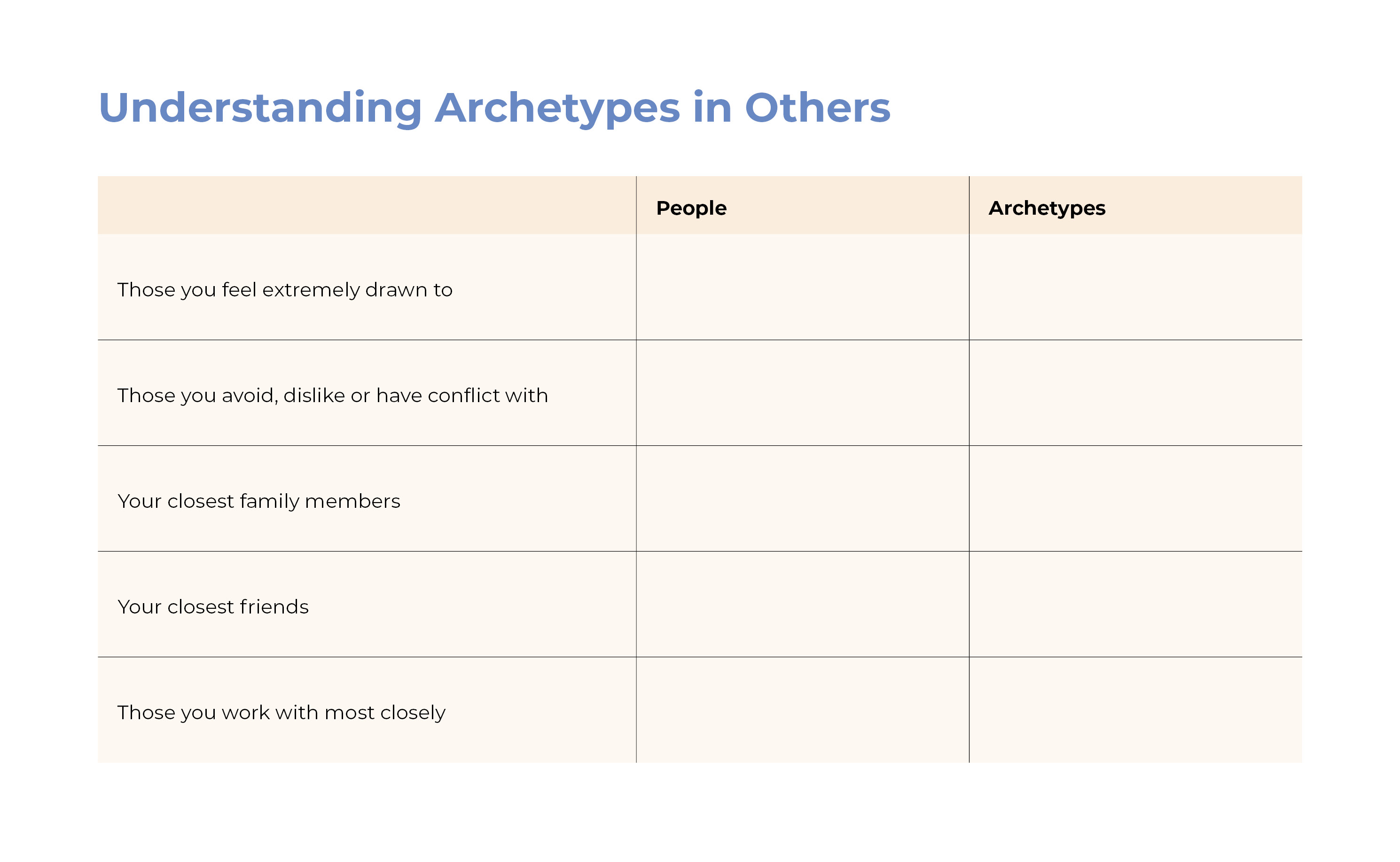
Recognizing the Shadow Side of Archetypes
People who want to understand themselves at a deeper level may find it interesting to explore the shadow side of archetypal development . The shadow includes the negative side of the archetypes, which can limit perception, and repressed archetypes, which can undermine success by causing us to project disowned characteristics onto others. Following are some pointers on how to avoid pitfalls expressed by the shadow sides of archetypes:
- When an archetype is active in your life, it determines the story that you tend to live. In experiencing that narrative pattern, you gain that archetype’s gifts or virtues, and in addition, you learn to face its temptations. The archetypes descriptions summarize some of the major forms each archetypal story can take. If you identify what version of the story you are living – and notice its likely ending – you may be able to predict and avoid negative aspects of that archetype and its story. For example, if you are living a Ruler story, you might have a tendency to be controlling (which can be normal for that archetype). If you can see this danger you can use the strength of the Ruler (the ability to create structures and systems that support people’s authentic gifts) to create group harmony and success rather than slip into the Ruler’s default desire to dictate what others should do.
- The archetypes you are living determine what you notice around you and the actions you take. Your low scores are clues to your blind spots- what you might not notice or think to do. If things are not working for you, you may be living out a story that is inappropriate to the situation that you are in. Finding the story that fits the situation may help you break loose and be successful.
- Negative expressions of an archetype may be an unskilled attempt to express its more positive side. When you see signs of an archetype’s undeveloped and unproductive sides in your own or another’s behaviors you can hold in your mind and heart what the positive version of the story looks like and thereby reinforce it.
- Your undeveloped archetypes especially if they are actively disowned can be projected onto others who you then see as problems, as scapegoats, as rescuing saviors, or even as evil. When you realize you may be projecting, it is best to focus on seeing the good potential within the archetype and then integrate those gifts into your attitudes and behaviors Sometimes it is helpful to notice the part of you that has some of the negative impulses that you find yourself judging so harshly in others.
- Sometimes archetypes can become so habitual in their expressions that you may succumb to a trancelike state. Under such circumstances, regardless of what happens, you will respond from that archetype’s perspective, whether or not it is appropriate or useful to do so. In this case, the archetype is no longer empowering you, instead it has essentially died as an archetype and stayed on as a stereotype, which limits your options. If you notice a story that feels more like an old unfulfilling habit rather than something that gives your life meaning and juice, it is best to try to avoid the behaviors associated with that archetype.
- When archetypes are highly active (high scores) or repressed (low scores) they can pull you into negative patterns, behaviors and ways of thinking. Understanding the common traps or pitfalls or archetypes can keep you from failing prey to their temptations.

Guidelines for Working with Archetypes
As you explore how archetypes influence your life, keep the following key points in mind.
- Each archetype and each individual has special gifts and challenges. There are no better or worse archetypes
- What Story Are You Living? scores are meant as an aid to self-discovery and personal reflection. The determination of which archetypes are active is a personal one. You should not let anyone tell you what archetypes are active in your life, and you should not determine archetypes for others. You can, however, have a hypothesis that improves how you relate with another individual, and you can test that theory in the laboratory of life (i.e. does a particular archetypal theory help you relate better to a person?).
- The purposes for working with archetypes include the following
- – Increasing self-awareness
- – Finding greater fulfillment and meaning in house
- – Improving personal, family, community and workplace relationships
- – Expanding abilities, perspectives, and optionis
- – Escaping habitual archetypal patterns that have become limiting rather than empowering paths
- – Learning to be actively engaged iin charting your life journey
Most people have one of more archetypes that remain stable over time and provide a sense of core meaning and identity. Other archetypes often change and shift over time as you face new life stages and challenges.
The journey is a spiral one, and therefore you may experience archetypes in an order that is unique to your own journey. In addition, each time the archetype becomes active, you may experience it at a higher and more profound level.
The emergence of archetypes in your life is generally an unconscious process. The What Story Are You Living? questionnaire helps you make that process conscious. Once you are aware of the archetypes that are active in your life, focused intent can help an archetype awaken and can influence the level of the archetype’s expression.
Think of archetypes as seeds within the unconscious. These seeds receive the ‘sunlight’ necessary for growth when you seek out people (family members, people in your ethnic group, co-workers, friends) who reinforce the archetypes you want to develop. This nurturing along with your own conscious decisions encourages the archetypes to ‘sprout’.
You can also look at archetypes as sources of energy that exist in the unconscious that help you find the motivation to maximize your gifts and abilities, and to become more developed and mature. This energy can assist you in having a greater quality of life (i.e. being happier and more successful as you fulfill your potential).
If you gained the gifts of an archetype in the past, you can retain the gifts even though the narrative pattern may no longer be dominant. Archetypes are natural to the human psyche, so they stand in waiting, available when they are needed. Pay attention as you read through the descriptors to archetypes that may have been active in your life in the past, even if their current scores are not as high .It is likely that you still have access to the gifts of these archetypes, even though they no longer give you energy or determine the flow of your life.
Steps for Validating and Understanding your Results
The Heroine’s Journey Questionnaire can help you reflect on the archetypal stories most prominent in your current life. By giving you a sense of which archetypes are dominant in your life and which ones are in the background, The Heroine’s Journey Questionnaire assists you in understanding the mix of stories that informs your life narrative.
As explained earlier, active and dominant archetypes may change from time to time depending upon your circumstances. As archetypes are not static, you may wish to retake the questionnaire as you progress on your journey, when you are stressed, or when you undergo major life changes, such as marriage, job change, or geographic relocation. To learn about the archetypes currently active in your life, as well as those that may have been active in the past, you will need to refer to the archetype descriptions. Once you have acquainted yourself with the archetype descriptions, use the following step-by-step process to help you identify the archetypes active in your life, determine archetypes active previously in your life, and intepret your results from the Heroine’s Journey Questionnaire.
Step One: Record how the archetypes function in your life
Refer to the Archetype Score-Ranges worksheet where you wrote the names of your highest, lowest and midrange archetypes. Read the meaning of their functions in your life. Then, using the scores for the archetypes, follow these steps to help validate your results:
- In the 24 to 30 range, circle the one or two archetypes that seem to be the most characteristic of you. (if you have no scores in this category, move down to your top three scores in the next range – more if you have a tie – and circle the one or two that seem most like you).
- In the 18 to 23 range, put a star by any archetype that seems enticing to you and that you might want to have more in your life. Put a check mark by any that may have been more active earlier in your life than they are now
- In the 6 to 18 range, put an X by any archetype that (1) reminds you of some person you find difficult or bewildering or (2) that reminds you of a situation that has been difficult for you to manage or resolve. Put a star by archetypes that you wish you had more of in your life.
Step Two: Validate your scores
The Heroine’s Journey Questionnaire is not a substitute for your own judgment. Rather, it is a mirror to help you have a conversation with yourself and others about the stories that influence your life and that create or inhibit the satisfaction you get from life. If, after reading the relevant descriptions any of your scores feel inaccurate, there are several steps you can take to check them against your experience. Remember you get the final say about what is true for you.
- Put marks by archetype scores you wish to reconsider and make brief notes why
- Check your responses to the questions on the Heroine’s Journey Questionnaire for that archetype. Go back to your Heroine’s Journey Questionnaire and read the questions and your responses to any archetype on which you scored differently than you expected. Try to determine if you may have read a question somewhat differently than others might. Then look back at the archetypal description to see if the archetype is dominant in your life but with a somewhat different style or expression than the questions reflect. Plese not the the Rule Breaker scale does not measre the outlaw or revolutionary aspects of the Rule Breaker archetype. The Rule Breaker questions on the Heroine’s journey Questionnaire focus more narrowly on the experiences of loss and letting go. You may score low on this archetype if you express it as the outlaw or revolutionary.
- Notice whether you have a mixture of high and low scores for the archetype in question. You may be expressing the archetype in a particular style or modality but not in others. If you think the archetype is more active than the questionnaire would suggest, then notice the items on which you scored low. These may describe aspects of the archetype that are not currently expressed in your life, even though the archetype, over all, is strong for you.
- Determine if the level of the archetype in your life is higher than that tested by the Heroine’s Journey Questionnaire. The questions are most often framed at the midrange level for an archetype, tapping a mix of positive and negative aspects Sometimes a person in whom an archetype is expressed at its highest level may score low in that category. For example, if you are a wonderfully generous, compassionate, and giving person and you also have ease in setting boundaries, saying ‘no’ and taking are of yourself as well, you may be an exemplary Caregiver. However since most midrange Caregivers are less good at caring for themselves than for others – and the questions on the Heroine’s Journey Questionnaire reflect this imbalance – your Caregiver score may not reflect the full strength of that archetype in your life.
- Be alert to other influences. Look back at the items for the archetype or archetypes that you question and determine if your answers genuinely reflect what you really think and feel, or if they reflect what others (partner, parents, teacher, employer) think you should be.

Step Three
Understand your high scores
- Determine the four archetypes that are highest for you. Write the names of these archetypes in the spaces provided, starting with the archetype with the highest score and working down.
Highest archetype
Second highest archetype
Third highest archetype
Fourth highest archetype
These are the archetypal characters likely to be most influential in your life right now. Your leadership approaches are likely to reflect the stories of these archetypes,with their corresponding needs, aspirations, and pitfalls.
The archetypes you are living are helping you to develop their gifts. If an archetype has been active in your life for a long time, it is possible that you already have these qualities.
2. Review the descriptions for the strengths and pitfalls of your highest archetypes. Refer to thedescription of your highest archetype, specifically noting the characteristics. In what way is that energy expressed in your life right now? It surprises people sometimes to find that they exhibit both the positive and negative qualities of an archetype. Your Heroine’s Journey Questionnaire results will not tell you whether you have the strenghts as well as the pitfalls of the archetype. The scores tell you how strongly the archetype affects your life, not whether it does so in a positive or negative way or at what level it is expressed. List the strenghts and pitfalls of your highest archetypes that are most applicable in your current life.
Remember that negative archetypal qualities can be redirected into more positive expressions. You do this by paying attention to what you are thinking and doing and consciously choosing not to act out the negative possibility, experimenting instead with more positive expressions of that energy.
Make notes here about shifts from negative expressions to positive ones that you would like to make:
3. Assess whether the expression of the archetype feels empowering or limiting. Most of the time the archetypes active in your life feel empowering because they give you energy and encourage skills and activities that are right for you at this time. Such archetypal expressions offer resources that can help you develop new skills and excel in ways you never thought possible. However there a few ways that your archetypes can trip you up:
- Your archetypal gifts may make you think that you are better than others. This is called inflation. A clue to inflation is to observe if you feel empty, depleted, or even deflated when that particular archetype expression is over. For example, a person giving a well received talk may feel extremely wise (Sage archetype) like a guru or oracle. However later in his hotel room, he may suddenly feel vulnerable and needy. An archetype can also take you over, so you either live out its story compulsively (for example a person expressing Caregiver who can never say ńo’ or someone expressing Rule Maker who cannot be comfortable when not in control. This is called archetypal possession or archetypal trance.
- Archetypes also can become sterotypes. If you cling to a particular archetypal expression so much that you and others expect that expression, you may become too rigid in that role. Inside you, new archetypes are ready to emerge, but the combination of habit and pressure from other’s expectations can lock you into an old way of being. You can tell that this has happened if you are doing things that once made you happy, but you observe that you are becoming bored and unhappy. The answer is to allow the expression of emerging archetypes to help rekindle your joy in life.
Make notes of ways your active archetypes are empowering or limiting in the roles you play.
Empowering………………
Limiting…………………….
4. Understand the energies of your highest archetypes and whether they are expressed in integrated or conflicted ways.
Integrated combinations If you scored equally (or almost equally) high on two or more archetypes, they may inform your life story in a way that is combined and integrated. Take a moment to make notes about ways your highest archetypes work well together.
Conflicted combinations. Sometimes when a person scores highest on two or more archetypes, the archetypal characters may be in conflict in his or her story. Describe a situation in your life where you say you want to do something but do not do it.
How might you experiment with living out this story at least in small ways?
Think of the parts of you that want to succeed in accomplishing your goal and those that resist. Give them archetypal names. What archetypes are involved and what role does each play in your life?
If any of these roles are in conflict, how might they be reconciled?
Step Four Find Your Dominant Life Story
We are going to look at the setting, tone, characters and plot structure that are present in the events in your life. First, we will look at the archetypal life myth or story that was present in your growing up years. Often this original life story informs your current life, just with more complexity or in a more mature fashion.
Then we will explore the archetypal story that informs your current life using a process similar to the one we just used in exploring your childhood myth. You will be able to see how the two are related in forming your overall life story.
Your Personal Childhood Myth
Setting: Describe the major life setting in which you spent the majority of your childhood time (for many it is likely to be your home, your school or the home of a relative or friend). Consider this the setting of your story. Write the name of that setting here:
Characters: The earliest ideas of the characters in your life story come from the people around you, usually family. List the important people with whom you lived in your early growing up years, such as parents, step parents, brothers, sisters and step siblings. If there was someone else who lived with you or with whom you lived, include them as well (e.g. grandparents with whom you spent summers or an uncle who lived with your family). Be sure to include yourself. Write next to their names which of the twelve archetypes each character seems most influenced by, and the gift that archetype brings. Next, write any of the archetypal pitfalls those characters seem to express.
Tone: In one to three words how would you describe the emotional state, the atmosphere or tone of your childhood family (for example empowering, tense, distant or easy going) Write the tone here:
Plot: To understand the overall plot of your childhood story, it is easiest to combine the plots of several childhood events or stories. In the space provided werite separate brief vignettes describing three memorable stories about yourself from childhood.
The first story should be your earliest memory. Don’t labor over which episode is earliest, just choose one that comes to mind.
The second story should be the family story about your birth, or, if you do not know the story of your birth, choose a family story about your infancy or early childhood
The third story should be your favorite childhood story from a fairy tale, a children’s book, a movie, or a TV program.
The vignettes should be specific, containing a sequence of events, actions or conservations that involved people important to you in the setting you have chosen. If you do not like to write, just make an outline or enough notes for you to decode the plot or the story you are telling
- Vignette of your earliest memory.:
What feelings if any are contained in the story or evoked by the story?
2. Vignette of your birth or infancy story:
What feelings, if any, are contained in the story or evoked by the story?
3. Vignette of your favorite childhood story:
What feelings, if any, are contained, in the story or evoked by the story?
Plot Summaries: A plot is a sequence of events often marked by a series of actions-one character says or does something, another responds, and so on. The plot usually builds to a climax and then moves to a turning point (called a denouement) which ends the suspense. For many people, the same plots recur, and shorter or smaller events may have similar patterns to the main story. In the following chart, summarize the childhood vignettes you wrote about. then write a headline for the story in the same manner that an editor would write a headline for a newspaper story.
Story One
Earliest Memory:
Title (headline):
Archetype: (Which archetype’s plot is the story most like?)
Story Two
Earliest Memory:
Title (headline):
Archetype: (Which archetype’s plot is the story most like?)
Story Three
Earliest Memory:
Title (headline):
Archetype: (Which archetype’s plot is the story most like?)
Review the titles and summaries of the three childhood stories. What is the major combined theme of the vignettes? Theme:
Your Current Personal Story
Setting: While the childhood setting was a family, your predominant current setting may be work, school, home or friendship. Describe the major life setting in which you spend the majority of your time. Consider this the setting of your story. Write the name of that setting here:
Tone: In one to three words how would you describe the emotional climate, the atmosphere or tone of that setting (for example, empowering, tense, distant, or easy going?) Write the tone here.
Characters: List the important people in this setting. Be sure to include yourself (again, you may have only one or two people/characters in your plot, or you may have many). Try to keep the list to the important people who have the most influence on your story. On the line beside each, write which of the twelve archetypes each character seems most influenced by and the gift that archetypes brings. Next, write any of the archetypal pitfalls those characters seem to express.
Plot: To understand the overall plot of your current life story, it is easiest to combine the plots of several events or stories just as we did for your childhood myth. This time we will use only two stories. In the space provided, write separate brief vignettes describing two memorable stories about yourself in the setting that you selected. The first should be about a satisfying time, a time when you felt you were at your best. The second should be about a troubling time when you did not feel at your best. Don’t labor over which events to record; just choose two that come to mind.
Vignette of a satisfying, fulfulling or effective time
Vignette of a troubling time
Plot summaries: As noted previously a plot is a sequence of events often marked by a series of actions – one character says or does something another responds, and so on. The plot usually builds to a climax and then moves to a turning point, which ends the suspense. For many people, the same plots recur and shorter or smaller events may have similar patterns for the same story. Summarize briefly in the following chart the vignettes you wrote about occurring in your dominant setting. And then write a headline for the story in the same manner that an editor would write a headline for a newspaper story.
Story One
Fulfilling time…
Title (headline)
Archetype (Which archetype’s plot is the story most like?)
Story Two
Fulfilling time…
Title (headline)
Archetype (Which archetype’s plot is the story most like?)
Story Three
Fulfilling time…
Title (headline)
Archetype (Which archetype’s plot is the story most like?)
Review the headlines, archetypes and summaries of the two current myth vignettes. What is the major combined theme of the vignettes? Theme
How does this compare with the theme of your childhood myths? How might the plots and themes combine?
Review your titles, plots and feelings for the combined theme. Then, in the following space, write the major combined plot.
Do most of these scenario’s clutter around one archetypal narrative? If so, briefly summarize that archetypal story. If there are several different archetypal stories, what are they?
If you have identified one primary archetypal story this may be your life muth, in which case you may find that your life is enhanced by committing more fully to that story and its possibilities. If you have identified several, live each consciously until it becomes obvious which seems most authentic and fulfilling to you.
Alternative endings. There are many versions of each story and so the endings of similar plots may vary. Consider what you might change in your childhood myth and/or in your current story to be more successful and fulfilled. Use the following space to retell the stories the way you wish they would happen – in the present tense, as if that is how it is.
Story One
Story Two
Step Five Understand your low scores
You may be primarily interested in understanding your high scores and learning from the dominant archetypes affect your life. However, you may choose to examine areas of your life that are affected by archetypes that are not available to you. Sometimes having access to different stories may help you overcome difficulties, adress conflict, and / or move forward in your life. The following analyses can help you understand the archetypes for which you scored low.
- list the archetypes on which you scored lowest and then read about them
There are several ways to understand low scores, and it is important to think through which may be most applicable. The low scores on your graph may represent characteristic ways of organizing the world that do not currently apply to you, or ones which you have not yet encountered in yourself. It is possible you may have difficulty working with people who are living your low scoring archetypal stories. You may also have difficulty in situations that require the gifts and perspectives of these lower scoring archetypes.
2. Establish if any of your own scores are dormant, shadow or allergy. There may be many reasons why you scored low on certain archetypes. Following are three explanations for why your scores might be low and hints about how to determine which one applies to your situation. You will want to know if the archetypes on which you scored low have never been needed, are disowned parts of the self, or are parts that have previously taken you over (in general that determination is made by the amount of emotional energy invested)
- Your low-scored archetypes may indicate that you have not needed these particular archetypes because you have not yet faced their challenges. You can think of these unencountered archetypes as dormant. An enencountered or dormant archetype generates little energy. You may find the descriptions somewhat foreign, and your reaction is likely to be unemotional and disinterested.
- The low-scored archetypes may reflect those characteristics that you actively disown in yourself. If this is the case, these archetypes may represent your alter ego or shadow self, of which others may be more aware than you are. Reclaiming these disowned parts of yourself may provide you with more choices for responding to situations and may make it less likely that you will be unaware of your own actions or feelings. This reclamation is a step toward further personal growth.
- If the archetype is a shadow aspect, you are likely to be more energetic, even ademant that this not an influence in your life. You may think of people influential in your life who do exhibit aspects of this archetype, and you are likely to have a negative reaction to it. Because it is disowned, the archetype is more likely to be expressed in its less differentiated and more problematic aspects. If you have friends who can be forthright with you, ask them, ‘In what ways do I show the positive and negative aspects of the archetype?
- The archetypes on which you scored low may represent qualities that you have overused in the past and need to stay away form. We call this an ‘allergy’. Overexposure to an archetype may make its expression toxic.
- It may be quite obvious to you if an archetype is an allergy. You will know it well but feel an aversion that is something like, ‘Oh, not again’. You also may feel annoyed at people you know who overexpress that archetype. And you may realize that your source of annoyance is your own frustration at over-expression of the very same archetype.
In the following paces make some note about how you might express the low scoring archetypes in your life:
Dormant Archetype(s):
Shadow Archetype(s)
Allergy Archetype(s)
3. Assess situations or relationships that are difficult for you in light of low scores. Recognizing your low scores is important when you are in a situation that seems as if it is defeating you. Often, if you do not know what to do to make it better, you either ignore it or obsess about it. You may encounter such situations because you do not have access to the gifts of the archetype that could help you know how to handle this difficulty.
List two situations that are currently troubling to you:
Review The Archetypal Gifts and use the chart to record the gifts of your low archetypes. Note the ways you may be able to use those gifts.
You can increase an archetype’s availability to you by using the following techniques:
- Recognize its value and decide that the archetype would be a good one for you to express
- Read books, watch movies, listen to music, and view art that reflect the archetype
- Be around people who express the archetype in its positive forms
- Consciously act, dress, speak and think as the archetype does
- Consider when in your life you decided that particular story would not be appropriate for you. Be open to making a new decision about that archetype. (Ask yourself who dissuaded you from living that story or expressing the attributes of that archetype. Also review who in your life might have lived that story so badly that you decided not to be like them)
4. Recognize any tendency to project your shadow archetype(s) onto others. Your low scores can cause you to be more intolerant of others, especially those who express the common pitfalls of the archetypes you most want to avoid. You may find it helpful to actually write the names of people you find particularly annoying or troubling. You can also include people you do not personally know, such as celebrities, politicians, newsmakers and even characters from books, movies or TV shows. Note what is so annoyinig about them and check these against the common pitfalls for that archetype. What archetypes do they represent? Is there a relationship to your low scores?
What is the cost to you of not relating well to people with these qualities?
You may find that you are more understanding of difficult people when you recognize which archetypes are being expressed (although it may be the negative aspects) and you may begin to notice occasions on which those archetypes are espressed positively.
5. Examine your life stages and situations. There are particular life stages and situations that are difficult if certain archetypes are not yet available for you. For example, it is difficult to be a new parent without some access to an inner Caregiver or to be a soldier going to war without some access to the inner Warrior. On the following chart circle any archetype on which you scored low, but that you need because of the life stage or situation in which your currently find yourself.
Step Six Expand your options
People are often liited in their outlook because they think, feel and act in habitual patterns that arise from the archetypes. In order to practice moving beyond the selective focus of your dominant archetypes, pick one issue in your life that feels challenging to you: something that you do not know how to handle or that you feel that you are not handling well or that is not going well. You may expand your options in either an extraverted or an introverted manner depending upon which seems to fit best for you.
- Describe the problem in one of the two following ways:
- Extraverted Option: Explain the problem to another person, then summarize the essence here.
- Introverted Option: Describe the problem in the space provided here
Summarize the essence of the problem:
Continue with the following steps regardless of which option you chose:
2. Describe briefly how you have grappled with the problem or how you might ordinarily react
3. Identify the archetypes reflected in your response:
Archetype:
Archetype:
Archetype:
If you chose the extraverted option, role-play with one other person who plays in turn the part of each of the three archetypes you listed. If you chose the introverted option, write a dialogue with the archetypes you have listed
4. Summarize the advice that can be garnered from how these archetypes act ini the situation you set up. You can do this through additional role-play or written dialogue. Remember that you and others have all the archetypes within you, so you can access their wisdom. However it is easer to do so if you lighten up and do this in the spirit of play.
5. Given these new perspectives, what might you do differently?
You may wish to repeat this exercise on additional paper, using a different issue or challenge. You can also use this exercise to examine past issues in order to think through what might have been, to explore present issues to expand your horizons, or to consider your actions for future issues.
STEP SEVEN Sum up your The Heroine’s Journey Questionnaire results and self – analysis
It is useful after undertaking the detailed analysis included in this seminar to sum up your results. Doing so helps you retain what you have learned about yourself as well as what you have decided to do with that knowledge.
Summary Chart of The Heroine’s Journey Questionnaire results
Insights………………
Desired changes……………………….
LIVING THE HEROINE’S JOURNEY WITH CONSCIOUSNESS
Archetypal stories of heroes and heroines in all cultures help us understand the ideal for how we live. These archetypal stories provide the call to live life to a new level. The results from your The Heroine’s Journey Questionnaire make it possible for you to understand and explore how archetypal stories influence your life. In addition to the analyses you have undertaken thus far, you can use what you have learned about yourself to see where you are on the three major stages of the Heroine’s Journey. The Heroine’s Journey is one way to understand the individuation process – that is the journey to finding your uniqueness and learning to express your highest potential in positive ways in your life, family, community and work. The pattern of living these stories is unique to each individual. The journey described here is in a linear form because it is easier to understand but your personal journey is more likely to be experienced in a spiral way, which will be discussed further at the end of this seminar. The spiral concept is important because we constantly circle back to relive archetypal patterns and each time our experience of the possibilities within any given story deepens.
Each of the twelve stories described in this seminar can be seen as a part of the larger narrative of the heroine’s journey and leading to a heroic gift. All the stories require courage, even though for example the courage of the Warrior (to fight to achieve goals) and the courage of the Lover (to let down barriers to be completely seen and known) differ profoundly. Recognizing which archetypes are active in your life right now is a way of discovering what heroic challenge or challenges you may be facing. Putting your life within this context ennobles what may seem like everyday problems and triumphs and connects your trials, tribulations and exultations to the great heroes of all times. This process can help you to become a more mature, fully realized human being.
The heroine’s journey is the overarching story that prepares us to take our place in the world. This may involve exercising individual responsibility and/or participating in shared responsibilities.
While stories of heroes and heroines in myths, legends and fairy tales ordinarily seem removed from our everyday lives, we can see some of their patterns as we examine our own archetypal stories. Noticing the stages of the heroine’s journey can help us claim the nobility of our own lives, even during life’s most difficult passages.
Each of the archetypes presides over a stage in the heroic journey. Within the larger pattern of the twelve stages of the heroine’s journey, there are three intermediate journeys each of which is aided by four of the archetypal narratives described in this seminar.
The Preparation of the Journey: Dreamer, Realist, Caregiver and Warrior (associated with the ego-level of development)
The Transformational Journey : Explorer, Rule Breaker, Lover, Creator (associated with the soul level of development)
The Return from the Journey: Rule Maker, Magician, Jester (associated with the self level of development)
Each of the stages gives you gifts, and each has its traps – traps that are more difficult to avoid if you are not able to anticipate and recognize them.
THE THREE STAGES OF THE HEROINE’S JOURNEY
The Preparation for the Journey
We prepare for the journey by awakening the four archetypes that provide us with an inner family (Dreamer, Realist, Warrior, Caregiver), thus freeing us from issues determined by our family of origin. The stories associated with the preparation are related to this inner family: the Dreamer and the Realist are two sides of the inner child (spontaneous and wounded) and the Caregiver and the Warrior are two sides of the inner parent (nurturing and protecting).
Living these stories helps uw with good ego development. The open, receptive nature of the Dreamer helps us learn and socialize. The hard knocks experienced by the Ruler help us to be appropiately cautious, realistic, and aware of our own vulnerabilities and those of others Together these stories teach us to be discerning and resilient. Similarly, the compassionate Caregiver helps us to share with others and be nurturing and gentle with them, while the Warrior helps us to be disciplined and tough enough to set and achieve goals and create and protect boundaries. Together these archetypes help us balance getting what we want with showing kindness and consideration to others.
If your highest scores are in the preparation stage. It means you are working on issues related to dealing with the vulnerabilities of being human and also learning to grapple with those difficulties in a way that is socially acceptable in the society in which you live.
You can see the pattern of development of these four archetypes in fairy tales, albeit communicated in metaphorical terms. In the beginning, the heroine has the virtues of the Dreamer because she has the opotimism to begin the journey. Along the way, she has to distinguish between tempters and guides, thus requiring him to balance the Dreamer with the skepticism of the Realist. At some point she meets a dragon or other monster that she must slay (Warrior) proving she has strength and courage, and someone in need she must help (Caregiver). In many stories, the heroine meets an old man or woman who has nothing. The heroine has also little but she shares gladly what she has, demonstrating that she is not just out for herself. She cares about other human beings, showing she has a wise and noble enough heart to take the journey.
When we experience these four archetypes we may demonstrate the qualities that are often identified with the negative aspects of the ego. From a psychological perspective, the ego’s positive function is to keep us safe, differentiate us from others, and give us a sense of individual worth. When we overdo this we may become fearful and lonely and in order to protect our sense of worth (ego) we may make excuses or blame others when we make mistakes.
Then all the life becomes a way to keep the vulnerable inner child safe as the world is imagined as a treacherous place. The Dreamer desperately seeks to please, the Realist uses the victim role to manipulate others., the Warrio preemptively attacks,and the Caregiver obsessively resuces others.
The antidotes to this dilemma which can happen naturally as we experience more and more of life, are to learn how the world works (so you know when you are safe and when not) to gain the emotional intelligence to recognize when you should trust and when you should not and to develop your Warrior strength and your Caregiver ability to care for yourself and others, so that you develop inner parents to provide nurture and coach your inner child. In addition, you are much less likely to experience the ego archetypes if you have taken your soul journey, so that you find an identity deeper than the ego.
The Transformation Journey
Following the preparation, we begin to experience the journey. The four archetypes that help with the journey (Explorer, Lover, Rule Breaker, Creator) preside over a transformation process. The journey can begin with the Explorer’s curiosity about the self and the world or a pervasive sense of boredom, emptiness and dissatisfaction. It also can begin with the experience of loss, when people and things are taken from us or when our ego-defenses are undermined or when we are brought face to face with ways in which we have failed to live up to our ideals (Rule Breaker). Either way, we step out to explore and in the process let go of what is no longer relevant in our lives. In the first instance, we are motivated by hopes for the furture and discover we cannot have a new life without sacrificing some of the old, whereas, in the second, we are moved to seek because much has been taken from us. Either way the initiation of the journey usually entails some suffering or loss.
Although we are ultimately questing for self-knowledge, the conscious motivation of the journey is often to find ourselves and feel at home (or to relcaim that feeling if we have been forced out of what seemed to be a safe haven or personal Eden). In this process, we find who we are through the various expressions of the archetypes active in this stage. We do this in part by what we let go of and in part by what we find that we love (Lover) – people, places – activities – and by what we create in our lives and work (Creator). When we create from the level of the soul – which we do when we are living our purpose – instead of just from the ego – our lives begin to fit and satisfy us.
In mythic stories of the heroine’s journey the heroine embarks on a great adventure (Explorer) experiences difficulty and suffering (Rule Breaker) as well as love of life, of individuals, of causes or places (Lover), which can mitigate the aspects of the Rule Breaker. Ultimately the heroine demonstrates resourcefulness and imagination in finding the way and solutions to obstacles (Creator) and evnetually a treasure emerges (one’s own gifts and nature).
In the dark version of the story, people will wander aimlessly, never finding themselves, develop self-destructive habits or do things that harm others, create endless drama’s in their lives that divert them from their real creativity, and give in to self-indulgent pleasures, rather than committing to real love. The antidote, in all these situations, is to confront one’s own soul and live out one’s own destiny however difficult doing so might be.
The Return from the Journey
The challenge of the return is to share your talents and gifts with the world, once you have found them. Classically: at the close of the heroine’s journey, the heroine comes back to the kingdom and becomes the queen. Thus, the archetypal stories associated with this challenge are those associated with the royal court and the archetypes of the Rule Maker, the Magician, the Sage and the Jester. We find stories about the return generally in legends or histories about extraordinary leaders who,took the risk to serve out of a commitment to the greater good. In our own lives, we can feel royal when we are both true to ourselves and committed to sharing our gifts with the world.
When you know you are are at a deeper soul level, your Rule Maker instills the responsibities to live out your purpose for the greater good of the world, your Magician helps you shift consciounsess to transform or heal, your sage is curious to know the real truth, to share wisdom respectfully with receptive and open minds, and your Jester celebrates the joy of existence in a way that is contagious and helps others enjoy themselves.
If your highest scroe is in the return category, it is likely that you are concerned with issues of how to share your genuine gifts with the world If you run into problems it may be just that this stage is new to you, or that you did not first complete the work of the transformational journey. If you jump to the return without having taken the journey, these archetypes are inevitably expressed in limited or negative forms. The Rule Maker can be self-serving and controlling, the Magician manipulative the Sage opinionated and the Jester irresponsible.
Also, if you enter this stage focused only on your own good, you may become stuk in the dark version of the story. Here, the Rule Maker motivates a compulsive drive for power. The Magician puts a spin on truth to distort public perception. The Sage tries to be smarter than everyone else in order to be more successful than they are. And the Jester escapes all this in pursuing mindless pleasures or conspicious consumption. Understanding the archetypal nature of the heroine’s journey, therefore, is especially critical for various types of leaders or any other group that influences the shape of events and people’s lives.
The antidote for a stuck return story is connecting with a genuine desire to be of service in the world. Each of the four self archetypes brings a gift back to their own world: the Rule Maker brings direction and organization, the Magician brings the importance of perspective, the Sage brings wisdom and the Jester brings the ability to maintain equilibrium. These are the gifts which the Self passes on to the next generation of heroines and heroes.
A Spiral Journey
The three stages of the journey do not ordinarily happen in a neat, linear order. You may find elements of all three in different aspects of your life at the same time, or you may look back over your life and notice a recurring pattern of getting ready, journeying to find yourself, and returning to share what you know and what you have. If you have been at the return stage and find you are again at the preparation or journey stage, it does not necessarily mean you have regressed. It means that you have more work to do on developing an even stronger and healthier ego (preparation) or a deeper, more authentic sense of soul (journey) to go to the next level of claiming your power (self( and freedom (return). Thus we revisit the preparation, journey and return multiple times. With each new journey and return, we learn to express the archetypes in a richer and more mature fasion. This is the spiral nature of encountering the archetypes.
In fact, all three stages might be present in a single event. Let’s say you are making a presentation to a client. At the ego (preparation) level, you are anxious to prove yourself. At the soul (journey) level, you are eager to do the work in a way that is authentic for you and that reflects your gifts. At the self (return) level, you want the outcome of your efforts to serve the greater good of the organization, community, world As you begin to notice which area has the greatest resonance for you, you will begin to realize that is where your consciousness primarily lies. Within each of the three areas, the archetypal stories that score highest for you provide the narrative that most strongly energizes how you face the challenges of each of these three major and larger stages.
Facing the Challenges of Modern Life
Writing about the challenges of modern life, the Harvard psychologist Robert Kegan, in ‘In Over Our Heads’, says that virtually all of us are in over our heads, because we lack the cognitive complexity to thrive in a contemporary context. What is required, he explains, is the capacity to understand and balance the following:
- an attitude of self-awareness and self-reflectiveness that allows you to think about your own thinking and analyze why you think and feel as you do.
- an ability to step out of yourself to see how it is that someone else sees something differently from you or wants something different from what you want.
- the capacity to understand organizations and other social systems and recognize their logic and their needs and
- clear values that allow you to face the conflicts and contradictions inherent in organizational systems and decide what to do in complex and ambiguous situations.
Similarly Daniel Coleman in ‘Emotional Intelligence’ tells us that emotional intelligence is more important to success than IQ (intelligence quotient!). Successful people have a capacity for personal mastery that comes from taking the time to learn to feel their feelings without having to act them out. They also foster the ability to understand others, seeking to communicate non-judgmentally and find common ground.
Understanding the stories you and others are living is a way of enhancing your cognetive complexity and emotional intelligence so that you can thrive in today’s complex times. I will show you to move from a clear articulation of ‘my story’ and ‘your story’ to find ‘our story’ and thus an outcome that works for both. In a company setting you may notice what story people are collectively living and recognize if it works for everyone, exploring the possibility of finding a new ‘our story’ that brings a greater sense of aliveness and vitality to all involved. Because many people are trapped in stories that no longer fit, the ultimate purpose of the Heroine’s Journey questionnaire is to encourage you to live the stories that will hellp you realize your real potential as a human being.
Analyzing Your Heroic Journey
Review your scores for the stages of the preparation, the journey, and the return and explore the ways the three patterns (which include the interaction of each of the four archetypes) are expressed in your life. A low score in one of the four in each stage may mean a missing chapter in your inner script for living out this heroic theme. For example, if most of your high scores are in the preparation stage, but your Warrior score is low, you may spend most of your time pleasing others. The antidote would be to work on calling up your Warrior so you can become more assertive to protect your boundaries and meet your own goals. Complete the following information to help you analyze the stages of your journey:
Not your positive expressions of the four – archetype combination for each stage
Note your negative expressions of the four archetype combination for each stage
Note if you need to develop a missing or underdeveloped archetype to fulfill the potential of one of the four combined archetype stories
Make notes about any patterns you might like to enhance or change
You may find it hellpful to combine this analysis with the analysis completed in the prior step as a background to writing your life story from an archetypal perspective. You do this by writing a short autobiography that references the universal stories that are active in various life situations and stages as well as noting the overall narrative of your life. You can also draw on the examples of myths and folk tales used in this seminar wrting your own story as if it is a myth, a fairy tale, beginning with phrases like “Long ago and far away, there was a ” or “Once upon a time” Alternative creative ways to express the universal stories you are and have been living are to paint, dance, sing, or act them out (in a one-person show or with others who play the other key characters in your life) If you observe that continuing your current life pattern might lead to outcomes you do not desire, you can also experiment with rewriting your story or otherwise expressing alternative versons of the same archetypal stories (what your story would look like if one or more additional archetypes were introduced or expressed at a higher level? Use the space here to begin making notes for your autobiography.
FREQUENTLY ASKED QUESTIONS
Q: What is the most desirable profile? The most desirable profile is one that reflects the mystery and uniqueness of your psyche. Having said that for most people an ideal profile has a few archetypes that are high enough to give form to your journey and some basis for decision making. (If all the archetypes were equally active, it would be difficult to make a decision, as your archetypes would all have different points of view). It is also desirable to have some access to as many archetypes as possible, or at least to appreciate people who express their perspectives. (The younger you are, however the fewer archetypes you may have had time to develop).
Q: Is a certain profile expected at different times of life? No, it is fine to express the archetypes in your own way and in your own order. However, certain archetypes are helpful in responding to the predictable challenges of different stages of life so they may emerge at these times if they have not done so before.
Q: My results seem to me to be quite flat. What does that mean? It may mean that you are a conservative test taker and you avoided using the 1s and 5s. It may also mean that you are in transition and many archetypes in your psyche are activated, but canceling each other out. Or finally, it may mean that you responded to the instrument using too long a time period so that you scored high on archetypes both formerly and currently dominant in your life.
Q: How do I tell if my low scores are a problem? They are not likely to be a problem unless you are experiencing the following:
- Difficulty in at least one relationship
- A hard time coping with a situation
- A lack of energy or enthusiasm for life
In any of these cases, it may be important to develop one of more dormant or disowned archetypes.
Q: What if I think the results are accurate but I’d rather express different archetypes? Can I change archetypes? It is best to trust the logic of your journey. However your desire to live a different archetypal journey can also be a call to a new episode. In order to move on consciously work to get the lesson and the gifts of the archetypes that are active now. In the meantime, expose yourself to movies, plays novels, music, and role models that relate to the archetype you wish to express in a desirable way. Notice the times and places where you express that archetype and experiment with acting the part until it comes naturally to you.
Q: What If I have scores of 24 or over? This likely results from your being a conservative test taker avoiding 1 and 5 responses. If you have no archetypes in the 24-30, your three to four highest scores are your most active archetypes
Q: How can understanding archetypes help me at work? You can use the knowledge of what motivates you to find career direction or fine-tune roles. Recognizing the archetypes active in others aids you in understanding and communicating with them. As you learn to awaken archetypes, you can also acces qualities and attitudes necessary for career advancement and developing or enhancing your leadership abilities.
Q: Can the Hero’s Journey Questionnaire help me relate better with family and friends? Yes, in several ways. When you know which archetypes are most active in your life. It will be easier to recognize the expression of archetypes in those people significant to you. This information sensitizes you to their journeys and reminds you that the way people behave may be an expression of only one part of them (i.e. the energy from one archetype). Understanding archetypes can also help you understand when a friend or family member expresses a particular phase of a journey .For example if you investigate the attributes of the Caregiver you can see the gifts and the challenges and be better able to recognize these in someone you know Understanding another person’s journey can help your relations with others.
Q: Several well-known authors advocate letting go of all ‘stories’ in order to live fully in the moment. Does this mean I should leave behind these archetypal stories? Like many other words, ‘story’ has more than one meaning. Such authors are advocating letting go of the narrative in our heads that remove us from really living or that fill us with fear, worry or judgment of ourselves or others. Their point is to live fully, rather than getting lost in the fictions – good or bad – we make up about our lives. Generally, they are also advocating a high level of Sage ability to quiet the mind and experience inner peace and love. But archetypal stories do not remove us from experience (unless we are living them in a trance form). Rather these archetypal stories help us live more fully and authentically experiencing at a deep level the potential for what it means to be human. If you are living a story in its archetypal dimension, you can be fully in the moment. If and when we live a story in a way that disconnects us from reality, we can use the Hero’s Journey questionnire to ‘name’ the story and put distance between ourselves and the ‘fiction’ with which we are identifying.
The Twelve Archetypes
This part of our journey provides comprehensive descriptions of the twelve archetypes. Each archetypal description found there begins with a story from Paris to help explain the context of the archetype. Each archetype also has descriptions of its imagery, its gifts and ways it is seen. This is followed by ways you might experience the archetype when it is active in you, which is typically reflected by high scores for that archetype.
One day the god Apollo spotted Daphne running through the woods. Immediately he became enchanted and began to race after her. Even though Apollo was a god, he found it hard to catch the fleet Daphne. Apollo implored her to stop, trying to reassure her. ‘You have nothing to fear. I am no rude shepherd; I am the lord of Delphi!”
But Daphne ran all the faster. Still Apollo gained on the frightened Daphne, until she could feel his breath on her neck. Suddenly the trees parted to reveal the bank of her father’s river. ‘Help me, father! Help! she screamed.
As she sceamed, she slowed. Her feet seemed suddenly bound to the earth. Her skin hardened, and leaves began to sprout from her arms and hands. Apollo drew up to find, in place of the beautiful and free Daphne, a small laurel tree.
Apollo decreed in his sorrow and despair that the laurel would forever become his tree; and the prize for victors in athletics or in song would always be a wreath of laurel. The little tree bowed and sawyed in the breeze as if in assent.
THE DREAMER
Daphne loved to run in the woods on her father’s estate. She would spend her days wandering or hunting, her unkempt hair waving in the wind. At times her father, the river god Peneus, despaired because she refused the affections of even the most eligible suitors, choosing to reamin unmarried. ‘Am I to have no grandson?” lamented Peneus. Daphne would throw her arms around her father’s neck and implore him to let her run free like the goddess Diana. Peneus would invariably relent and Daphne would bounce happily back to the woods.
The archetypal character. The archetype which is usually first encountered is th eDreamer, presenting a childlike naivete and trust. The Dreamer exemplifies a basic trust in others, and in the world as a safe place.
The Dreamer is the archetype of the innocent child who depends upon adults for care and safety. When the Dreamer has a setback, she responds by trying harder and by attempting to have more faith and be more worthy. This strategy is based on a deep-seated belief that such efforts will be rewarded in time. The Dreamer is effectively encouraged in children by an environment of love and safety and by protective limits.
Archetypal plot: The Dreamer appears in numerous stories and myths. Think of Amelie. Most often in stories with a Dreamer plot, the Dreamer either takes the role of the trusting sidekick, or the plot concerns the transformation of the Dreamer into other archetypal roles) where the movement is from Dreamer to Realist. In such plots, other characters, Rule Breakers as oppressors, Lovers as tempters, Jesters as con artists – can undermine the Dreamer’s faith.
Other stories that primarily concern the Dreamer:
- By far the most common story of the Dreamer concerns the relationship with a Caregiver (protector) which protects the Dreamer from losing his or her trusting view of life. With the help of a caregiver, the Dreamer can be seen negotiating unanticipated minor conflicts that otherwise be confounding.
- Dreamer becomes a pure, naieve observer for the tragedy and the irony of the world. The reader or viewer is able simultaneously to see events through the eyes of the world and through the contrasting eyes of the Dreamer
- In the tragic form of the story the naivete of the denial of the Dreamer becomes a tragic flaw. If there is a Caregiver in the story, that person is unable to save the Dreamer or others around her from the fatal naivete of the Dreamer.
- Beautiful and sometimes inspiring narratives that show the Dreamer prevailing because of sheer goodness and a commitment to follow the rules and to do things right exemplify another form of the Dreamer’s story. More adult patterns include any number of stories about women protecting their virtue, and both women and men protecting their beliefs by being true to them, whatever the cost.
Imagery: The imagery of the Dreamer archetype can be the beauty of a green meadow, the peacefulness of a small quaint town. In times of difficulty, innocence is associated with hope. Thus in winter, at the darkest time of year, virtually all religions have celebrations that include the lighting of candles signifying the triumph of light over darkness.
Gifts: The Dreamer has incredible optimism and faith that institutions, authorities or gods will provide what she needs. Such faith is very important to the development in children of basic trust in life. There are also adults who just know they will have whatever they need, and often their faith is justified.
Social support: Children need adults to protect them so that they can be dependent and innocent. Even in adulthood, we all need the belief that we will have what we need – jobs, food transportation, health. There is in most every one of us the sense, that our family, government, our employers, and other organizations should take care of us, and that at least most of the people we encounter will be honest and decent. When family, workplace and societal support break down, the Dreamer in any of us tends to wither, leaving bereft of basic optimism and faith in life.
In leadership: Dreamers are good at being true to and maintaining traditions. They can effectively apply traditional rule-based approaches to leadership. Unexpectedly, their optimism also allows them to apply state of the art leadership approaches, especially when those approaches are recommended by a mentor. The Dreamer leader can be good at inspiring people seeing opportunities and staying cheerful and upbeat.
If the Dreamer is active in your life (high score), you have faith that every cloud has a silver lining.
At your best (now or when you fulfill your potential) as an Dreamer, you exemplify what a life of faith and simple goodness brings to the world. You have a basic trust in others and in the world as a safe place, you avoid temptation no matter how strong, and you help the world maintain virtue and fairness. You are now (or potentially) able to model hope, optimism and the awareness that happiness comes from living a simiple, wholesome life. Even when circumstances are difficult, you know how to focus on the positive and not allow the negative to control your sense of yourself or of possibilities for the future. You keep hope alive in the most difficult circumstances either by overcoming problems with positive thinking or by reframing them into opportunities.
You may want to guard against underestimating difficulties or in being overly confident in your own abilities. You may be blindsided by unforeseen problems, taken advantage of by people you know or shaken by being forced to see the dark side of life that you would rather avoid. You can also fall prey to people who promise easy answers that fail to work.
When problems emerge, you are likely to apply traditional and time-honored strategies; downplay the seriousness of difficulties; and/or seek an expert to figure out what to do, all the while keeping the faith that the problem can be solved. You may also do nothing, hoping that rescue will come. Or, if frightened, you may call for help, experiencing real trust that help will arrive.
Others may appreciate the Dreamer’s wholesome and upbeat approach to life. When under the influence of the Dreamer, you may be seen as naive, in need of protection, and not fully capable of puling your own share of the load. This can lead to frustration, or even resentment, on the part of others who have enough problems without having also to take care of you. The Dreamer may be the straight man to other’s jokes, no fully understanding the complexity or irony of the situation. Finally the Dreamer archetype may be taken for granted and not recognized for contributions.
You tend to notice what is good and trustworthy and meritorious in the world and in yourself. You may be oblivious to dangers that threaten, to how hard life is for others around you, to your own limitations, or to unconscious dependency.
You want to be seen as a nice, good and positive person, and you want to avoid doing anything that might seem unkind, bad, or to be a drag on others.
Actions or qualities that you may find beneficial:
- Cultivation of the ability to anticipate difficulties
- Becoming more circumspect before trusting others
- Gaining a realistic appraisal of your own abilities – neither underestimating nor overestimating
- Putting less trust in authorities or in simple easy answers
- Solving as many of your own problems as you can
- Balancing the Dreamer’s virtues with those of the Realist
If one of your lowest scores is Dreamer, you may do one or more of the following (check any that apply):
- Be overly skeptical, cynical or despairing, seeing no hope in whatever circumstances you are facing
- Get annoyed at people who seem wide-eyed and naive or out of touch with reality
- Never have experienced a time or place where you were safe enough to let down, be yourself and trust others
- Have been taught, and believe, that it is not acceptable to be too optimistic or trusting
The Realist
Once there was a little girl whose parents were too poor to keep her, so they set her to live with her grandmother in the country. The little girl shared many happy times with her grandmother, but at last the grandmother became ill and died. The little girl was returned to her parents in the city. The parents sent her out every day to sell matches on the street. When she returned at night, her father would beat her if she had sold too few matches; and often there would be nothing to eat for dinner. The seasons turned and the weather grew quite cold. The wind whipped between the tall buildings and through the city streets. There were few people out, and those who where hurried past to find warmth inside one of the buildings. The little match girl huddled in a doorway, drawing her bare feet up under her as snow swirled and danced. She thought of returning home, but home owas not much warmer than the street, and there was not likely to be anything to eat. Finally she thought of striking one of the matches to see if it would give her fleeting warmth. She struggled to hold the match in numb fingers. After dropping several, she managed to light one of the cobblestones. The tiny light flared up, and there in the flame, she saw the smiling face of her grandmother. Suddenly her grandmother vanished, and only the barren icy street appeared behind her burned finger. Determined now, the little girl struck another match. There again appeared the laughing eyes of her grandmother. Wouldn’t it be wondrous, she thought, if I lit all the matches?! And so, lighting another, she set fire to the whole bundle. There appeared her grandmother – not just her face, but her whole body. Her grandmother reaches out her arms and gathered the little match girl to her. In the early light of a winter morning they found the tiny frozen body, barefoot and dressed in rags. She clutched a charred bundle of matches. They were surprised to find she had a smile upon her face.
One of the defenses of the Dreamer against recognizing vulnerability is to believe that bad things happen because you were bad. The little match girl shows the Realist awareness that bad things happen to the good and bad alike. Indeed the Realist situation is sometimes hard to face squarely because it raises deep existential questions about why Dreamers suffer. The tension within this story is built on feeling sympathy for the girl and sadness or anger at the failure of the parents or of the community to properly care for her. The only hope for her comes in death. At least there she is not orphaned, because the figure of the protector grandmother comes to comfort her.
The Archetypal character. The archetypal character of the Realist can be a child lacking the support of those who should be there to help, but he or she can also be an adult caught in a powerless situation at the mercy of unfortunate events, oppressive people, or a mental or physical health crisis. Such characters may retreat to cynicism and despair, justifying their oppression or taking advantage of others. They may also reach out and ask for help (in the little match gril’s case to a figure beyond the grave). The Realist within you offers the resilience to survive whatever life throws at you. It can also offer you a humble and accepting attitude.
The achetypal plot: Realist plots begin with trauma, betrayal or victimization, in which a person learns the skills and perspectives that allow him or her to overcome adversity and/or to survive difficulties. Alternatively, the Realist fails to do so and is defeated. Other stories with the Realist as the main character:
- Fatalistic or cynical stories, such as Looking for Mr Goodbar, in which a person’s neediness leads to victimization or as in the story of The Little Match Girl, the indifference of parents and society leaves the match girl defenseless against the cold. The Realist can also be ssen in sotires where former victims victimize others (Hotel Rwanda).
- Stories in which the dispossessed help one another (e.g. Braveheart, Easy Rider) even though their efforts may not be successful. As with The Rime of the Ancient Mariner or survivors of the Holocaust, people may tell their stories to help make sure such mistakes, injustices, or atrocities do not happen again.
- Narratives that show the triumph of the underdog and in which Realists succeed because they help one another (Good Will Hunting, Hotel Rwanda, Seabiscuit). For instance in Seabiscuit, the over-the-hill horse trainer understands that you do not give up on people or horses just because they have been roughed up a bit.
- Stories in which Realists move from facing their own pain to developing empathy for others in need. This change may often be difficult to identify because the Realist transforms into Caregiver, Warrior and pershaps Sage (Consider Oprah’s rise from insupicious beginnings to being one of the most influential women in the world or characters like Celie in The Color Purple).
Imagery: Realist imagery includes barren landscapes, broken objects, dejected or emaciated people, grainy images in black and white, ordinary (often working-class) people helping one another out, and even the Statue of LIberty as a symbol of refuge for the tired, lonely and displaced.
Gifts: The Realist balances the Dreamer by facing difficulties and disappointments head on, by becoming a survivor. Such survivors do not have to sugarcoat life. While they are hypervigilant to anticipate and head off difficulties, they also have learned through experience that they have the resilience to cope whatever happens. Because they have had the courage to face their ofwn fears, they can be there for others.
Social support: The Realist dilemma is generally caused or intensified by a lack of family, community or governmental support. People are left on their own to cope with situations beyond their control. Realists often need assistance to help them get back on their feet, but this help need not perpetuate long-term dependence. Those living an Realist story also like to feel as if they are not alone in their troubles.
In nature: As the high level of the Realist is the discovery of interdependence and its importance to survival, modern environmental science shows us that even the natural world is interdependent. The ecology of any given area is based on species that need one another, thereby creating an ecosystem in which each life form makes its contribution to the whole. In the human body, interdependent organisms such as intestinal bacteria are essential to our survival. They cannot live without us or we without them. In this context, survival of the fittest does not refere to dominance (the way the Warrior archetype would see it) rather it means a coexistance between organisms and systems. This is the interdependence chararacteristic of the mature Realist.
As leaders. Realist leaders are generally realistic about what can be accomplished, do not promise what they cannot deliver, and are good at anticipating and adressing problems. If they have dealt with their own pain and wounding, they are generally empathic with people in difficulty but not likely to let them use excuses to get away with not doing what they are supposed to do (thus exhibiting the practice of tough love).
If the Realist is active in your life (high score) you assume that it pays to be careful
At your best (now or when you fulfill your potential) you demonstrate the resilience to survive life’s tragedies and disappointments, a deep egalitarian belief in the dignity of ordinary people, a hardboiled realism that does not need to sugarcoat life, and a deep empathy for others, especially those in need. You may also make effective use of self-help or friendship networks and you may band together with others to advocate for those who are weak, hurt, poor, or otherwise in trouble.
You may want to guard against the tendency to be fatalistic, cynical or fearful of trusting again because as a Realist you have been let down many times. In fact, the worse things get, the less likely you are to trust others and get the help and support you need. Often you hunker down, protect your turf, and let others cope as best they can. As an Realist, you can excuse your own hurtful actions with reasons such as ‘everyone does it’, ‘the person deserved it’ ‘it was really the other person’s fault’, or you can use the bad things that have happened to you as an excuse for inappropriate behavior.
When problems emerge, you may have a tendency to feel like ‘here we go again’ THis may trigger a sense of despair or conversely, boost your confidence in your abilitiy to weather hard times. You tend to articulate the problem clearly (bear witness), emphasizing how serious it may become if not addressed, and work (alone or with others) to get the attention of those who can fix it. Recognizing that not all problems can be solved, you also try to help people support one another to cope with intractable issues that will not go away.
Others may appreciate your tough-minded realism, your self-depreciating or sometimes cynical humor and your resilience. While others may sympathize with the difficulties you have gone through, they may also be put off by what to them seems like chronic whining, complaining or negativity. Some may try to rescue you while others may identify you as a target for victimization.
You tend to notice and anticipate difficulties so that you can head them off, and you often serve as the ‘squeaky wheel’ that gets attention to a problem. You are careful to discern people’s characters before placing any trust in them, and you have an acute awareness that whatever can go wrong will. You may fail to notice opportunities, especially if they come from unexpected sources or in anticipated ways.
You want to be seen as realistic, tough, and resilient, and you want to avoid seeming naive or like a potential patsy or victim.
Actions or qualities that you may find benficial:
- Avoidance of settling for too little instead of setting your sights higher and being willing to excel.
- Collaborating with others for self-help or for economic or political advantage
- Disconnecting responsibility from blame, so that you can take responsibility for your life without blaming yourself or others when things go wrong
- Learning what part your own behavior might play in your difficulties and making indicated changes
- Balancing the Realist virtues with those of the Dreamer
If the Realist is one of your lowest scores, you may do one or more of the following
- Lack compassion for people in need
- Find people who whine or complain insufferable
- Fail to notice when you are being mistreated or mistreating yourself
- Have lived such a privileged life that you do not know what it feels like to be neglected, powerless, abandoned, or victimized.
- Have been taught and believe that is shameful to be or to feel powerless.
THE WARRIOR
One morning, in the middle of the Middle Kingdom, when Yao was emperor of all the land, the Eastern sky grew a beautiful crimson. Soon the sun rose, shining its bright yellow orb over all the people. But then, once again, the sky glowed crimson down near the horizon, and soon a second sun rose over the hilltops. Curious farmers glanced up. Fishermen put aside their nets to shield their eyes and glance in wonder at the eastern sky. Soon looks of wonder turned to consternation, then to horror as a third sun rose, then a fourth, and a fifth until ten suns began to bake the land. Crops began to turn brown and shrivel; the lakes and rivers shrank to trickling creeks. The people fled into houses and under shade trees, trying vainly to escape the searing heat. In desperation, Yao prayed to Taiyang Dijun, god of the east heavens. It was Dijun who kept the giant mulberry tree in whose boughs rested the ten magical ravens, each of which inhabited a sun. The ravens would take turns, and each day one would carry its sun acoss the sky. Only now all ten suns had arisen at once, and the earth was in danger of roasting.
Dijun heard the emperor’s prayer and sent his trusted assistant Yi, the greatest archer of all time. Yi hoped to find a peaceful settlement, but upon seeing the parched earth, he knew he would have to fight. He was taken to a high tower overlooking the heavens. There he fitted an arrow in his bow and launched the missile straight into the last sun to rise. As the light was extinguished, a shower of black feathers rained down from the sun-raven within it. The people emerged from their dwellings and cheered as a second, then a third and fourth sun were extinguished. By the eight shot the thousands of black drifting feathers had cooled the earth. Yi raised his great weapon a ninth time, then set it asside as the ninth sun exploded into black feathers. He left the tenth westernmost sun to warm the world for all time.
While this story focuses on the heroism of the great archer Yi, the story also presents the devastation that can be caused by violent action, no matter how much it may be justified. Not that Yi’s action, while saving the world, destroyed the ravens. Yao sent Yi on many other missions in the years after the archer saved the earth. Yi fought with the wind god that had created torrential storms, with the river god that caused terrible flooding and with a huge person-devouring giant.
The archetypal character: The Warrior archetype is about achieving goals as well as setting and enforcing boundaries. The Warrior archetype often has a code of honor involving a high level of discipline, principle, and as in this story, heroism. The Warrior enjoys competing and tends to embark on crusades. At worst, they are ruthless, like Atitila the Hun, destroying peoples without regard to their civilizations or culture. More evolved Warriors may show greater understanding of their supposed enemies.
The film Crouching Tiger, Hidden Dragon is a captivating portrayal of the Warrior in its many guises, demonstrating the incredible skill and courage of the Warrior. In one scene, the master swordsman defeats a woman who has attacked him and then offers to teach her. However even those most magnamimous Warriors often pay a price. They are typically stoic and thus deficient in the ability to be intimate and vlunderable, even with the people they love.
The archetypal plot: Warrior stories include almost all variations of the war story, accounts of competitive sports or business transactions where the alternatives are winning or losing. The typical plots include a courageous figure who fights to save the underdog, to rescue the damsel in distress, or to overcome a major obstacle (e.g. Superman; any John Wayne movie, Saving Private Ryan; Rocky or any story about how the home team wins, a candidate gets elected or success is achieved after a long struggle). Thus the major foils in the story are often the Dreamer or Realist in need of rescue, and the villain (who may be another Warrior, a Rebel or occasionally a Caregiver) is seen as emasculating or disempowering the strong (e.g. Nurse Ratchet in Ken Kesey’s One Flew Over the Cuckoo’s Nest). Responding with the Warrior archetype when another archetype is more appropriate tends to lock others in the complementary roles of victim and villain. In fact, Warriors tend toward dualistic thinking, with their attachment to being heroes transforming anyone who disagrees with them into villains.
Other stories that primarily concern the Warrior:
- Stories of courageous and effective action, as with any of John Wayne’s characters, or with superheroes such as Superman, Xena or Wonder Woman
- Stories that show the process by which a person develops Warrior courage and determination (Henry Fleming in The Red Badge of Courage; Celie in The Color Purple; or Yu Shu Lien in Crouching Tiger, Hidden Dragon)
- Stories where a heroic person stays true to her own vision, even when facing death (as with Joan of Arc)
- Stories where the Warrior fails in the quest, often because of some tragic and unrecognized personal shortcoming (the story of Achilles in The Iliad – invulnerable except in his heel – is the classic example). The villainous warrior (Darth Vader in Star Wars) has his goals corrupted to the extent that power and control become his only ideals.
- Stories of revenge where the hero warrior takes on a mission of payback for past grievances (Uma Thurman’s character in the Kill Bill series avenges the murder of her husband) or advocacy where a hero takes on the powers for a just cause (Silkwood)
- Stories where a hero, such as Luke Skywalker in Star Wars, starts out with traditional ideas about the enemy only to gain sympathy for the enemy’s plight, as Skywalker does when he recognizes that Darth Vader is his father.
- Stories in which the Warrior defeats the enemy within, becoming a spiritual Warrior who overcomes his or her own inadequacies and has the strength of character to seek out nonviolent ways to overcome oppression (Gandhi, Martin Luther King)
Imagery: Warrior imagery is bold, dynamic and often mechanistic, giving a sense of strength, directionality and focus. It may include big buildings, weapons, or sports arenas and people moving quickly, with defined even sharp gestures, with energy directed toward a goal.
Gifts: the gifts of this archetype include perseverance in the face of obstacles, the ability to set and defend boundaries, the courage to stand up for yourself and your ideals, the toughness to fight to win, persevering over great odds. The Warrior archetype offers the strength and discipline to achieve goals and to protect personal boundaries.
Social support: The Warrior benefits from opportunities to compete in school, in athletics, in businss and in debating ideas. Unless their training is rigorous about following rules and living up to ethical standards, Warriors may be so intent on winning that they are capable of taking unethical actions to prevail. For this reason, Warriors thrive when they are trained by teachers, coaches, bosses, or others who model a combination of strength and integrity and who hold them to a high standard. Indeed, Warriors need to be pushed to give their best effort and appreciate not being let off the hook (e.g. in boot camp). For this reason, they may not like the idea of the social safety net because they fear it will encourage people to slack off and be dependent on others.
In nature: The Warrior exists in the hunt where one animal pursues, kills, and eats another. The Warrior spirit is also seen in many mammals where the young males or females fight, sometimes to the death, to be head of the herd. The Warrior energy is evident in the competition built into nature: survival of the fittest.
As leaders: Warrior leaders excel at goal setting and implementation, motivating teams to give their best efforts, building winning teams, and constantly critiquing efforts to improve performance. They generally do not put up with slackers or whiners, expecting people to get it together and do what needs to be done. If they believe strongly in something, they will give it all they have, even (as in war) their own lives.
If the Warrior is active in your life (high score) you assume that the tough prevail
At your best (now or when you fulfill your potential) you model or try to show what it means to have real courage and determination, the kind that allows a hero to face the most fierce antagonist or challenge with skill and determination. You also may have, or desire to have, the fortitude to stand up for your ideals, yourself, or others and do whatever it takes to succeed, regardless of how scared or tired you may be. You have a code of honor that requires a high level of discipline and a strong sense of pride, so that you feel humiliated if you lose or show cowardice. You enjoy competing and/or spearheading a crusade. You are at your best when you are on a mission.
You may want to guard against the Warrior’s tendency to view the world in terms of black and white, avoiding gray areas and perceiving those who have different ways or opinions as wrong or bad. Warriors can get locked in contests or even wars that leave devastation in their wake. When your commitment to doing what it takes gets out of control, you may need to guard against burnout. You may find it difficult to care for yourself, perhaps because you cannot face the fact that you have vulnerabilities, needs, and frailties. You might do well to remember that even great Warriors need some rest and relaxation.
When problems emerge, you tend to do whatever you have been doing but longer and harder. You face problems directly and defend your boundaries and those of others. You also tend to identify enemies or antagonists that you see as causing the problems, and you set out to defeat them.
Others may appreciate your strength, decisiveness, and capacity to win. In fact, you embody a cultural ideal, which traditionally has been associated with men; however, the concept of women as Warriors (Xena Warrior Princess) can be equally appreciated. Friends and loved ones may worry that you will burn yourself out and that you are so stoic that you fail to recognize or express your fellings. To some people, you may seem so aggressive or ruthless that you scare them. Nevertheless, others will try to enlist you to deal with difficult situations and to rescue them when they are in trouble.
You tend to notice injustice, challenges and antagonists, and you develop strategies to overcome them and to achieve your goals. In people you focus on how tough or skilled people are, and in addition you note any weaknesses that have to be shaped up so they do not let you down. In framing solutions you tend to be attracted to either/or scenarios. You may be unable to recognize the talents and contributions that can be made by people who in your eyes seem weak or inferior.
You want to be seen as tough, competent, and in control; you want to avoid seeming weak, vulnerable, or needy.
Activities or qualities that you may find beneficial:
- Choosing battles wisely, realizing that not every situation needs to be either combative or competitive
- Seeking enough rest and relaxation to stay healthy and refreshed, taking time to recognize and express your vulnerabilities
- Working to see the point of view of others, even your competitors or adversaries.
- Hanging back so that others might show what they can do for themselves (because not everyone always needs rescuing)
- Avoiding either/or thinking and instead seeking out win/win solutions.
- Balancing the virtues of the Warrior with those of the Caregiver.
If the Warror is one of your lowest scores, you may do one or more of the following (check any that apply):
- Get run over by others who see you as weak
- Have difficulty setting limits or saying ‘no’
- Avoid competitive situations
- Have difficulty being planful and self-disciplined
- Dislike people who seem pushy, aggressive or even bullying
- Let others push you around and then ruminate on how bad they are
- Never have been in a situation where you needed to fight for yourself or others
- Been taught to believe that you should never get angry, lash out, or do anything that disadvantages someone else
THE CAREGIVER
Demeter, goddess of the grain, brought agriculture to Greece. She enjoyed making the crops grow so the people would be nourished and could prosper – giving to them out of pure generosity without any need to be rewarded for doing so. Demeter loved her sweet daughter Kore, who was beautiful but not quite old enough to marry. But without warning Kore was abducted to the underworld by the god Hades, who had fallen in love with her. At first Demeter did not know where Kore was, so she traveled the world in distress and despair looking for her. She was befriended by Hecate, goddess of the crossroads, who took her to see the sun god, Apollo (who had looked down and seen what happened). Apollo explained that Hades had his brother Zeus’s permission to abduct Kore. Now Demeter was furious. Zeus was not just the primary god, he was also Kore’s father. He should have been looking out for Kore, and more than that, he should have consulted with Demeter and Kore about what they wanted. Demeter sent emissaries pleading to get her daughter back, but none of the gods would help her.
In the first recorded sit-down strike, Demeter sat down and refused to make the grain grow. People began to starve. Finally, Zeus gave in because he realized, if he did not do so, there would be no one left to worship him. Kore – who came to be known as Persephone, queen of the underworld – returned to the earth and immediately not only did crops begin to grow again, but flowers sprang up beneath her feet. However, Persephone told her mother that she ate three pomegranate seeds while in the underworld, so she must return there for three months of the year. This is why we have winter; every year during the time that Demeter grieves the loss of her daughter; the crops do not grow. Kore, however, seemed happy enough in both places, as statues show her smiling both with her mother and with her husband, Hades.
This famous story shows the typical Caregiver dilemma. Demeter begins giving out of her own sense of fullness and generosity, only pulling back and setting boundaries when she feels taken for granted by those who benefit from what she has done. A subtext suggests moreover, that her love for her daughter might also be a bit controlling, as Demeter has difficulty letting her grow up and have her own life. A further segment of the story tells us that Demeter and Persephone founded the Eleusian mysteries that first taught girls, and then adult women and men, about the laws of agriculture as well as sexuality, birth, maturation and death.
The archetypal character: Caregivers are typically kind people, who gain satisfaction from caring for others. At best, they inspire the world with their compassion (Princess Diana, Mother Theresa) Caregivers believe in the golden rule but are often better at ‘doing unto others’ than letting others ‘do unto them’. Because their lives are so linked to their children and others they help, however, they may unconsciously seek to keep them dependent in order to keep them close. At worst, they can become codependent, diverting themselves from their own issues by being overly involved with trying to save others. The Caregiver within you offers you the potential to be genuinely caring and altruistic as well as a great humanitarian.
The archetypal plot: In the classic Caregiver story, a kind and giving person demonstrates generosity by helping others in ways that make a real difference (example is It’s a Wonderful Life). Others show their gratitude by giving back; or the Caregiver learns to balance care for others with care for oneself. Other characters essential to the Caregiver plot are the Dreamer and the Realist, who need care, nurturing, and/or protection. Generally there is also an antagonist who causes problems either by neglecting or harming the person in need or who stands in the way of allowing the Caregiver to provide aid (although in some cases, like Steel Magnolias, the antagonist is an illness not a person)
Other stories that primarily concern the Caregiver:
- Stories that extol the virtues of giving
- Devouring mothers or controlling fathers, who because of their own anxiety, risk ruining the lives of their children and of others because they cannot let them go (Luke Skywalker’s uncle in Star Wars)
- The Caregiver learning to establish boundaries and determine when to let others solve their own problems (Demeter refusing to make the crops grow until her demands are met).
- A caregiving figure that intervenes when others are neglected (Mary Poppins) and set things straight. At a spiritual level this may be someone willing to sacrifice his or her life for others (the lion in the movie The Chronicles of Narnia, The Lion, the Witch and the Wardrobe, based on the Chronicles of Narnia series by C.S. Lewis)
Imagery: Caregiver imagery includes the cornucopia: images of abundance, harvest, and smiling kind-looking people bending toward others in a benevolent way. Images of home and family, a fire in the hearth, soft colors, and rounded shapes are also symbolic of the Caregiver.
Gifts: Caregivers find satisfaction caring for and even sacrificing for others, gaining the gifts of altruism, compassion and nurturance. At their best, they are saint-like in their generosity.
Social support: In a highly competitive economy, people are most often rewarded for achievement, rather than care and concern for others. Yet societies prosper when they value the gifts of the Caregiver, which can be exemplified through the efforts of parents caring for children, adults caring for aged parents, friends and neighbors helping one another. In a society that values the gifts of the Caregiver, individuals can be rewarded for providing that role. The Caregiver archetype is one that is often honored by religious, governmental and educational institutions that encourage altruism.
As leaders: Leaders who express the Caregiver archetype have a wonderful ability to take care of those they lead – whether family members, employees, constituents or community members. They also have a natural ability to provide customer or client services. Those who express this archetype partner well with other individuals and groups because they are trusted. However, such leaders may also allow people with a good ‘sob’ story to get away with underperforming. Caregiver leaders that have a wider global perspective are good at organizing people in charitable, humanitarian and philanthropic efforts.
If the Caregiver is active in your life, you assume you have a responsibility to help others.
At your best (now or when you fulfill your potential) you may demonstrate a saintly nature, full of love and caring for your fellow creatures. You model altruism both in material ways and in seeing others with kind, compassionate and forgiving eyes. You make the world a safer and gentler place for everyone. In most of your relationships, you act like a caring parent who creates nurturing environments where people can heal or grow.
You may want to guard against the Caregiver’s tendency to use control and maipulation to get people to do what you think is best for them. Caregivers may be uncomfortable asserting their needs directly, making it easier to use guilt or other means to get their way. In their desire to help, they martyr themselves, undermine their health and in modeling this behavior, implicitly pressure others to burn themselves out as well. If they are not careful they also enable other’s weaknesses, reinforcing rather than reducing their dependency.
When problems emerge, your tendency is to notice who is hurting and try to do whatever you can to help them, perhaps even without thought to what it will take to do so. You are likely to provide emtional sustenance and comfort, to guide and teach, to perform maintenance tasks that allow a system to operate (cleaning, repairing, editing, decorating, etc) and to build a sense of community characterized by nurturing relationships.
Others may appreciate your kindness and generosity, take advantage of you or deride you as controlling and codependent.
You tend to notice problems concerned with the physical and emotional side of life-poverty, ill health and the ways people hurt one another. You immediately take action to help people in need. You also focus on resources and strategies for helping, being open to a wide field of possibilities for aid and comfort. Everything else, including your own health and well-being may escape notice, except in exhaustion. At that time what beckons is anything that revives energy (such as a good meal or a talk with a close friend).
You want to be seen as generous and caring, and you want to avoid doing anything to seem selfish, self-aggrandizing or egotistical.
Actions or qualities that you may find beneficial:
- Making sure your own physical and emotional needs are met, showering the same quality of care on yourself that you habitually show to others
- Expecting others to do everything they can for themselves, thus avoiding the unconscious habit of enabling others’ weaknesses and fostering dependency
- Learning to have good boundaries, saying ‘no’ protecting your time and priorities
- Letting others give to you and appreciating their efforts on your behalf.
- Balancing the virtues of the Caregiver with those of the Warrior
If Caregiver is one of your lowest scores, you may do one or more of the following (check any that apply)
- Have a hard time taking care of anyone else and be seen by others as selfish
- Feel irritated at people who are always trying to help you or others
- Find that it is hard for you to sympathize with people’s problems
- Have never been in a position where you were expected to help another person
- Have been cautioned about the dangers of being codependent
- Determined you did not want to be devalued like some Caregivers you have known
The Explorer
A Spanish sheperd, Santiago, awakening from his sleep in an old abandoned churchyard, seeks out a fortune-teller to tell him what the dream means that he keeps having night after night. He tells her he dreams that a child comes to him and tells him of a treasure bured at the foot of the Pyramids. The fortune-teller encourages him to embark on a quest to find this treasure and he does. However, there are many challenges on his pilgrimage. He sells everything he has, and books passage for Tangiers, Africa, where a guide he engages steals all his money. Fortunately, he finds work in a crystal shop, where he discovers that he has a gift for selling, greatly enhancing his boss’s business. Paid fairly for his great contribution, he joins a caravan to cross the desrt, which is no mean feat, as warring bands are fighting all around him. On this journey, he meets a teacher – an alchemist – from whom he learns and then practices all the skills to thrive in the desert and to escape captivity.
Finally, he arrives at the Pyramids and starts digging. Three men appear, beat him up, take his money and laugh at him when he explains to them why he is there. One of the men tells of a dream of buried treasure in an abandoned churchyard in Spain, saying he would not be stupid enough, just because of a dream to travel there. The shepherd immediately realizes where the gold is, travels home , and finds it, just where treasure always is: in one’s own backyard (for him, the abandoned churchyard) or in oneself.
A journey is always necessary to discover who we are and what we can do – way beyond what we initially thought possible – but the treasure is therefore, always within.
This story illustrates the essential tension within the Explorer’s story between looking outward for fulfillment and the need to find purpose and identiy within. This tension is often resolved when we discover who we are through our experiences in the outer world and by living out adventures exploring the potential within the world around us.
The archetypal character: The Explorer is active in a person on a quest, pilgrimage, or adventure that takes place in order to satisfy an inner hunger or yearning. Often there is an inner tension between the drive to fit in and the deeper drive to be true to oneself. While the Explorer fears the loneliness that can result from individuality, he or she is more afraid of the emptiness of not ever knowing or expressing one’s true self.
The Explorer archetype provides the energy for finding one’s uniqueness and for doing whatever it takes to be true to oneself through a sense of adventure and exploration.
The archetypal plot: The Explorer leaves a confining or boring situation and takes some kind of inner or outer journey (Harry Potter leaving the restrictive and abusive confines of his aunt and uncle’s house for Hogwarts, or the children leaving the stern and formal mansion through the wardrobe in The Lion, the Witch and the Wardrobe). After many adventures, Explorers either find what they seek (generally some place where they can be true to themselves and fit in ) or fail to do so (tragic form). Sometimes the Explorer is forced into a journey (Dorothy in the Wizard of Oz) or sets out voluntary. Typically,, when a person acts out the Explorer plot, others may take the roles of sidekicks on the journey or as oppressors prohibiting the journey.
Other stories that primarily condern the Explorer:
- Stories about figures who perpetually seek an elusive ‘something’ just beyond their grasp or who simply enjoy the journey. This is the basic structure of science fiction, as well as quests, pilgrimages and travelogues (John Steinbeck’s travels with Charley, Mark Twain’s The Adventures of Huckleberry Finn).
- Coming of age stories, where a young person leaves home and goes on a journey that provides the challenges needed to grow up (Huckleberry Finn). In the process, Explorers learn to question what they have been previously taught, develop their own opinions and make their own choices. Sometimes they remain alienated from their roots, and other times not.
- Tragic stories of people forever alienated because they cannot be authentic and still fit in – anywhere – or who isolate themselves out of a chronic fear of conforming (Howard Hughes in The Aviator)
- A catastrophic event happens and the hero must leave home and then seeks a new home – a place where it is possible to be authentic and fit in (exemplified in The Wizard of Oz or in the Exodus story from the bible) If the hero returns home, that place seems different because the hero has transformed. For instance, at the end of the story, Kansas is different for Dorothy because, having taken her journey, she is different.
- Stories of ambition – exploring capabilities by scaling a mountain, sailing around the world, or seeing how far one can go in climbing the ladder of success.
- Stories about the call to the quest. For example, the search for the Holy Grail in the King Arthur legends invites each knight to enter the forest. As the knights follow their own paths, some succeed in finding not only their vocations but the deeper spiritual meaning of their lives, while others wander without success.
Imagery: Explorer imagery includes the horizon receding ahead, mountain ranges and other vertical images (ladders) and people looking off to the distance or walking away from the viewer
Gifts: The gifts of the Explorer include a solid sense of independent identity, great memories of an adventurous life, and a sense of adventure and curiosity.
Social support: So many times people are punished or exiled for being true to themselves. Explorers need to have the room to explore and focus on themselves and what is possible for them, without others acting abandoned or aggrieved. Parents often expect their children to make the choices that the parents think are best. Young people (especially in the formative years of finding themselves) need to know they are loved and valued for who they really are, and they need support to find and value their gifts.
As Leaders, Explorers are independent and individualistic, gung ho, adventurous, and willing to try new ideas. Because they embody a ‘don’t fence me in’ attitude themselves, they allow others great autonomy – as long as results are attained. While some people quake in fear at today’s rate of change. Explorer’s love it, preferring the new to the tried and true. Because of this, they are often pioneers and entrepreneurs, always scanning the environment for new ideas, new tools and new talent.
If the Explorer is active in your life, the grass always looks greener somewhere else.
At your best (now or when you fulfill your potential) you are wonderfully adventurous, independent and self-sufficient. You refuse to live a cookie-clutter life, always seeking out new experiences, testing the limits of what is possible. Avoiding conformity, you search for your true identity and struggle to fulfill your true potential Ambitious by nature, but not conventional, you may aspire to climb a mountain or the ladder of success, or to achieve enlightenment. Whatever your goals, you seek to improve yourself, every day becoming more yourself.
You may want to guard against the Explorer’s tendency to be a perpetual Peter Pan, who won’t grow up and accept adult responsibilities and commitments. Explorer’s also lose those they love because others feel abandoned by their need for independence and freedom. In avoiding conformity, Explorers can go too far, becoming not just eccentric but misfits. In fact, some could end up lonely and alone, being so oppositional that they alienate others who try to get close.
When problems emerge, your tendency is to take off and leave them behind. However, you are also good at looking everywhere you can to find new ideas or approaches that might work, and thus you can serve as a scout or pioneer, bringing back solutions from the outer edges of a field or of society that others might not know or trust.
Others may appreciate your adventurousness, integrity, and refusal to confrom to social expectations. However they can also experience you as abandoning, alienated and alienating, and lacking loyalty and team spirit.
You tend to notice the new and exotic, keeping your eyes constantly on the horizon. You are also keenly aware of the aspects of your present life that are unsatisfactory, limiting or alienating and you use them as motivation for your next journey. In groups, you focus on the ways you are different, and you notice how others compromise to belong. You may miss the everyday wonders right at your feet and the way others accept you for yourself, however idiosyncratic you may be.
You want to be seen as unique and special, so you avoid doing anything that might make you appear conformist and ordinary.
Actions or qualities that you may find beneficial:
- Keeping in touch with those you truly value
- Noticing ordinary pleasures right here, right now, finding joy in the journey itself, not its end
- Testing out the potential for being true to yourself in community
- Remembering that you are still an individual, even if you are not calling attention to how you differ from the group
- Balancing the virtues of the Explorer with those of the Lover
If the Explorer is one of your lowest scores, you may do one or more of the following (check any that apply)
- Find yourself compromising what you want and believe in order to fit in
- Avoid traveling or experiencing new things
- Avoid thinking about yourself and what you want and believe
- Get annoyed at people who always seem to have to be different
- Have never had the opportunity to focus on who you are or what you want or
- Have been told it is selfish or bad to focus on yourself
THE LOVER
Ceyx was of noble birth; he was the son of the Morning Star, the light that heralds the coming of the day. His wife, Alycon, was likewise of noble lineage, for she was the daughter of the god of the wind. The two are said to have been devoted to each other and ruled the kingdom of Thessaly with a benevolence that sprang from their love. The king and queen were rarely apart, so much did they enjoy each other’s company.
But one day Ceyx confessed to his wife that he was troubled and wished to consult the oracle far across the sea. Alcyon begged to accompany him, but Ceyx would not put his beloved wife in peril. Alcyon watched tearfully until the ship was far out at sea. That very night hurricane force winds whipped the seas into mountainous waves and the rain pelted in sheets. Ceyx thought only of Alcyon; indeed it is said that her name was upon his lips when the little ship listed and sank beneath the dark turbulent waters.
Alcyon wove a beautiful robe for the king’s return, and prayed to the goddess Juno, Juno, moved by her prayer, sent her a dream. In the dream Ceyx told her that it was her name he had uttered at the last. Alcyon awoke herself crying ‘wait for me’! As the dawn lightened the eastern sky, she ran to the headland where she had watched Ceyx’s ship so long ago. There, on the tide, she saw something floating. As the waves washed it nearer to the shore, she recognized in horror the body of her dear husband. She leaped from the pinnacle toward the water, but instead of plunging beneath, she floated just above the surface. Feathers now covered her body, and her arms had become wings. The body of Ceyx, too, rose from the water buoyed by air – for he, too, had become a seabird.
And when you are near the sea, you can still see a pair of birds skimming over the waves. No matter how stormy the seas become, there are always seven days in a row of calm. It is then that the seabirds make their nest upon the waters. These are, indeed, what we call (h)alycon days.
The archetypal character: The most well-known Lover archetype is the hero or heroine of a love story, but anyone who loves anyone or anything deeply can be a Lover. Generally. Lovers are attractive and charismatic, pulling people towards them by the force of their personalities. There is an inner tension within the Lover between the desire to experience many loves (Don Juan) and the desire to commit to one person. There is also within the Lover archetype a connection between love and death, as we see in the story above. The Lover has a desire to m erge with the other (a friend, a group, an activity, or even the divine), but to experience that union fully is to lose the self and one’s sense of separate being. The challenge for the Lover in everyday life is to maintain commitment while still keeping a separate sense of self. Without that, those who express the Lover archetype may lose themselves in relationships and end up resenting their loss of individuality. Yet, love stories that end with the lovers choosing death over being apart reflect the belief that great loves may transcend death.
The Lover energy within offers you the chance to develop your attractiveness, to attract people who will love you, to choose to do what you love, and to become a loving person.
The archetypal plot: We know the Lover story most directly through romance novels and comedies, as well as the great love stories in literature, movies, opera and art. The basic plot usually involves two people who are attracted to one another, but obstacles keep them apart – often miscommunicatioins. In the course of the story, the two people overcome the obstacles, fall in love, and commit to one another (the classic happy ending as in Sleepless in Seattle). Alternately they may never get together, break up, or even die (Romeo and Juliet).
Other stories with the Lover as the main character.
- Stories about great lovers of life (Zorba the Greek or Shirley Valentine) or of how people find themselves by finding what they love to do (work, play) and where they most like to be
- Love’em and leave’em stories of sexual seduction told from the seducer’s point of view (possibly a comedy) or from the point of view of the person who has been seduced and abandoned (usually tragedies)
- Stories such as O. Henry’s The Gift of the Magi, which recount the sacrifices people make when they are truly committed to another; or as, in the myth of Alcyon and Ceyx, how commitment survives challenges (in this case even beyond the grave)
- Stories of committed friendship or bonding between groups and work teams that really love one another
- Stories of spiritual love where the goal is union with the divine. St. Francis of Assisi, although monastic, was a great Lover, as was the great Sufi poet and mystic, Rumi
Imagery: Lover images include hearts, flowers, the moon in the night sky, sand dunes, breaches (such as in the movie From Here to Eternity when the lovers kiss in the surf) soft colors, circular and curving shapes and other natural or sensuous objects.
Gifts: The gifts of the Lover are intimacy, sensuality, closeness, and most of all a heightened capacity for love of others, of beauty and of life
Social support: The Lover archetype is threatened on the one hand by societies that are too puritanical or on the other hand by societies where sexual behavior is portrayed or approached casually or recreationally. The Lover archetype is enhanced by helping people understand the different kinds of love they experience – romantic, familial, friendship, love of work love of country – and encouraging them to show that love openly and in appropriate ways. Sometimes the expression of love can be considered taboo in the workplace and public life. Full expression of the positive nature of the Lover archetype allows people to share love, passion, and connections in all areas of life, from intimate relationships to support for causes, places and ideas.
As leaders, Lovers have great passion and enthusiasm. As a result they generate similar passion in others, so that people willingly work very hard and gain satisfaction from doing so. They also have a gift for helping people on teams bond, so that they are friends as well as co-workers. If they have developed their emotional intelligence, people who express the Lover archetype are wonderful at providing an atmosphere where people can discuss conflict honestly but still care for one another.
if the Lover is active in your life, you believe that love is the answer
At your beast (now or when you fulfill your potential) you are sensuous, alive, vital, and full of love for others and for life. You would always prefer to be passionately in love with someone who returns your affections, but you also fall in love with cherished activities, the vocation that is your calling, children, pets, and beautiful surroundings and material possessions. You may well have a knack for helping individuals and groups appreciate one another and hence become very close and intimate with others. Your love differs from that of the Caregiver because you see others as peers, not people in need of help. When you shower your attentions on people, they feel the magic of your charisma. A romantic and bliss seeker, you create experiences that help people know what it is like to experience at least a touch of the ecstatic; or failing that, a time that feels really special
You want to guard against being promiscuous, becoming infatuated with hurtful people, or injuring others by dropping them when your infatuation cools. Or, in your enthusiasm, you may play favorites and exclude or hurt people You can also feel empty when not loving or being loved. Some people may see you as vain, cliquish or shallow, or even as a drama queen.
When problems emerge, you look to see how relationships have broken down between individuals or groups. Then you tend to heal this breach through communication, helping people to share what is bothering them and to restore love, friendship or harmony. You help others (or yourself) become more beautiful (in body, clothes, mind, heart, and/or soul). You may believe that most problems of life can be solved if people, even from diverse cultures and with different ideas, open their hearts and love one another.
Others may appreciate your loving nature, your passion and friendliness, and your intensity. Some people may even be enamored with you.
You tend to notice the people, objects, activities, settings and experiences that evoke love, passion, and sensuality, particularly anything beautiful, romantic, aesthetic, or having an idealized quality. You may miss the importance of things that are merely functional, or things or people lacking in beauty, charm or grace.
You want to be seen as attractive (physically and in every other way) and loveable. You do everything possible to look attractive and accessible to those you court and even to those whoe=se attentions you may eventually need to spurn.
Actions and qualities that you may find beneficial:
- Clarifying values about sexual expression and friendship, maintaining good boundaries
- Expressing sensuousness in all aspects of life , including everyday experiences such as the aroma of coffee or the songs of birds
- Making a long term commitment to care about others and their well being even if the relationship, friendship or project does not last
- Cultivating a sense of identity and self-esteem that is independent of whether or not you love or are loved.
- Balancing the virtues of the Lover with those of the Explorer
If the Lover is one of your lowest scores, you may do one or more of the following (check any that apply):
- Find it difficult to be truly intimate with anyone or to commit to them
- Have an aversion to sexuality, nudity or people with sexual orientations different from yours
- Not care much about beauty, sensuality or having lovely experiences
- Laugh or smirk at the term “Lover” if used to describe anyone you know
- You may not have yet had the experience of loving anyone or anything
- You have been taught that love makes you too vulnerable or that sexual love is demeaning, dirty or dangerous.
THE REBEL
Long ago, the god Hun Hunahpu (the Pre-Columbian Mayan god of maize) descended into the underworld realm of Zibalba, where he was defeated and killed by the twin lords of death. These lords then placed the head of the sacrificed god in the branches of a tree. The moment the head touched the tree, it instantly sprouted abundant foliage and enough fruit for all.
Later, a young maiden visited the tree, as she had heard how miraculous it was. As she reached for some fruit, Hunahpu spit in her hand, impregnating her and saying, ‘In my saliva and spittle I have given you my descendants. Go up, then, to the surface of the earth, that you may not die. Believe in my words that it will be so’.
The maiden had twins who became great and joyous ballplayers as their father had been before them. The lords of death challenged them to a contest. These playful Hero twins cheerfully survived all sorts of trials and even death (the House of Cold, the House of Jaguars, the House of Fire, the House of Knives). Eventually, they willingly jumped into a bonfire After they were dead, their bones were ground up and thrown into a river. But they were miraculously resurrected. Realizing that they were immortal, they began to astound others by doing all sorts of tricks, including killing each other in assorted ways and coming right back to life. The lords of death become jealous of their fun and ability and begged to die too. The Hero twins then found their father and restored him to life. It is the resurrected Hun Hunahpu who created the World Tree that links heaven and earth and is the axis of creation, making our world possible.
Although most modern cultures fear the actions of the Rebel, this story is one of many myths and folk tales that show us that new life can be achieved through death and loss. It shows that death is not only unavoidable, but also necessary to life and creativity. In this story, the god could not have created the World Tree, and with it the world itself, without having suffered and died first.
The archetypal character: The Rebel character can be seen as a victim (who experiences tragedy or loss and then has to rebuild his or her life) as an initiate (who willingly accepts an experience of metamorphosis) as an outlaw (who breaks unjust rules like Zorro or Robin Hood) or as a revolutionary (who actively undermines the order to make way for something better).
The archetypal plot: Rebel stories are often about unforeseen disruption or destruction (external). They can also depict the process of learning to let go of possessions, situations, relationships and habits. Generally, there is no assumption that someone should be saving you from these problems, unless the story also has Realist elements. The Rebel offers the opportunity to trust the process of letting go, whether chosen or not, as part of a process of metamorphosis. In the story’s positive form, metamorphosis leads to something much better. In ironic or tragic form, metamorphosis fails to happen.
Other stories that primarily concern the Rebel:
- The whole genre of horror stories, those about monsters, deranged or villainous people who do unspeakable things to others (Alien or The Ring)
- Stories of natural or manmade disasters where people are killed, wounded or maimed (The Perfect Storm or The Constant Gardener) or stories in which faith is lost (Stephen Crane’s The Open Boat and Other Stories).
- Cautionary tales (The Rime of the Ancient Mariner) where someone lives to tell the tale so as to warn others about how to avoid such destruction.
- Narratives of letting go, in which someone abandons (or renounces) or even destroys aspects of his or her life that were once important (Drinking: a Love Story)
- Tales using the Phoenix concept that involve people rebuilding their lives or their faith after tragedies (The Shipping News, The Horse Whisperer, The Divine Secrets of the Ya Ya Sisterhood or Hemingsway’s tale of The Old Man and the Sea). The Phoenix is a beautiful bird of Egyptian mythology who, when it feels death approach, builds a nest of aromatic cinnamon branches and sets it on fire. After being consumed by the fire, a new Phoenix rises from the ashes.
- Outlaw stories, where an individual or a group breaks unjust laws (or thrives outside the law) tales about people who risk or give their lives to create a better order; or whistle – blowers who risk their jobs to stop unethical practices (Erin Brockovich).
- Inspiring stories about people such as Thoreau on Walden Pond, who simplify their lives, discovering that eliminating (figuratively or literally destroying) activities and possessions often brings greater richness of life.
Imagery: Rebel imagery is symbolized by the dark of night, black holes, Halloween, monsters, the Grim Reaper, hooded and threatening figures – all reflecting a cultural fear of this archetype. Other, less frightening images include fall leaves, objects dropped into bodies of water, a wave of goodbye, weeding the garden, pruning a tree, or cleaning out a closet.
Gifts: The wisdom fostered by the Rebel experience includes discernment about when to hold on and when to let go and about how to manage the terror of gooing into the unknown. When people move beyond the fear of death, loss or change, they gain an incredible kind of freedom that can take the form of the ability to live fully in the moment, the capacity to take risks without undue stress, the willingness to risk failure in order to create out of deeper knowledge and the wisdom to flow with life’s changes (such as growing older). When we make friends with the Rebel, we no longer need to shrink in fear, holding on to what we have (no matter how negative). We begin to see that it is possible to trust the unknown.
Social support: People need places to fall apart and come back together, places that are not so much about fixing problems as about providing rituals for acceptance, letting go, and then making new choices. People also need assistance to take inventory of what in their life is ‘dead’ and what needs to be revived or sacrificed so that vitality and zest for life can re-emerge. In order to honor legacies and keep others alive through memories, people also need times and places to share stories of those who have died.
As leaders: People with good access to the Rebel archetype tend to be good at re-engineering or redesigning organizations, ending unproductive programs, and firing unproductive workers. Ideally they demonstrate powers of discernment to keep them from metaphorically cutting down the trees in winter (because they cannot distinguish between temporary and permanent unproductiveness). These type of leaders also do their best to minimize the hurt, anxiety and fear that accompanies the change process in organizations.
If the Rebel is active in your life, you may want to let go or to cut your losses.
At your best (now or when you fulfill your potential) you know how to deal with loss gracefully, letting go and moving on. You are also able to weed out old habits, possesions and relationships and phase out projects and activities that are no longer productive or fulfilling. Over time, you may have come to acknowledge the complex interrelationship between experiencing destruction you do not choose and deciding to end something. For example, after tragedy or misfortune strikes, you may have to let go of both possessions and lifestyle in order to re-create your life Even ending a self-destructive habit requires change in order for a person to overcome it. And, if you take strong action to end a marriage, blow the whistle on injustice, or end an unproductive endeavor, you may have to sacrifice a great deal in the process.
You may want to guard against lashing out or harming others. You may rationalize breaking ethical or legal rules because ‘the end justifies the means’. You may need to guard against behaviors that are emotionally or physically violent or that break the law or harm yourself or another.
When problems emerge, especially when destruction threatens what you hold most dear, you may feel confused and afraid, triggering some deep and complicated questions. However as you grapple with these questions, you gain the wisdom to change what you can and accept what cannot be changed, opening yourself to being transformed in the experience. When you identify things that are wrong in the world, you may take on the role of the outlaw or the revolutionary, breaking the rules or even the law, if necessary to put an end to injustice or harmful practices.
Others may appreciate and even be fascinated by the way your suffering or your outlaw/revolutionary activities place you a bit outside the regular world. They may, however, avoid being with you out of a superstitious belief that misfortune is contagious or out of fear of sharing the consequences of outlaw or revolutionary behaviors.
You tend to notice and focus on the pending crisis or destructive force on strategies for maintaining equilibrium and just getting through the situation, and on the means to bring the problem to an end. You may also notice the injustice of the situation and try to figure out ways to remedy this unfairness, either through compensation (‘Living well is the best revenge’ or I’ll get what is coming to me’) or revolution (‘I’ll change the world’)
You want to be seen as whole, even when you are going through difficult times, so you may hesitate to share the immensity of what you are going through. You may also want others to understand that you do not mean to be ruthless or unkind just because you need to cut things out of your life that no longer work for you.
Actions or qualities that you may find beneficial:
- Having a metaphysical view that accounts for life’s injustices
- A clear sense of personal ethics (‘if you are going to live outside the law, you have to be honest”)
- A study of the natural processes of birth, maturation and death; an attention to the consequences of your actions for yourself and others; and a commitment to minimizing the pain involved in change
- Balancing the virtues of the Rebel with that of the Creator
If the Rebel is one of your lowest scores, you may do one or more of the following (check any that apply):
- Feel unprepared to deal with death or loss
- Hold on to things and people long after they have lost meaning or value for you
- See yourself as essentially unchanging (that’s just who I am)
- Never have experienced any significant unwanted change
- Have been taught that you should always be able to keep your life under control
THE CREATOR
In the beginning, Llmater, a maiden and daughter of the ther, lived alone in the great expanse of heaven. Llmater was sad for she was lonely. So she decided to descend to the firmanent, landing on the ocean, where she was tossed to and fro by powerful waves which impregnated her with the union of power and beauty. As she became large with child, she could not even rise above the surface of the water, and she labored there for seven hundred years until finally she began weeping at her fate, praying that she would be delivered of this child.
Just at this time a duck appeared looking for a place to nest. The compassionate maiden, and now a water-mother, lifted her knees just enough out of the water to rpovide the duck a place to lay her eggs in safety. As the duck warmed her seven eggs, the water beneath her became hot, until it started to burn the maiden, who hrew off the eggs. The eggs shattered and then reconfigured on the ocean floor in great beauty to form the lower vault of earth and the upper vault of heaven. The white of the eggs became the moon and the yolk the sun. Then swimming about, the water mother created all the rest of the earth, but still she remained undelivered.
Within here Wainamoinen, the first man – a hero and singer – remained trapped, increasingly impatient to be born. He was a full adult and yearned to walk on the dry land which his mother had ceated and to enjoy the sunshine and moonlight. He began to pray for his deliverance out of the womb, which he came to see as a dark prison, but no one helped. Finally he took things into his own hands, making his way through the birth canal and out into the water. In the water, he rested for seven years until he finally stepped onto the dry land and walked in the crisp air, singing under the moon and the constellation of the Great Bear.
Implicit in this story is the tension between the more ‘heroic’ creative urege of Wainamoinen and LLmater’s more organic process of birthing. Although once LLmater is heated by the fire, she also creates in a more intentional and dynamic way. In this myth, we see a process involving five elements (ether, water, fire/heat, earth, and air) which contrasts the urgency of the desire to birth against the reality that the creation of anything truly magnificent takes time.
The archetypal character: The Creator archetype can be an artist whose work is to create literature, art, music, or some other artistic form; an entrepreneur, inventor, or innovator; or anyone who uses imagination and creativity in work or daily life.
The archetypal plot: The Creator story line typically includes a foil for the Creator – one or more people who have little regard for the creative process. They may counsel or even pressure the Creator to live a more ordinary, conformist life and to attempt to succeed in more traditional ways. The Creator thus needs to find a way to express his or her own creative vision in ways that others appreciate and value. Other stories that primarily concern the Creator.
- Stories of struggling artists who (while staying true to their art) grapple with poverty, not being appreciated, or even drug or alcohol abuse (the movies Ray about Ray Charles or Walk the Line about Johnny Cash). In the positive form, Creator archetypes eventually triumph and gain success. In the tragic form, they exploit or even give up their art, or suffer in poverty because they will not compromise their standards or allow their creativity to be co-opted by others (Amadeus, about the life of Mozart).
- Narratives about ordinary people who change their lives by reflecting on them (Celie in Alice Walker’s The Color Purple). The character in this story changes her life, in part because she starts to write about it and hence understand it.
- Narratives, such as Fried Green Tomatoes or Big Fish where the creative act of telling a story becomes a life-changing force in the life of another character.
- Tales of artists, i nventors, entrepreneurs and other creative people who have the imagination to envision something admirable and have or develop the skill to make that vision a reality.
Imagery: Birth, the sun rising or any other image of beginnings, the picture on the ceiling of the Sistine Chapel of Adam’s hand rising to touch God’s, God as Creator, flowers opening, the beginning of spring, all forms of art.
Gifts: The Creator fuels innovation, artistry, creativity, imagination and anything new that emerges in the world
Social support: This archetype is encouraged when the arts are supported and when ordinary people have access to experiencing and understanding the arts. It is also supported when craft is a natural part of life and acknowledged as an important aspect of human creativity. Most importantly, it flourishes when we move beyond the dualistich idea of the great artist or innovator as separate from everyone else to a mind-set of helping everyone find his or her own way of being creative. Society evolves when each person lives his or her life in a way that reflects personal uniqueness.
As leaders: The Creator is entrepreneurial, innovative and unorthodox, creating new products, new business or organizational ways of operating, and new frontiers of knowledge. The Creator may craft an organization like an artist crafts a painting, story, or song, moving from inspiration to structures that can hold and reflect that inspiration. Or the leader may initiate even more organic change, birthing new potentials within the organization that are just waiting to be delivered.
If the Creator is active in your life, you assume what can be imagined can be created.
At your best (now and when you fulfill your potential) you are highly imaginative and even inspired, and your skill level allows you to create with ease. You have moments when the ideas just flow and creativity seems effortless. You have a wonderfully developed aesthietic sense and surround yourself with things that reflect your taste. You have the potential, moreover to create your own life as a work of art, so that you avoid the ordinary, the shallow, and the mundane, opting for more satisfying ways of life – even if that means that others do not always understand why you live the way you do.
You may want to guard against the Creator’s tendency to reduce life to raw material for art, robbing life of the joy of felt experience. The Creator also may become overwhelmed as a result of taking on so many projects. Like weeds that kill a garden, too many projects can sap the joy out of an otherwise great life. When the inner critic gets out of control, Creators may undermine their own confidence and that of others.
When problems emerge, you seek inspiration to develop a clear visioin of how you want to remedy them, to decide what you want to create to put in their place, or to choose what other innovative steps you might take. Or you divert yourself by undertaking some satisfying creative project, believing, often correctly, that the answer to how to handle the problem will come to you in the process.
Others may appreciate and even envy your imagination and taste However, they may have no idea how much dedication and hard work is involved in creating anything of real worth, minimizing what the outcome costs you. They may even see you as elitist or eccentric, perhaps even immoral and someone not to be trusted.
You tend to notice the need for new inventions or interpretations. You also focus on the resources that help you innovate and on ways to enhance your skills. You know that if you open your eyes wide enough, you will find what you need to be successful. You also have a highly developed critical sense and generally notice every flaw in what you and others do, which could lead you to feel inadequate to the task and dissatisfied with life.
You want to be seen as grounded, practical and having the ability to create something the world needs, so you may avoid doing things that make you seem like a stereotypically wild-eyed, crazy artist.
Actions or qualities that you may find beneficial:
- Taming your inner critic so that you become more appropriately critical of others and yourself
- Remembering that anything worth doing takes time to complete
- Moving from an ego-oriented focus on whether what you do is good enough to an attitude of service or being a channel for the muse or the vision to be expressed.
- Balancing artistry with being a responsible , thoughtful person (avoiding the trap of excusing self-indulgence)
- Balancing the virtues of the Creator with those of the Rebel
If the Creator is one of your lowest scores, you may do one or more of the following (check any that apply)
- Get stuck in a rut
- Feel frustrated that your creative self cannot express itself
- Lack the ability to imagine ways to do things other than what you have already seen and experienced
- Daydream, but never act on those daydreams, even though you would like to
- Have never yet had any reason to want to create anything new
- Haven been taught that creative people are flighty, poor, unsuccessful, untrustworthy or immoral.
THE LEADER
Long ago and far away a kingdom had become a wasteland, experiencing not only famine but a sense of malaise that dispirited everyone in it. As in many times and places in the world, the people of this country believed that the health of the kingdom was dependent upon the health of the monarch. They understood that things were not working in their land because their king was both physically and mentally wounded. However, a legend predicted this dreary time, the ailing king, and a visiting knight who, without knowing the legend, would ask two magical questions which would heald the king and restore the prosperity of the country.
Meanwhile in King Arthur’s castle a young knight named Parsifal was being trained for knighthood. He was a rather naive fellow, brought up in the provinces. He had so many questions (just as five-year-olds do today) that he was told never again to ask any unnecessary questions. Over time he became a great and accomplished knight and soon found himself traveling to the ailing king’s land. He was invited to dine with the king and was terribly curious about the nature of the king’s suffering and of what appeared to be a magical grail that provided everyone at the table the food and drink they most loved. However, Parsifal did not ask any questions because he had been warned not to, and he was trying to be good knight. Everyone was incredibly let down, and they saddled his horse and set him on his way. Years later he learned what he had failed to do. And even though he thought it was unlikely that he could successfully heal the king, he went back and asked the two questions that originally burned in his heart. With genuine feeling and sympathy, he asked “What ails you, Uncle?’ and ‘Who serves the grail?’ Ultimately the king was healed and the kingdom restored to prosperity.
According to Joseph Campbell, Parsifal’s two questions can restore the king (and Parsifal) to health. The first question opens the heart and acknowledges genuine sympathy and relationship. As the grail is sent from God, the second question reminds the king that his suffering comes from being disconnected from his soul. When he is reconnected to that deeper self, he comes back into health and power. Implicit in this story, and in the archetype of the Leader, is an understanding of the interconnectedness of the inner and outer worlds. When things are right inside us, it is easier to right the world outside ourselves.
The archetypal character: The Leader archetype can be seen in anyone with authority and in individuals or groups that shoulder responsibilities in families or organizations. Those who take such responsibilities seriously and learn to perform them well typically gain power, authority, and both privilege and temptations. The Leader is faced with the decision to take advantage of this power for personal gain or to use it wisely for the common good. The Leader archetype offers the potential to claim authority and order life in ways that reflect personal values.
The archetypal plot: Accepting stewardship for a family, a group , an organization, or a nation is a big responsibility, and there is a whole genre of biographies, historic events, movies and books that offer examples of this archetype in action. The initial situation generally includes a ‘kingdom’ in jeopardy (chaos, misrule, and/or a scarcity of resources and talent) and then shows how the leader succeeds (or tragically fails) to turn around the situation. If successful, he or she fosters order; harmony; and shared prosperity. (King Arthur is the perennial mythic example of the Leader archetype).
Other stories that primarily concern the Leader:
- Stories in which someone accepts or denies responsibility for a kingdom (Elizabeth, The Lion King, or Prince Hal in Shakespear’s Henry IV) Stories about ordinary people willing to limit their freedoms in order to take on responsibilities as parents, citizens, neighbors, workers and leaders.
- Tragic Leader stories show how the arrogance (hubris), corruption and/or despotism of the leader threatens or destroys the family, group, company, or state (most Greek tragedies). Other examples of the tragic Leader include stories of gossip and rumor about the behavior of celebrities. Leader stories can also show redemption.
- Leader-in-exile stories (Robin Hood) or stories about revolutionary leaders restoring a rightful leader or way of life (The Constant Gardener).
- Stories that show a flawed leader renouncing power are deeply mythic and demonstrate the ancient belief that in a symbiotic relationship between the Leader and the kingdom, the kingdom cannot thrive with a Leader who has lost his or her vitality. Thus, inform or impotent Leaders must be sacrificed when they lose their power (James George Frazer’s The Golden Bough or Saul Bellow’s Henderson the Rain King). The promise and hope is that a new just and able leader (or leadership team) will restore peace, justice, effetiveness and prosperity for all.
- Exemplary Leader plotlines that show how great leaders can move people to do their best with ripple effects that ennoble the rest of the community or even the world.
Imagery: The grandeur associated with royalty, expensive clothing, ornate rooms, imposing buildings (which may have columns and other grand touches) square and rectangular forms, deep purple and other beautiful rich colors, people moving in slow stately ways.
Gifts; Gifts of the Leader include claiming one’s own power and authority, living by strong personal values, taking on responsibilities, being aware of how one is seen, dealing with the politics and leadership that are a part of most enddeavors.
As leaders: Leaders are good at putting structures, policies and procedures in place that make life easier and more efficient. They also excel at networking and at moving along business and political processes. Leaders attend well to ceremonial events and act responsibly under unpleasant circumstances. In addition, they are responsible even for problems they did not create.
If the Leader is active in your life, you assume that you should exercise control
At you best (now or when you fulfill your potential), you step up to the plate to take control when things are in disarry Like the good king, queen, president, boss or parent, you reign for the good of those who follow you, so that your highly developed sense of responsibility and order benefits everyone. You know that healthy social systems do not just happen. Someone needs to shoulder the responsibility to create them. You are not only willing to be that person, you also recruit others and groom or coach them, knowing that the more you are willing to claim your own power, the better you are at empowering others.
You may want to guard against the Leader’s tendency to be dictatorial or to use the Leader’s position to enhance status, prestige, or financial means at the expense of responsibilities. Leaders also may misinterpret differences of opinion as threats to power and/or put too many rules in place, thus creating catch-22 situations where nothing gets accomplished.
When problems emerge, your natural response is to put in place policies, procedures, and systems, not only to solve this problem and all similar ones, but also to avoid such difficulties in the future. You also monitor these systems and resist those ‘loose cannons’ that get carried away by wild ideas that might throw a monkey wrench in your well-olied machine.
Others may appreciate how you take charge and get things done. They also may envy and undermine your authority and, in response to it, become passive agressive, overtly oppositional or competitive, or flatter you to get in your good graces.
You tend to notice the tools and trappings of power and where the source of authority lies. You also know how to use status, image, and prestige to intensify your power and hence you are attentive to how you appear to others and to context appropriateness. You may fail to notice the important input of people who have little or no status.
You want to be seen as so thoroughly in charge that others naturally follow you, but you avoid doing anything too harsh so as not to seem cruel and unfeeling.
Actions or qualities that you may find beneficial:
- Having a commitment to governing for the good of all
- Sharing power and encouraging as much self-determinism as possible in others
- Remembering that you cannot make people do anything, but you can inspire them by sharing a worthy vision of outcomes that take their interests into account
- Modeling the behaviors you wish others to exhibit
- Balancing the virtues of the Leader with those of the Magician
If Leader is one of your lowest scores, you may do one or more of the following (check any that apply)
- Have trouble being responsible or doing your duty
- Have difficulty putting systems and orderly habits in place
- Live by other’s rules and values rather than your own
- Feel irritated at people who are bossy, take charge, or order you or others around
- Have had little or no chance to be responsible for yourself or others or to take charge
- Have been taught to think (or you decided based on an experience with a despot) that people who act like Leaders are bad
THE MAGICIAN
For most of the 400 years that the Outer Banks of North Carolina has been occupied by European settlers, it has been a remote and desolate outcropping. By the early 1900’s, following the publicity of the Wright brother’s famous flights, summer tourists began arriving by boat from Norfolk and Elilzabeth City. Despite the construction of a few grand old hotels and cottages on the sounds, many ‘bankers’ (descendants of those early settlers) continued to eke a living from the sea, living in isolated communities or in remote huts in the gnarled woods. In one cedar-sided cabin lived an old woman and her black cats. She went by the name of Miss Mabe, and it was said that she ‘had the sight’. Children would search for coins beneath the piers and plank walkways, then, unbeknownst to their parents, make their way to Miss Mabe’s cottage. For a coin of any denomination, she would tell them their future. She always foretold pleasant things for the children – candy, fishing trips – and, surprisingly, many of the events foretold came to pass. A rickety pier snaked its way from Miss Mabe’s house into the sound. There she would sit and gaze over the water. It was the custom of returning fishermen to throw several fish from the days’ catch onto her dock, and Miss Mabe would call out a blessing for the man and his boat. But, occasionally, a returning fisherman would be preoccupied and neglect to share his catch. Within twelve hours the wind would shift. A gale would blow out of the northeast, and the boats could not go out. The fishermen would send a delegation to apologize and implore Miss Mabe to change the wind. Miss Mabe never promised to change the wind back, and she would accept no payment from the delegation. She would tell them she was just a poor widow woman, but she would see what could be done. Invariable the wind would shift back, bringing with it an even greater bounty of fish.
This story raises important questions about magical figures: to what degree are they doing magic versus to what degree do people ascribe magic to them based on a belief that they are controlling events? LIke the Leadre their power comes from the synchronistic relationship between their inner state of consciousness and outer reality. The story of the rainmaker is helpful here. A rainmaker would be called to a village during a drought. He would enter into a home, meditate and get his consciousness aligned with the place. Then the rain would fall. The magician seemingly conjures the miraculous through a deeper understanding of how much our world is determined by our perception. By altering his own and others’ perceptions, the Magician alters the known world.
The archetypal character: The characters from stories and myth that come to mind as examples of the Magician are Merlin from Arthurian legends, Yoda in Star Wars, Mary Poppins, the witches and the wizard in The Wizard of Oz, Harry Potter, or any indigenous shaman or medicine woman. Typically, these characters are not the center of power. Rather they are on the sidelines, or they help leaders succeed by providing vision. They bring out the potential in others and expose people to empowering esoteri seecrets about how the world really works. Sometimes, as in Prospero, a character in Shakespeare’s Tempest, the Magician and the Leader exist in one person who uses magical wisdom to right the kingdom. The Magician within offers the opportunity to change your outer life to realize your hopes and dreams by first changing inner thoughts and attitudes.
The archetypal plot: Something is wrong. A person is ill and needs to be healed. Things have broken down, and need to be set right. The Magician intercedes to heal or to transform the situation, but does not generally aspire to positions of overt power and authority. Rather, the Magician archetype prefers to be on the sidelines, retaining freedom and time for the inner work that gives him or her power. However, when Leader energy is also present or when circumstances demand it, the Magician may take on the mantel of direct power in the world.
Other stories that primarily concern the Magician:
- Stories such as the Harry Potter series, that focus on the growth and development of the Magician, who typically comes from difficult circumstances, having experienced significant wounding (for Harry the loss of his parents and the scar of his forehead inflicted by the dreaded Voldemort) Their power to help others comes from having first healed themselves (Ursula LeGu in Earthsea Trilogy or Black Elk in Black Elk Speaks)
- Visionary stories, such as the ones about Merlin, the wizard in the Arthurian legends, who show others how to develop a sense of what might be accomplished and how to implement that vision. Sometimes as with the heroine of the movie Chocolat, they heal the community and move from the sidelines to a more prominent role.
- Cautionary tales about Magicians who abuse their power, going over the dark side, such as Voldemort in the Harry Potter series or Darth Vader in the Star Wars series.
- Spiritual narratives about the miraculous abilities of saints and mystics from a variety of spiritual traditions. These characters connect directly with their divine nature and are able to heal the sick, solve seemingly insurmountable problems, preside over rituals to restore harmony and love, or connect people with God or their own divine natures.
- Salvation narratives whereby a person accepts grace through divine intervention, resulting in a miraculous change in life, or where a change in consciousness, generally assisted by spiritual help, allows someone to escape the laws of fate, which might require them to suffer the consequences of sinful or ill-advised behaviors.
Imagery. As a master of the laws of nature, the Magician archetype is often evoked with images from nature – not so much your everyday meadow, but craggy peaks, expanse of oceans, or the night sky. Images of power are often common, such as lightning or a comet, as are views of the world that are usually out of our reach because they are too small or too big or far away (other galaxies). Figures of Magicians are rarely ‘dressed for succes’. Think of the simple attire worn by Jesus or Gandhi or the flowing robes of mythic Magicians in stories such as The Lord of the Rings or the Harry Potter series.
Gifts: The Magician serves as a catalyst who has real power to shape and influence events, not through positional power but through charisma, influence and the triumph of character over circumstances.
Social support. Magicians often live on the edges of society, as most contemporary societies focus only on the surface of things, and Magicians seek to understand forces at depth. The success of the Harry Potter series shows us that children are hungry for magic, and although often less ready to admit it, so are adults. The Magician archetype, however, is unlikely to emerge in a positive form in a society unless there is sustained education about inner life and about implications (and integration) of the old and new sciences for understanding existence and purpose.
As leaders: Magical leaders are visionaries who energize others by inspiring them to be true to their deeper values and to work together to make a wonderfully transformative dream come true. Magical leaders are good at fostering flexible structures and attitudes of personal responsibility and responsiveness in everyone. They create synergistic partnerships and networks whose whole is greater than the sum of their parts. They excel at leading whole movements. They tend not to micromanage, but to first get alignment on a vision and then allow people to have freedom to make local decisions about how that vision might be realized.
If the Magician is active in your life, you assume that perception defines reality
At your best (now or when you fulfill your potential) you are a charismatic, transformative and healing presence who knows how to unite people behind a common vision and make that vision a reality. You understand that the structures of consciousness govern what happens in life, and you are highly self-aware. You may use methods to be certain that you are mentally clear and living in a way that is in keeping with your purpose. Most of all, you believe that seemingly miraculous events can happen if human beings just get smart enough to understand more about the science of how nature , the mind and the spirit work.
You may want to guard against the Magician’s tendency to get hooked by gurus who promise easy magical solutions or you may fall prey to the temptation to set yourself up as a guru. The Magician can use charisma to manipulate others and overwhelm them with extremely high expectations. The Magician may also underestimate what it takes to consistently pull rabbits out of hats.
When probllems emerge, you respond first by changing your own attitudes, expanding your perspectives, and adjusting your behavior to create ripple effects that may shift the whole system. You also work to reframe the situation in ways that help you or others see solutions that otherwise might be overlooked. You trust that when your intent is clear and pure, things will work out.
Others may appreciate your charisma and vision; they also may dismiss you as a flake or fear that you will set yourself up as a guru.
You tend to notice serendipity, synchronicity (meaningful coincidences) the interrelationship of events and seemingly disparate parts of a system, the ripple effets that emerge from seemingly small changes (The Butterfly Effect) and the ways in which attitudes affect outcomes. You are also keenly interested in how things work from a metaphysical or spiritual as well as a scientific perspective. Yet sometimes you may miss the obvious and seem lacking in common sense.
You like to be seen as a visionary but also as mysterious and even a litlle removed and unnerving. While this makes for some loneliness it also contributes to your power. You may prefer a role on the sidelines, as an internal or external consultant for example rather than as the chief executive officer or an organization.
Actions or qualities that you may find beneficial:
- Taking a scientific approach to understanding how the world works, studying natural processes and tracking what actually works, not just what sounds good
- Doing inner work that fosters awareness of psychological forces, heals wounds from one’s early life, and keeps you self-aware and aligned with your sense of life purpose.
- Being aware of how other people think and act, without needing to change them.
- Staying grounded through routine work, being in nature, and experiencing the joys of sensuality.
- Balancing the virtues of the Magican with those of the Leader.
If the Magician is one of your lowest scores, you may do one or more of the following (check any that apply)
- Find it difficult to develop a vision of the future or to use charisma to galvanize collective efforts
- Think that everything that is not explained by reason or by linear causality is nonsense
- Have disdain for people who believe in miracles or that seek out esoteric knowledge about how the world and people work
- Not have been in any situation where noticing synchronicity (or meaning coincidences between what is happening in the inner and outer worlds) would be helpful to you
- Have been taught not to believe in magic, miracles, or anyone claiming to do anything outside the bounds of what is commonly understood (you may have been taught that such people must be evil, deluded, or con artists).
THE SAGE
Once a poor distraught Jewish man sought an audience with the rabbi. ‘Holy Rabbi, my life is terrible. I cannot manage another day!”
What seems to be the problem? inquired the rabbi.
I am poor and I live in one room hut with my wife, my six children, and my in -laws. There is no room, and we quarrel.
The rabbi pondered for a moment, then asked ‘have you animals’?
Yes, answered the man, ‘a goat, some chickens and a cow’
‘Then take the animals into your house, and God will help you.”
The man did as he was told but returned a few days later, ‘Holy Rabbi, things are awful. I did as you told me, and now the chickens are squawking and fouling the table, and there is not even room to sleep.”
“Then remove the chickens’ adivsed the rabbi.
The man did as he was told, but returned again. Holy Rabbi you have made my life unbearable. The goat eats our clothes and breaks everything”
The rabbi was thoughtful “You must remove the goat, he advised.
The man returned yet again. “Holy Rabbi, the cow is always in our way, and she defecates on the floor. We work so hard to clean behind her we barely have time to speak to one another.”
“You are right” admitted the rabbi, ‘take out the cow’.
A few days later the man returned. “Holy Rabbi I want to thank you. The house is so clean and quiet, and we all get along so well. I feel blessed.
While archetypes like the Lover and the Magician help us realize our desires, the Sage helps us let go of what we think we want in order to accept reality as it is. Indeed, as one Sage put it. ‘Don’t fight reality. It always wins’. This story illustrates the inherent tension with in the Sage archetype between the desire to understand reality as it is and the knowledge that we see that reality through our own lenses, and therefor our sense of reality is relative to our experiences.
The archetypal character: The Sage may be a scholar of someone who has learned from experience what to expect and what not to expect from life or from any situation. The motivation of the Sage is to find truth, or at least to move closer to satisfying his or her curiosity and inquiring mind. The Sage within offers the potential for wisdom and for the freedom tha comes from learning the truth about what is real.
The archetypal plot. The genre of the Sage archetype is the mystery story. It begins with a fact or event that is curious and unexplained: a murder, an unexplained result in a lab, the discovery of ancient documents. Then the Sage archetype represented as the scholar, sleuth, or wisdom figure, undertakes a process for uncovering the truth. The consciousness of the Sage is reflected in academic writings, mystery stories, biographies or histories that are tales of discoveries (Sherlock Holmes mysteries or Umberto Eco’s The Name of the Rose).
Other stories that primarily concern the Sage:
- Narratives that show someone learning to think, reflect, or figure things out. In adolescence, the Sage is seen by other children as a nerd, until, in adulthood, intellect results in great achievement.
- Stories about teachers and their impact on the young for good or ill (The Prime of Miss Jean Brodie, Mona Lisa’s Smile, or Mr. Holland’s Opus). These narratives also include wise oracles and guides who teach others how to succeed in their quests. In fairy tales, the Sage is represented by the wise old man or woman who provides advice and possibly a talisman.
- Detective stories about how an investigator, a scholar or anyone else figures out what others have missed (the Miss Marple mysteries, The Da Vinci Code)
- Wisdom stories that show a person triumphing over their own thoughts (as in A Beautiful Mind where John Nash overcomes mental illness by learning to know what thoughts the an trust and which he cannot). This type of Sage narrative is also exemplified by the Buddha and his understanding of the importance of moving past desire and even past thoughts to connect directly with a higher wisdom beyond the mind.
Imagery: Sage images include libraries, books, archives, spectacles, absent-minded professors, laboratories, and the workings of technology.
Gifts: The gifts of the Sage include intelligence, curiosity, an open mind, knowing where to find information, critical thinking and the capacity to hold well-formed opinions to guide one’s work and life.
Social support: To support the Sage people need excellent school systems that foster an understanding of different learning styles and strategies for how to awaken latent curiosity and the desire to learn. Adults need access to lifelong learning including retraining for new professions and careers when old ones become anachronistic. They also need press and media that provide information about critical issues, not just about who is using what strategy to win.
As leaders. Sage leaders are excellent at dispassionate analysis, planning, evaluation, research and making well-reasoned decisions. when others are panicking, they can detach, see the big picture, or take the long view and know what to do. They have a calming influence and under such leadership events move forward at a measured pace, so that people can see that the right thing is being done in the right way.
If the Sage is active in your life, you assume that ‘The truth will set you free’.
At your best (now or when you fulfill your potential) you are not only knowledgable but wise. You are wonderfully curious and love to think things through, striving as much as possible to filter out your own biases, to be as objective and fair as possible. You are motivated by a genuine hunger for truth and take a long-range perspective that prevents you from bgetting bogged down in petty squablles and problems. You also see patterns in apparently discrepant events; you spot the error of logic or reasoning and practice paradigm vigilance, knowing how easy it is to be trapped by habits of mind or accepted ways of thinking things through. You excel at evaluating the merits of relative truths and commit to people and ideas even in the face of the realization that it is impossible to know anything for sure. You also have a gift for staying calm and unruffled.
When problems emerge, you typically research how others have addressed them before. Then you seek out the best process possible for thinking the issue through, finding an answer, and taking action to solve the problem. Finally you try to track and evaluate the results.
You tend to notice methodological flaws and to be rather slow to respond to situations unless they are urgent, because you see clearly how dangerous it is when people take action before they know what they are doing. By nature, you love ideas and the process of thinking, so you gravitate more toward the life of the mind than toward doing or experiencing. As a consequence, you may filter out ‘gut’ or kinesthetic wisdom and facts that are not intellectually interesting.
You may want to guard against the Sage’s tendency to be dogmatic and opiniated with an ivory tower disdain for ordinary life and affairs. The keen ability of Sages to see the flaws in opinions and practices can take a negative or cynical turn, as they sit on the outside criticizing the efforts of others. Those expressing the Sage archetype may retreat to their heads, so they fail to act on what they know. Their emotions may take them over so that they act in snobbish and petty ways, masked by high-sounding principles and rhetoric.
You like to be seen as intelligent and perceptive, so you avoid revealing any areas of ignorance.
Others may appreciate your intelligence and expertise, or they can see you as nitpicky, living in an ivory tower and irrelevant. They may seek you out as an advisor or enjoy trying to catch you in a mistake.
Actions or qualities that you may find beneficial:
- Avoiding dogmatism and staying open to new information, even if it contradicts what you have thought previously
- Paying attention to what works in the real world rather than what simply delights the mind by its complexity
- Communicating simply rather than showing off your genius
- Staying in touch with gut or body knowledge
- Balancing the virtues of the Sage with those of the Jester
If the Sage is one of your lowest scores, you may do one or more of the following (check any that apply)
- Lack studiousness or curiosity about things
- Not think things through very carefully, so you get yourself in unfortunate situations
- Think of intellectuals as nerdy and not very interesting or worthwhile
- Have the idea that you are not really very intelligent
- Have never had to actually think very deeply or study very much
- Have been told that you were not smart or that people who study are not doing anything valuable or real
THE JESTER
King Casimir of Poland loved merriment so much that he had two court Jesters. And when he learned that Tyll, the traveling Jester, was in the land, he invited him to the palace, too. Often the king’s Jesters would argue, but when Tyll visited he would usually have the last word with his quick wit.
The king was determined to learn who was the cleverest Jester, so he devised a contest that was attented by the whole kingdom. After feasting and dancing, the king announced that he would offer twenty gold pieces to the Jester who could make the greatest wish.
The first Jester wished that the heavens he turned to paper and the sea to ink so he could have room to write the number that represented how much money he wished for. The second Jester wished for as many towers as tere are stars so he would have space to store all the money wished by the first.
After a period of silence, Tyll spoke. I wish he mused, that these two would name me in their wills to receive all their riches right before your majesty sends them to the gallows. The court filled with delighted laughter as Tyll left with the twenty gold pieces.
The archetypal character. The Jester character includes comics, clowns, humorists and satirists as well as fun loving people who bring laughter and enjoyment wherever they go. For the Jester, the purpose of life is to experience it fully and those who express the jester archetype try to find ways to enjoy unpleasant tasks or trick others into doing them (such as when Tom Sawyer gets his friends to pay him for the chance to paint a fence). The Jester within holds the secret to enjoying life.
The archetypal plot. The generic Jester plot is comic or edifying. Generally either the central character does very stupid things or the narrator makes fun of the stupid things others do especially people in power. Jester stories include slapstick comedies like Laurel and Hardy or the Marx Brothers. Such comedies revolve around the silly things people do, such as making slipping on a banana peel funny instead of upsetting. At the root of such comedies is the trickster, a popular figure in stories from many cultures, particularly Native American. The American Indian coyote was driven by his id (base desires such as hunger and lust) to get into all sorts of funny scrapes. These situations strike us as funny because they expose the parts of life we want to hide in our desire to seem sophisticated, virtuous or important, and they provide some relief by reminding us of the humorous side of our undeveloped natures.
Other stories that primarily concern the Jester:
- Comic stories about painful events that help people accept difficulty, such as when people transform painful events into humorous anecdotes to tell their friends.
- Absurd narratives, such as the novels of Kurt Vonnegut that describe difficult events humorously
- Satire that reveals dishonesty through exaggeration, such as Jonathan Swift’s essay from 1729 ‘A Modest Proposal’ in which he suggests the Irish eat their own children. This was his satirical effort to show how logic was being used to mask a lack of concern for others
- Skits on late night talk shows or monologues and endless stories circulating through the Internet that ridicule the events of the day
- Narratives about telling truth to power figures in comic ways. This can be the classic court Jesters who act as foils to those in power, using wit to puncture pomposity and telling truths that others dare not say (as late night comics still do today).
- In a less friendly form the Jester archetype can use satire to ridicule or put down another. This form of humor is often quite agressive, a tool to win at another’s expense or to undermine the authority of tyrants or incompetents in the family, the office or anywhere at all ( Examples are the Emperor’s New Clothes or certain lines in movies such as Ghost Busters).
- Stories about great times people have had, generally told with great energy and joy, even if those stories include escapades that might be really zany, dangerous, or even illegal Often these stories move us out of overly serious or moralistic ways of thinking.
- Kindly humor. Stories in which people are able to laugh at their own foibles as well as those of other people.
Imagery. The classic Jester wore a three point cap and bells, bright colors, and often ridiculous-looking bright colored clothing with geometric designs. Today the Jester archetype is exemplified by silly stunts (clowns piling out of a very small car but acting as if what they are doing is normal). People who express the Jester spirit might wear loud ties or scarves or bow ties with suspenders, signaling that they do not take themselves too seriously.
Gifts: The Jester knows better than any other archetype how to live in the present savoring the pleasure of the moment. The Jester is also adept at knowing how to use humor to defuse anger, embarassment or conflict.
Social support: the Jester archetype is expressed in communities and social situations in many ways, including the circus, comedy shows, the entertainment industry, and a growing awareness in schools and businesses that playfulness increases creativity.
As Leaders: Leaders who embody the Jester archetypes know how to make anything fun. They excel at divergent thinking in the way a joke makes us laugh because of the shift that requires us to see a surprising (and therefore often funny) perspective. Jester leaders are also good at being light-hearted about the challenges of organizational life. They encourage others to laugh rather than despair, and they can often come up with playful and creative ways of saving problems and realizing visions.
If the Jester is active in your life, you assume that life is meant to be enjoyed
At your best (noew or when you fulfill your potential) you are happy, playful, funny and fun to be around. In fact, you bring out the joy in life for everyone around you, showing others how to ‘be here now’ to be playful and inventive, to enjoy the gift of living, even in stressful or difficult times. When everyone else is going crazy with fear and anxiety about how much change is going on in the world, instead of feeling anxious, you experience a rush of excitement. Instead of getting white – knuckled, you cry ‘Whee!’. Like court Jesters and wise fools everywhere you have a deep wisdom and use humor to say things with impunity that others ight not want to hear. Implicitly politically incorrect, you are irreverent and apparently unconcerned with what others think. However, you know how to share what you think in ways that provoke laughter not outrage. In fact you find nothing more satisfying than making others laugh.
You may want to guard against the Jester’s tendency to be irresponsible, to give in to overindulgence in pleasure seeking, or to play tricks or make cracks that may hurt people or at the least hurt their feelings. You may also fail to take yourself seriously enough to fulfill your own dreams.
When problems emerge, you think outside the box. Having a trickster side, you know how to maneuver so that others help you out. By nature, you also look for ways to enjoy the process of dealing with an issue.
Others may appreciate your humor and enjoy being around you. They may also wish you would stop fooling around, settle down, be serious and get a life.
You tend to notice chances for fun in almost any situation, clever ways to get around obstacles and the absurdities of life, which eventually become the basis of funny stories. Like a kid in a candy store, you are drawn to new experiences, the more the merrier. You may be a bit oblivious to the seriousness of situations or how seriously others are taking them.
You want to be seen as a fun person so you try not to do or say anything that makes you seem boring or a drag on others. As a result, especially if you do not seem to be taking the situation seriously yourself, your clowning may make it difficult for others to help you when you need it.
Actions or qualities that you may find beneficial:
- Being certain to fulfill your responsibilities even if they are boring
- Finding fun ways to do work that might seem routine or dull
- Remembering to have empathy for how others may experience your jokes
- Taking time to clarify your values and protect what and who are really precious to you
- Practicing moderation and common sense
- Balancing the virtues of the Jester with those of the Sage
If the Jester is one of your lowest scores, you may do one or more of the following (check any that apply):
- Have a hard time lightening up and just having fun
- Be seen by others as overly serious or boring or as someone who cannot take a joke
- Find people who are always cutting up really annoying
- Experience life as difficult so you cannot think of much to enjoy or happy about
- Have been taught that life is a serious matter and that people who have a lot of fun are shirking important responsibilities
 The Power of Your Story